Cruise Ship Repairs Start at Harland & Wolff; Yard Eyes New builds

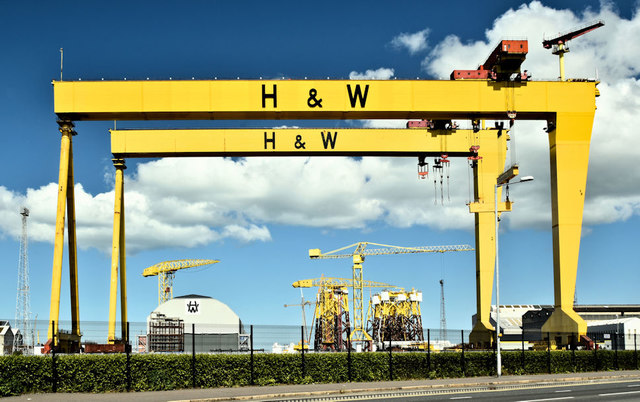
Harland & Wolff cranes, Belfast (May... © Albert Bridge cc-by-sa ...
Two massive cranes at the Harland and Wolff dockyard.

Harland & Wolff is surging back onto the cruise ship repair scene as the ship repair facility is hosting a trio of Viking ships, the Sky, Sun and Sea, in Belfast

Since acquiring Harland and Wolff in December 2019, the new Harland & Wolff team has been quick to realize their strategic ambitions to enter the cruise sector, according to a statement from the shipyard.

Strict protocols were put in place to ensure compliance with all public health guidelines, some of which will be maintained for the foreseeable future as a precautionary measure. While undertaking dockings during the COVID-19 lockdown and with OEM’s unable to travel the yard, teams have made extensive use of video conferencing, enabling OEMs to be virtually involved during maintenance activities onboard the vessels, according to the shipyard.

The yard said the cruise Industry is under financial strain during the pause in operations and has worked with its financial partners to put in place several extended credit term schemes, allowing owners to fully capitalize on periods where vessels are out of service and have works undertaken during this out-of-service period.

Viking Ships at Harland & Wolff
Viking Sky and Viking Sea docking in Belfast.

In addition, yard executives said they not only want to target drydock and repair projects but return to building ships, most likely starting with small expedition-type vessels.

John Wood Group CEO of Harland & Wolff said: “We are delighted to welcome Viking Sky, Sun and Sea to our facilities in Belfast, this is the first time we have had three cruise vessels docked in Harland & Wolff for many decades. Harland & Wolff was once a market leader in this sector and this is a title we are keen to hold again. On the doorstep of the Mediterranean, the UK is in a prime location for refits, conversions and revitalizations. With our vast facilities set in 85 acres, we can handle several large cruise ships concurrently, as demonstrated by the arrival of three vessels from Viking for minor repairs and upgrade works. With two of the largest docks in Europe and the only yard in the UK that can accept the majority of the works cruise ships demand, we look forward to increasing our presence within the cruise sector as we move forward.

“In order to future-proof our yard we are currently scenario-planning to ensure we can welcome all future cruise vessels as they continue the trend of increasing in size,” Wood said .”The cruise sector will be a key cornerstone of our business going forward. With 70% of shipyards closed during the global pandemic, we are now seeing the implications of this as we start to emerge from the crisis, we have witnessed a substantial increase in inquires from the cruise sector with numerous live inquires at this time. It is possible that owners will face delays as they try to get vessels back into service as the industry ramps up again, global availability of drydocks essential to returning vessels into service where they have slipped out of class will be fully occupied not just with cruise vessels but overall sectors that have had dockings cancelled”

Top Cruise Photos from Ocean liner Pictures

With the global cruise fleet in a temporary and extended service pause, take a look at these top cruise photos from expert photographer Oceanliner Pictures (by Oliver Asmussen), which is the largest cruise ship photo archive for photos of cruise ships, interior photos and maritime travel, currently with over 780,000 photos.

Queen Mary 2 cruising on the Elbe River

Queen Mary 2 cruising on the Elbe river at sunset


The MS Hamburg against the Garibaldi Glacier

MS Hamburg Garibaldi Glacier and Fjord


AIDAdiva leaves the port of Warnemuende

AIDAdiva leaves the port of Warnemuende


The Regal Princess outbound

Regal Princess outbound Warnemuende


MS Amera in Rendsburger Hochbrücke

MS Amera in Rendsburger Hochbrücke


The Nieuw Statendam after her maiden call in Kiel

Nieuw Statendam after her maiden call in Kiel


Sunset over the Astor, sailing for Transocean

MS Astor im Sonnenuntergang auf der Elbe

Antimicrobial surface coating said to show promise for ships, hotels

T0224PremiumPurity2_HR
A room is treated with Act. Global’s Act CleanCoat, a coating that is then activated with sunlight or artificial light.

As concern about the Covid-19 coronavirus grows, a promising new antimicrobial surface coating is being marketed to hospitality and transportation companies.

Its maker, Act. Global, founded in 2013, offers a proprietary Premium Purity system that involves the application of Act CleanCoat, a transparent, odourless coating that the company says decomposes microbes, including bacteria, viruses, mould spores and volatile organic compounds.

Richard Tubb, a retired U.S. Air Force brigadier general and former White House physician is now an informal advisor to Act. Global.

“We had SARS in 2002, MERS-CoV in 2012 and now the coronavirus almost 10 years later,” Tubb said. “These types of things come and go, but they will never fully go away. What we need is a containment approach to allow us the luxury of turning our attention to the discovery of treatment and prevention, while also restoring people’s confidence in a way that will get them to engage with the economy.”

Hotels in a number of countries and the cruise line Lindblad Expeditions are among the early adopters of Denmark-based Act.Global’s product.

The coating’s key ingredient is titanium dioxide, a non-toxic, naturally occurring compound often used in paints, sunscreen and toothpaste, among other products.

The company claims that once exposed to sunlight or artificial light, a photocatalytic reaction activates the coating, producing a continuous surface- and air-purification cycle.

According to Act.Global, the coating has undergone extensive testing and has been approved by several independent laboratories, including Dr Brill and Dr Steinman Institute for Hygiene and Microbiology in Germany, ISI Food Protection in Denmark and Chang Gung University on Taiwan.

T0224PremiumPurity1_HR
An Act ECA Generator produces an eco-friendly cleaning agent called Act ECA Water.

While still relatively new, the company is marketing its Premium Purity system to a variety of commercial and industrial venues, including hotels. To date, the company has launched the system in a dozen hotels throughout Denmark, Germany, India and Thailand.

Christopher Luscher, the company’s chief technology officer, said, “Act. Global is founded on the premise of sustainable disinfection, and what we have seen in the hospitality sector is that we’ve been able to convert the method of cleaning so it’s less like a firefighter coming in and trying to fight a fire and more like the installation of fire-resistant materials.”

In the hotel setting, the company’s CleanCoat can be applied on almost any fixed surface, hard or soft, though Luscher said his rule of thumb is that “if the Mona Lisa is hanging on the wall, it’s best to take it down.” After the coating is applied, it takes two hours to set.

How it works

Post-application cleanliness is maintained with the use of an eco-friendly and affordable cleaning agent called Act ECA (for electrochemically activated) water. The water is produced using an Act ECA Generator, which is installed on-site and requires just two ingredients: water and salt.

Coating costs vary greatly by region and venue. Act. Global sells Premium Purity with a three-year service contract.

Hotels aren’t the only settings in which an antimicrobial coating offers a promising solution. In the wake of the Covid-19 crisis, Luscher reported that the company is seeing a surge in demand from airports and restaurants as well as from airlines, railways and cruise ships.

Among the first cruise lines to adopt Premium Purity is Lindblad Expeditions, which deployed the system aboard its National Geographic Explorer ship in mid-2018.

Bruce Tschampel, Lindblad’s vice president for hotel operations, said, “We’re very careful about the environment, and we were looking for options for a green cleaning method that used fewer chemicals and plastic. Also, with cruise lines, we have to be absolutely clean and sanitary because you’re in this small environment, and someone could bring on a cold, and it’s easily passed around.”

The results made a compelling case for the product.

Following the National Geographic Explorer’s trial run, Tschampel said, the company “reduced guest-reported illness by 50%, eliminated over 1,000 plastic bottles of cleaning products and reduced water usage by 1.1 million gallons per year.”

Lindblad has since announced plans to adopt Premium Purity across its entire fleet, coating all of its eight ships, including all public areas and guest and crew cabins. The process is set to be completed by early March. Lindblad’s newest ship, the Endurance, will also be using the system when it debuts next month.

“There is a choreography that has to be managed, whether you’re a hotel or a ship,” Tschampel said. “How do you get all these areas coated, and when is the right time to do it? But so far, we’re extremely pleased, and there are so many benefits. The results have been even better than we expected.”