I love all things Cruise and add that to my hobby Photography I’m in dreamland, I’m an exTravel agency owner with the inside contacts, so I will try to keep you updated in all things travel related with a side serving of images and other maritime stories.
Appealing to travel advisors to start to sell cruises again, Royal Caribbean Group Chairman and CEO Richard Fain states his case in a newly released video.
The time has come, he said, to focus on how we come out of the pandemic, rather than how we should live during it. The time has come to look forward and do what we have done for decades, sell cruises.
Fain said a surge of interest has come mainly via the internet rather than from travel advisors, as people became used to buying things online during the pandemic, and continue to do so, while many travel advisors cut down on staff and marketing.
“Now, we need to rebuild so travel advisors need to do more,” he said. Appealing to travel advisors, Fain said: “We need you to reach our full potential. It was the personal contact with travel advisors that built up the knowledge and awareness (of cruising) in the first place.
“We need you and we need your personal touch, and the clients need you to help them understand the complexity of the product.”
Fain noted that while the pandemic is not over, its prevalence in the industrialized world is falling, and the main drivers behind the disease are understood and can be controlled.
He also noted that cruise ships have advantages over land-based comparables with the vast bulk of people onboard being vaccinated, and the sanitation being controlled, including air filtration, and strict health and safety protocols being enforced.
“As a result, we can make ships safer than shore-based alternatives,” Fain said.
Compared to a CDC colour-coded COVID-19 map of the United States, Fain said that cruise ships would be blue, representing the lowest category of risk, and better than most of the counties in the U.S.
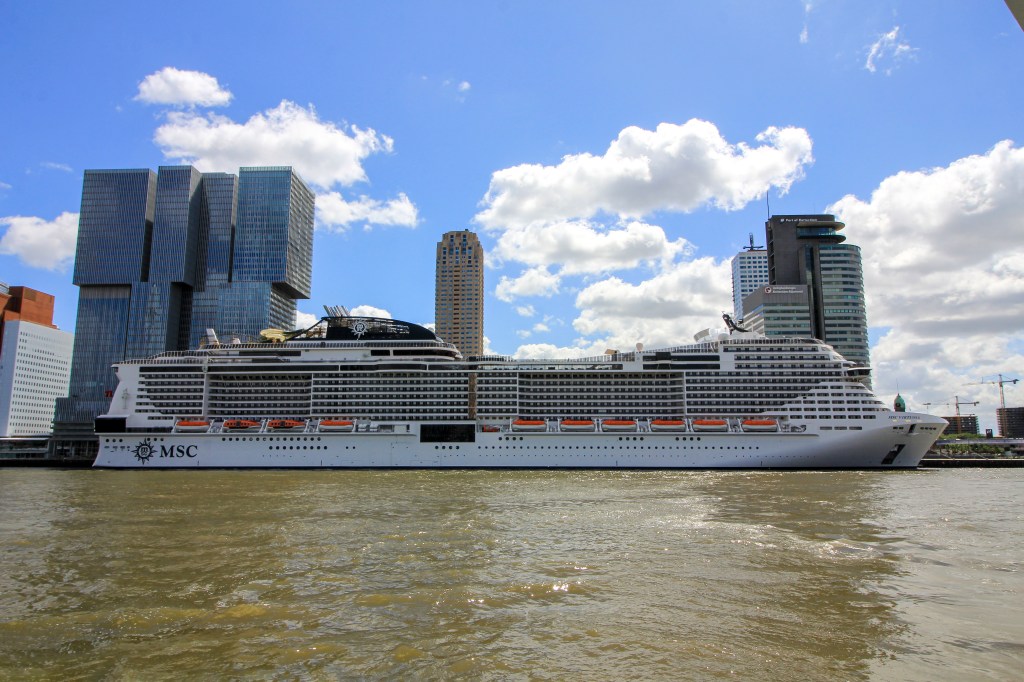
“Our core focus at the moment is on decarbonization,” said Linden Coppell, director of sustainability at MSC Cruises.
Solutions encompass energy efficiency both for the company’s fleet of current ships and orderbook extending through 2027, with five LNG newbuilds.
“The solutions for the existing fleet and existing engines include biofuels, using existing infrastructure,” she told Cruise Industry News.
That relies on there being a supply of sustainable biofuels that meet the high criteria that are expected of them.
“The ships that are currently being built, the LNG ships, can potentially transition to a bio or synthetic LNG.”
Then there are the future vessels, encouraging the development of new fuels and infrastructure, Coppell said.
“And that is whether they have advanced internal combustion engines or devices such as a solid oxide fuel cell,” she added.
When the LNG-powered World Europa debuts in 2022, she will have a test installation of a fuel cell aboard.
Cutting Carbon Intensity
Heading to the 2030 target to cut carbon intensity by 40 per cent, MSC has already gotten its emissions per ALBD kilometre down 28 per cent.
“In order to meet the intensity targets, it’s about driving this efficiency while bringing new efficient ships into the fleet,” said Coppell.
“We’re building bigger ships, so the emissions per ALBD (available lower berth day) kilometre go down (per guest),” she continued, “and we are improving the way we operate.”
The existing fleet is getting the latest technology, including the MSC Musica, which just had an exhaust gas cleaning system fitted.
“For shore power, we have a very clear position,” Coppell said. “All of our newbuilds will have it. So we are getting close to 50 percent (of ships) having it based on capacity. We’ve set a clear position: any ship using a terminal with shore power available will be capable of using it.”
MSC’s fleet is getting additional monitoring systems and sensors to monitor energy usage, plus the software to collect data and the latest artificial intelligence to make recommendations.
One big focus area for Coppell has been air conditioning.
“We have been finding lots of opportunities. There was a lot of education to be done in that area, with putting sensors and automated systems in.
“Once we addressed the big issues there, we looked at other activities,” she said. “There are so many different things going on. We talk about the hotel but then there’s the area of looking at the particular performance of particular items, like the desalination facility or wastewater treatment plant.”
When MSC relaunched operations in August 2020 it did so with the Grandiosa, which achieved a 4-percent reduction in fuel use per day, which Coppell credited to more training.
“We were doing a lot of awareness training with the crew. Whatever role any crew member has got will affect efficiency.”
Hydrogen Ship
In July, MSC, Fincantieri and Snam, an Italian energy infrastructure company, announced the signing of a deal to explore the design and construction of what would become the world’s first hydrogen-powered cruise ship.
“There is a lot of potential with hydrogen. A non-carbon-based fuel has to be one of the key ways forward.”
While hydrogen may be available now, Coppell said it’s not “green hydrogen” since it has been created directly from fossil fuels.
For now, MSC won’t be installing batteries.
“The fuel cells create energy … whereas a battery is an energy storage device and you need to recharge it. Again, if we’re in a situation where we can get shore power from renewable energy, that is a way to recharge batteries.”
Plastic Slashers
In 2019, MSC identified some 97 million single-use plastic items across its fleet, going through every single single-use plastic on the ships.
Those items ranged from straws and stirrers to primary packaging, like for a buttered serving, and then secondary packaging, in the supply chain.
“We went through and identified the top 200 items and we are replacing them or eliminating them,” Coppell said. “We looked at the delivery of mattresses and sunbeds, every single one was delivered in a huge amount of plastic and cardboard. We worked with suppliers to find new solutions.”
Dishwasher detergent and previously been delivered in big plastic buckets. Those now come in what Coppell said a concentrated solid product eliminating 90 per cent of the plastic previously used, reducing plastics packaging by approximately 80 per cent which is roughly 12 tons of waste plastic reduction per year across the full fleet.
Next up may be hand sanitiser, coming in a hard block instead of small plastic bottles, and the crew would then liquify and distribute it on the ship.
The Future
Come 2030, based on a conservative growth projection using MSC’s current orderbook, the company will have a fleet of 29 ships. That includes the group’s four-ship luxury brand.
Of the fleet of 29, five will be powered by LNG, but those will represent the biggest ships in the fleet, making up approximately 27 per cent of available berths, according to Cruise Industry News estimates.
“The hope that is by 2030 we will meet and exceed the IMO intensity targets,” Coppell said. “At that point, it will be energy efficiency at the front and centre of those efforts.”
The Marine Hotel Association’s (MHA) Symposium at Sea is officially underway on the Scarlet Lady from Virgin Voyages, as the event is taking place on the ship’s four-night/five-day voyage roundtrip from Miami.
MHA members, mainly composed of food and beverage and hotel supply vendors, will network with cruise line and vessel management decision-makers over the course of the next five days aboard what many consider to be the industry’s newest and most exciting ship.
Events exclusive to MHA members include cocktail receptions, organized dinners rotating between restaurants, panel discussions and an impressive five hours of speed networking between vendors and cruise line decision makers split over two days.
Vendors will look toward the speed network sessions for key one-on-one time with the right decision-makers.
Panel discussion topics will include a state of the business from each cruise line attendee, plus a deep dive into hotel product and food and beverage innovations, along with touching on the current state of the supply chain with issues, challenges and opportunities set to be discussed.
The four-night cruise includes a call at Nassau, a stop at Bimini, and one day at sea before returning to Miami on Sunday, October 24.