• We Travel 2U - Weblog

    We Travel 2U-Weblog

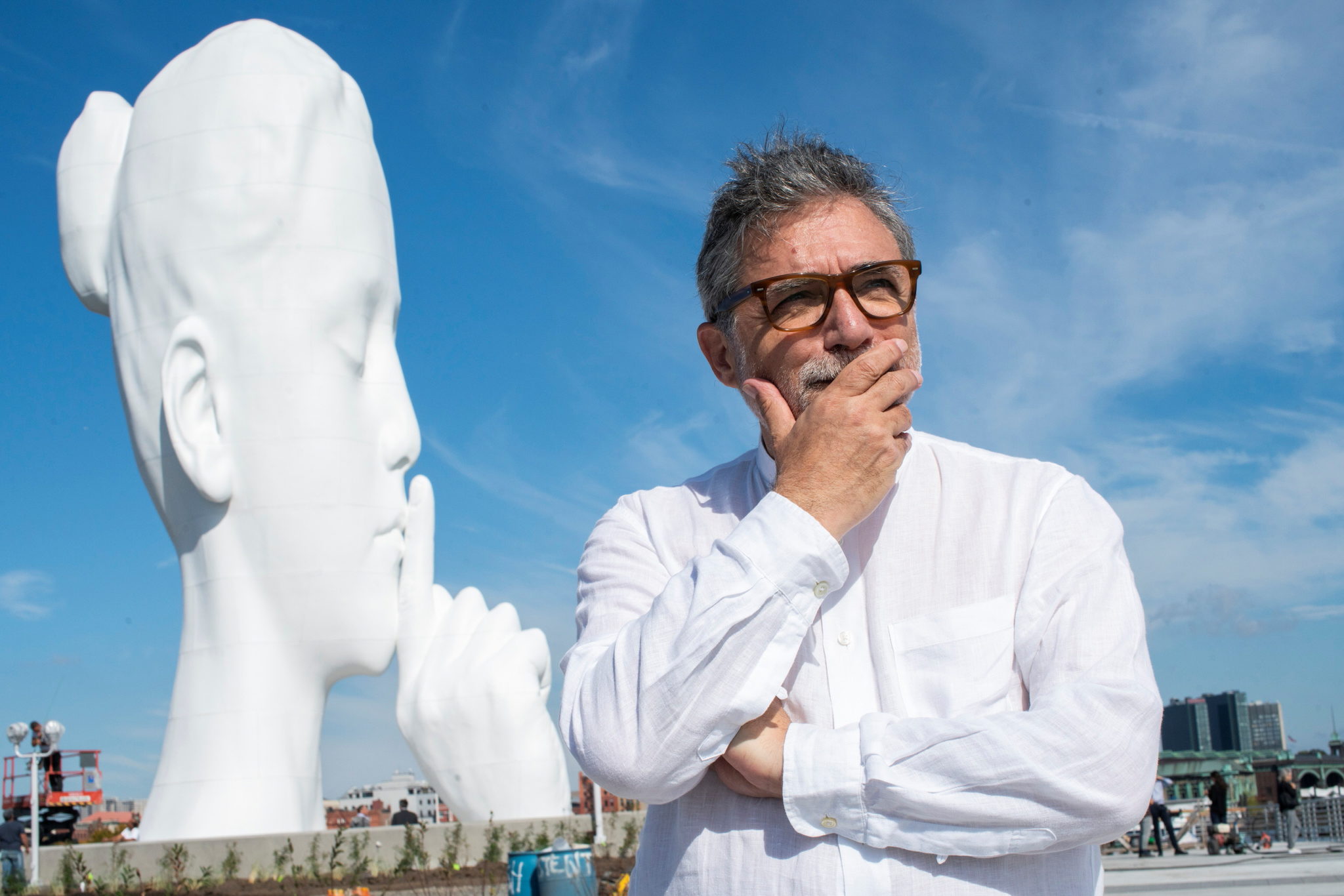
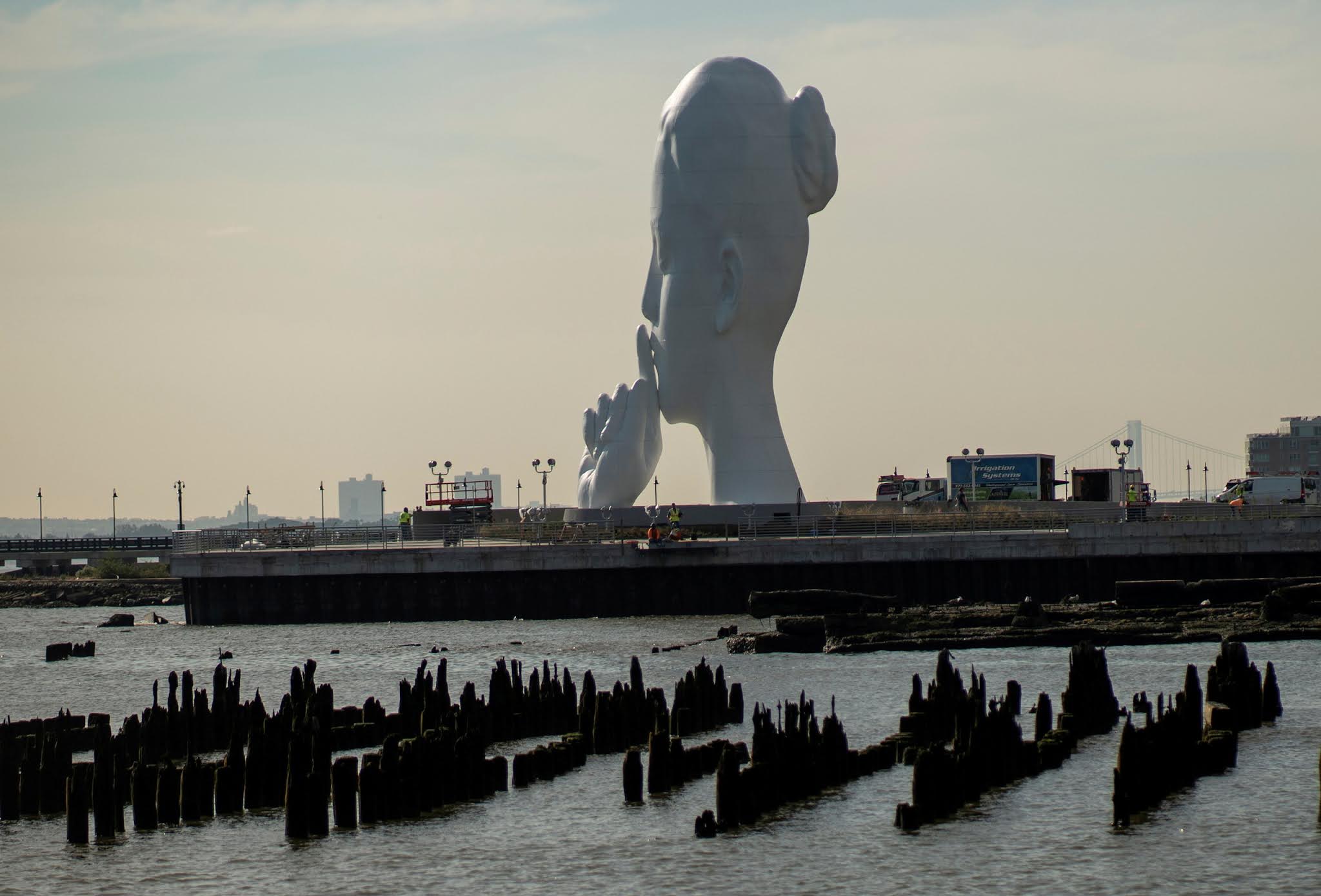
    The statue “Water’s Soul” by the artist Jaume Plensa is seen in Jersey City, New Jersey, U.S., on October 14, 2021. REUTERS/Eduardo Munoz

    By Peter Szekely (Reuters) A towering statue of a woman’s head with her index finger pressing on her lips now faces lower Manhattan along the Hudson River, inviting the chaotic metropolis to stop and listen.

    “The water, when it moves, makes a special sound, very special,” Barcelona-based artist Jaume Plensa said.

    The message of his 80-foot (24-meter) “Water’s Soul” – Plensa’s biggest work to date – is “to keep silent, … to listen to the profound noise of the water talking to us,” he said in an interview.

    The snow-white head commands a sweeping view of the river in front of a forest of high-rise buildings in Jersey City’s rapidly developing Newport waterfront. It stands directly across from Greenwich Village and about four miles (six km) upstream from the Statue of Liberty, a more familiar sentinel of the harbour.

    On a recent morning when Plensa saw the piece fully assembled for the first time, its call for silence competed with the hum of diesel engines from the nearby Hoboken train terminal, the overhead roar of helicopters, and the cries and laughter of children riding in strollers along the river walkways.

    But those are not the kind of noises that Plensa says his artwork is targeting.

    “I’m talking about the noise of information and messages to us,” he said at New York’s Galerie Lelong Co, where an exhibit of new work will open on Oct. 29.

    Plensa, 66, was commissioned to create the piece about two years ago by LaFrak and Simon Property Group, which have developed the area, including the plot jutting into the river where “Water’s Soul” stands.

    Depicting a real-life model whose image was scanned, the piece was fashioned from polyester resin, fibreglass and marble dust at Plensa’s Barcelona studio and shipped in 23 containers, each 40 feet (12 meters long), to the Jersey City site for assembly.


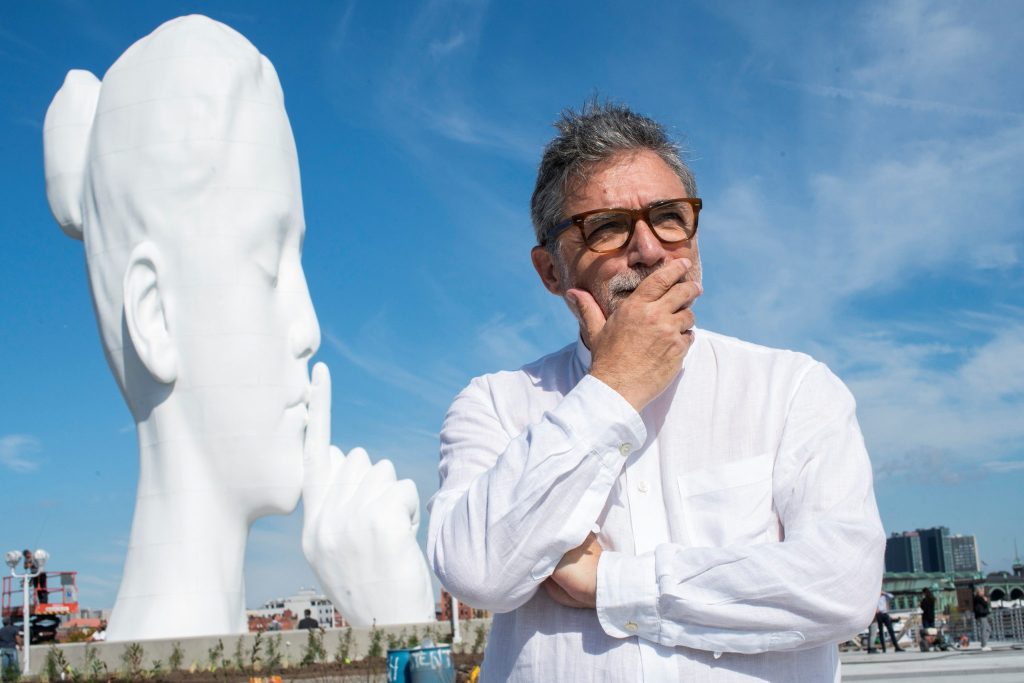
    Artist Jaume Plensa poses for a photo near his statue “Water’s Soul” in Jersey City, New Jersey, U.S., October 14, 2021. REUTERS/Eduardo Munoz
    The sculpture, whose official unveiling is on Thursday, is visible from far and wide, leaving some locals who have watched the piece being put together since August scratching their heads.

    “Why is she shushing?” asked Cleveland Rice, 63, a city worker.

    “I’m sure there’s got to be some kind of meaning behind it,” said William Schoentube, 53, a New Jersey Transit train conductor.

    “I’d say it’s telling New York City to keep this area a secret because we don’t want to drive more people to work here,” said Huan Yan, 31, a software engineer.

    Miriam, 46, a travel agent who declined to give her last name, has a direct view of it from her apartment window. She gave it a thumbs-down. “I don’t find it fitting in the entire environment,” she said.

    Plensa, who has been exhibiting his work around the world for more than 40 years, said it can take time for his art to become accepted into different environments.

    “In the public space, the piece is the piece, and it’s competing with so many other objects,” he said.

    His works include Crown Fountain in Chicago’s Millennium Park, in which moving LED images of faces are displayed on two 50-foot (15-meter) glass towers with cascades of water flowing from some of their mouths. The reaction was mixed when it opened in 2004 but it has since become a popular site.

    Best Viewed From Sea, Not Land

    Plensa said the sculpture is not sending a message to Manhattan, and she is not “shushing,” but silently calling for quiet.

    Like many of Plensa’s works, including several new pieces at the Galerie Lelong show, “Water’s Soul” is the elongated head of a woman with closed eyes.

    “In many of my pieces I’m asking the viewer: Close your eyes and look inside yourself, because you have an amazing quantity of beauty hidden inside,” he said.

    His pieces mostly feature women, he says, because he sees life and the world as a female, while “boys are just an accident – a very nice accident, but an accident.”

    “Water’s Soul” can best be viewed from the river, he said.

    “It’s a piece which is very much paying homage to water, and it’s in the water where you can enjoy it more,” he said.

  • We Travel 2U - Weblog

    We Travel 2U-Weblog

    With its three cruise brands now back in service, Norwegian Cruise Line Holdings plans to have 13 ships sailing commercially by Dec. 1.

    While Norwegian leads the way, with nine vessels slated to sail, Oceania and Regent are also speeding up their restart plans.

    Here is the latest brand by the brand update:

    Norwegian Cruise Line
    Status: Six ships currently in service; three more sets to follow by Dec. 1
    Ships: Norwegian Jade, Norwegian Encore, Norwegian Gem, Norwegian Epic, Norwegian Getaway and Norwegian Breakaway currently in service; Norwegian Bliss, Norwegian Escape and Norwegian Joy set to follow
    Regions: Mediterranean, Caribbean, Bermuda, Alaska and West Coast

    After a 500-day operational pause, Norwegian Cruise Line resumed service in July with a series of Eastern Mediterranean cruises.

    Currently, the brand has six vessels back in revenue operations, offering cruises in North America, the Caribbean and Europe.

    With three more ships returning by Dec. 1, the company is set to return to additional destinations, including the West Coast – where the Norwegian Bliss is welcoming guests back on Oct. 24. Based in Los Angeles, the 4,200-guest ship offers a program of Mexican Riviera cruises through 2022.  

    While two other vessels are returning in 2021, the balance of the 17-ship fleet is slated to resume service next year.

    Oceania Cruises
    Status:
     Two ships currently in service
    Ships: Marina and Riviera
    Regions: Mediterranean and Atlantic

    Oceania Cruises resumed revenue service in August with the Marina. The vessel welcomed passengers back in Denmark for a series of cruises to Western Europe, the Mediterranean, and the Greek Isles.

    A second ship, the Riviera, joined the active lineup recently, offering additional itinerary choices in the Mediterranean.

    In December, the upper-premium brand is also resuming service with the Insignia – which is set to offer a Panama Canal cruise before kicking off it’s epic six-month-long “Around the World in 180 Days” voyage.

    Phased restart dates for the balance of the Oceania Cruises fleet continue next, with three more vessels resuming guest operations in 2022.

    Regent Seven Seas
    Status:
     Two ships currently in service
    Ships: Seven Seas Splendor and Seven Seas Explorer
    Regions: Northern Europe, Mediterranean, Caribbean and Panama Canal

    With two ships now in service, Regent Seven Seas Cruises plans to have its entire fleet back in action by early 2022.

    The luxury brand first restarted revenue operations in September, with the 2019-built Seven Seas Splendor. After resuming its inaugural season in Northern Europe, the vessel is currently sailing in the Mediterranean ahead of a winter season in the Caribbean.

    The Seven Seas Explorer joined the active lineup recently, offering additional voyages in Europe.

    A third Regent ship returning in December. The vessel is slated to sail a Panama Canal cruise before beginning an epic World Cruise in January.

  • We Travel 2U - Weblog

    We Travel 2U-Weblog

    “Our number one goal is reducing our emissions,” said Bill Burke, a chief maritime officer at Carnival Corporation.

    That goal is a 40 per cent reduction in the company’s carbon emissions by 2030 when compared to a 2008 baseline, with carbon levels peaking for Carnival in 2011.

    It’s a combination of efficiency and sustainability, Burke said.

    That involves not only new efficient ships but finding more efficient equipment for the company’s existing fleet, making sure ships are operated well, meaning the right speeds, with the right engine loads.

    “Voyage planning is another area where we are focused,” Burke said. “That sort of thing is ‘free,’ if we can get it right, it’s free savings.”

    Burke has his sights set on HVAC system improvements as a key area where the company can save money on fuel and cut carbon emissions.

    “The efficiency of the equipment has increased in the last few decades. If we haven’t already, we change out chillers and HVAC equipment,” he said.

    One megawatt of savings translates roughly to about $1 million annually in fuel, Burke said.

    “It’s then the money we can use for other things … it’s seed money to make ships more efficient.”

    New Ships Get Efficient

    New ships are generally 20 per cent more efficient per passenger than the last class, and that starts with the hull design, Burke said.

    Then it’s a process of looking for the best and most efficient equipment fleetwide, with Carnival Corporate Shipbuilding in the UK focused on the job.

    With the new deliveries of the AIDAnova, Costa Smeralda, Carnival Mardi Gras and P&O Iona, Carnival sister brands now have four technically identical new ships on the Carnival XL platform. Expect a lot of note comparing.

    “We will compare performance, but a lot of that comes down to the itinerary,” Burke said, noting variables such as the speeds the ships travel at plus climate conditions driving air conditioning use.

    Trying to compare performance, the company uses climate zones to normalize energy use when reviewing data.

    That data becomes easier to use with ships in port, without a propulsion load, with Carnival now asking its brands to operate on just one generator while in port.

    “The brands will make adjustments and we will help them with targeted investments to reduce the hotel load to allow them to first operate on one generator (in port) and then get the load lower. We’ve dropped the electrical load down by several megawatts.”

    Ships are compared against each other with adjustments for size and climate conditions, with Carnival using its own port power coefficient to measure power usage by ship while docked.

    2030 Goal

    By 2030 Burke envisions what he called a green fleet with nearly 20 per cent of Carnival Corporation ships powered by LNG.

    “Both LNG and non-LNG ships would get some portion of their fuel from biofuels. Batteries would be on a number of ships for peak shaving and non-LNG ships would operate advanced air quality systems (scrubbers),” Burke said.

    Those ships running scrubbers would have wash-water filtration and significantly reduced particulate.

    “All ships would have achieved our port power coefficient goals and easily operate in port in all climate conditions on a single diesel generator, indicating efficient port hotel service operations.”

    Another project is a single fleet-wide maintenance and procurement system.

    “That will allow us to better leverage our scale and remove excess inventory.”

    Burke also plans to add more courses to the company’s Arison Maritime Center (CSMART) in the Netherlands.

    “In addition to operational team training for our officer core, we do have energy efficiency training and we will expand that.”

    Many ships, continued Burke, will have air lubrication systems, adding that around 60 per cent of the fleet will be able to plug into shore power by 2030. Another three-quarter of the fleet will have advanced wastewater purification systems, and all ships will have food waste digesters.

    “Our ships will be completely instrumented for measuring the efficiency of our largest power consumptions … you have to be able to measure (consumers) to know how you’re doing.”

    Data will result in self-correcting behaviour that will improve operational efficiency, according to Burke, who said the ships will continue to get more sensors and measuring capability.

    “We will be well on our way to designing and building our first zero emissions and zero discharge ship … that’s the biggest challenge and we hope our work with LNG will have us well prepared for that next fuel.”