Disney Cruise Line will continue to look for growth opportunities, says company president, Karl Holz. By David Mott
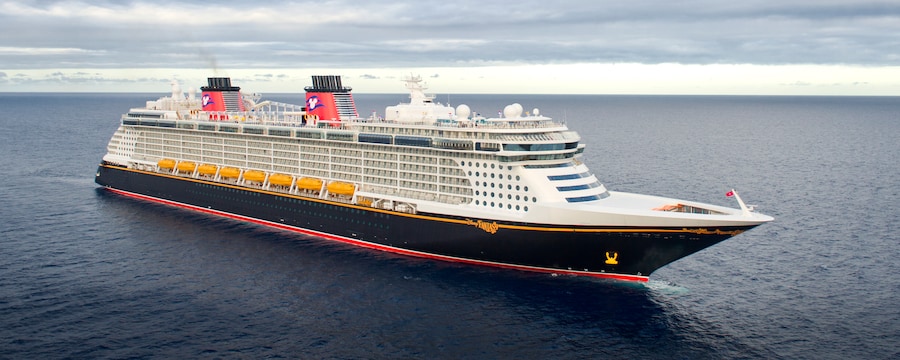
The 17-year-old cruise line’s four-ship fleet came in two tranches – Disney Magic and Disney Wonder in the late 1990s, as the initial ships, augmented more than a decade later by the larger Disney Dream in 2011 and Disney Fantasy a year later. Karl Holz says the launch of the two larger ships “transformed our cruise business in many ways. Simply put, we further expanded the blueprint for family cruising.” Both the newer ships have a passenger count of 4,000 against 2,700 for each of the first two vessels. The latest ships, at 130,000gt, are classed as large resort ships because of the self-containment of their facilities.
“We have noticed continuing popularity among our passengers since Disney emerged in the cruise industry in 1998,” says Holz. “With this expansion we have more opportunity to surprise and delight with an ever-increasing list of ports of call around the world.” These include a return to New York in autumn 2016, where Disney Magic will operate a series of cruises and a first-ever British Isles cruise with calls in England, Scotland and Ireland as well as in France.
For a family entertainer like Disney, where the focus is every bit as much on the children as it is on the adults, safety and the environment have a particular resonance and the cruise line is no exception. “We focus our environmental efforts on utilising new technology, increasing fuel efficiency, minimising waste and promoting conservation. We comply with and sometimes exceed all international environmental regulations,” says Holz.
To boost fuel efficiency, Disney claims it is the first cruise line to use an innovative hull coating on its ships which is both 100% non-toxic as well as reducing surface resistance in open water. “In addition, all Disney ships have dedicated environmental officers who are responsible for compliance and are ranked among the most senior leaders onboard.”
Much has been said over the years about the position of people without children on a Disney vessel and this is a subject Holz tackles. “What I can tell you is that there is that there is something for everyone on Disney ships, which all include areas created exclusively for adults. They also have the options of spas, nightclubs and lounges, as well as adult-exclusive dining and pools.” In addition, there is an adult beach at Serenity Bay at Disney’s private island in Florida, Castaway Cay.

Asked how Disney has been able to transpose its stories to shipboard life, Holz says this has been achieved by the extensive use of new technology. “Our team of ‘imagineers’ is always working to bring to life Disney stories for our passengers.
We have a portfolio of characters and intellectual property and are always looking to anticipate industry trends and plan strategically to deliver entertainment on our ships. As a member of the cruise industry we are always looking to identify trends alongside our competitors and to innovate.” Indeed, Disney’s use of technology has enabled it to become one of a growing number of lines which give passengers in interior cabins a real-time view of the ocean thanks to high-definition cameras positioned outside the ship.
With ships relying so heavily on shipboard attractions, a constant programme of technical updating is obviously important. Holz says: “Reinvesting in our ships, also to meet increased business, is part of the Disney heritage and over the years we have made many changes to upgrade our vessels. In 2013 the Disney Magic spent six weeks in drydock in an operation which made a wonderful ship even better.” The work involved the ‘reimagination’ of the whole upper deck. This autumn Disney Dream will dock in Freeport, Bahamas, when spaces throughout the vessel will be transformed. This work will include the addition of two interactive youth areas, one with a Star Wars theme and another slanted towards Disney Infinity.

In keeping with the international nature of its business, Disney Cruise Line, headquartered in both London and Florida, positions its ships in North America and Europe. In May this year, Disney Magic started sailing the Baltic and the Norwegian fjords out of Copenhagen. That done, she switched to Dover in the UK for two Baltic sailings and a repositioning voyage to Barcelona for two Mediterranean cruises before returning to Miami in the autumn.
Disney Wonder sailed Alaska out of Vancouver this summer before going to Hawaii for two cruises, followed by a return to San Diego for trips to Mexico. Throughout this year, Disney Dream and Disney Fantasy will operate out of Port Canaveral to the Bahamas and the Caribbean. Early in 2016 Disney Magic will carry out her maiden British Isles cruise as well as calling at ports in northern Europe, the Greek islands and the Mediterranean. Disney Wonder will reposition from Galveston to San Juan for a southern Caribbean itinerary including, for the first time, the French island of Martinique.
In common with a number of companies operating ocean cruises, Disney has just gone into the river cruising business. But in Disney’s case this is quite separate from the ocean cruise line and river itineraries are operated by Adventures of Disney in conjunction with AmaWaterways. From next year, sailings along the Danube will be operated using AmaViola. There was an initial programme of five sailings and another two have just been added. Passengers will be able to visit eight destinations in four countries: Germany, Austria, Slovakia and Hungary.
So growth is certainly on the cards for the operator, but (for now) this does not imply any new additions to the fleet, says Holz. “At this time we do not have any further details to share on building new ships,” he concludes.

 Wetravel2u's Weblog