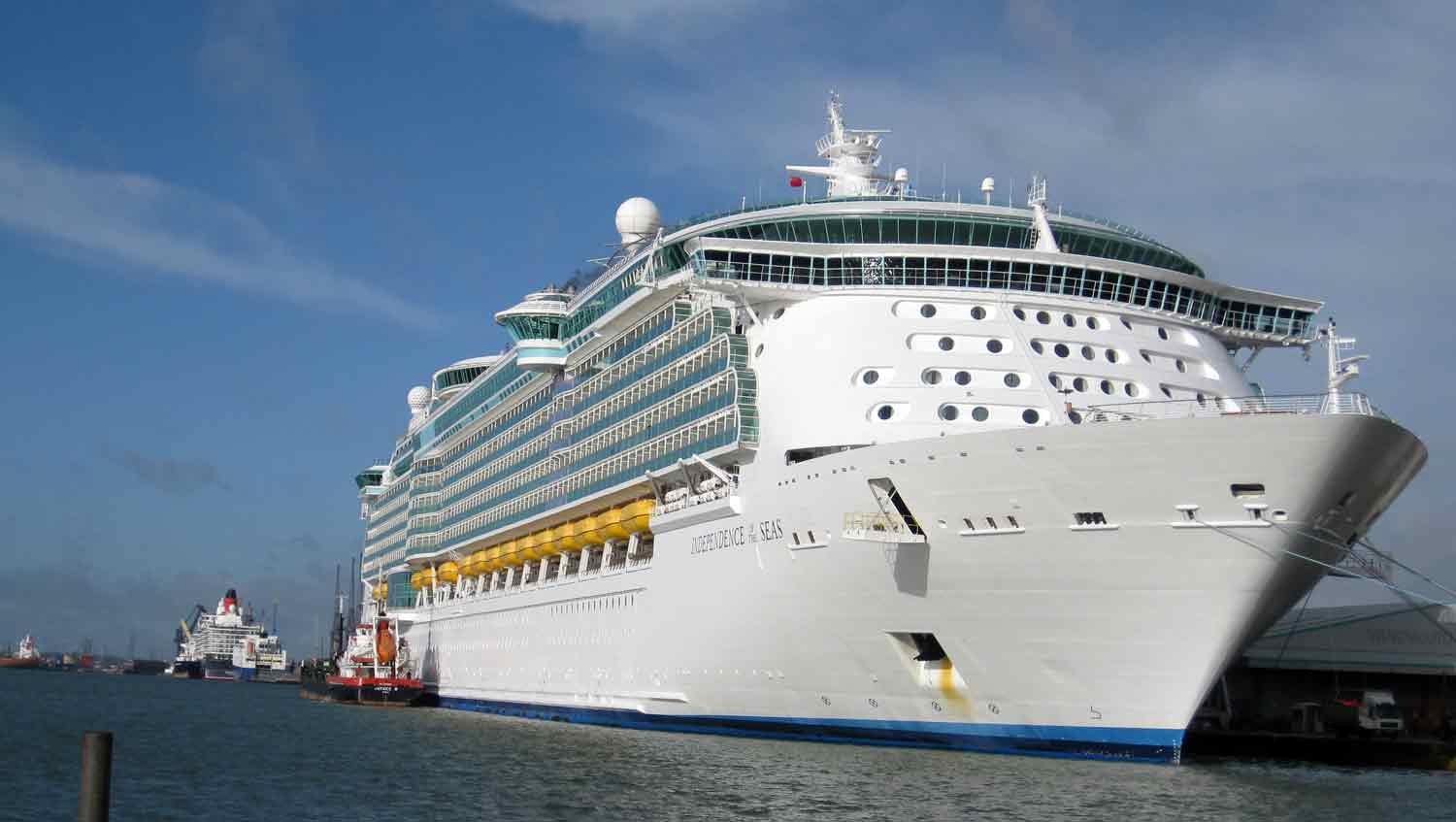
Independence of the Seas in Southampton photo by Dave Jones
Royal Caribbean Group is replacing the safety drill with Muster 2.0, an entirely new approach to delivering safety information to guests, the company announced.
The new program reimagines a process originally designed for large groups of people into a faster, more personal approach that encourages higher levels of safety.
With Muster 2.0, the key elements of the safety drill – including reviewing what to expect and where to go in case of an emergency, and instructions on how to properly use a life jacket – will be accessible to guests on an individual basis instead of a group approach that has been followed historically.
eMuster will be used to help provide the information to guests via their mobile devices and interactive stateroom TVs.
Travellers will be able to review the information at their own time prior to setting sail, eliminating the need for the traditional large group assemblies, the company said.
The new approach also enables everyone on board to maintain better spacing as guests move about the ship, and it allows guests to enjoy more of their vacation with no interruption.
After reviewing safety information individually, guests will complete the drill by visiting their assigned assembly station, where a crew member will verify that all steps have been completed and answer questions. Each of the steps will need to be completed prior to the ship’s departure, as required by international maritime law.
“The health and safety of our guests and crew are our number one priority, and the development of this new muster process is an elegant solution to an outdated, unpopular process,” said Richard Fain, chairman and CEO, Royal Caribbean Group. “The fact that this will also save guests time and allow the ship to operate without pause means that we can increase health, safety and guest satisfaction simultaneously.”
“Muster 2.0 represents a natural extension of our mission to improve our guests’ vacation experiences by removing points of friction,” said Jay Schneider, Royal Caribbean Group’s senior vice president of digital. “In this instance, what’s most convenient for our guests is also the safest option in light of needing to reimagine social spaces in the wake of COVID-19.”
This marks the first dramatic change to the safety drill process in a decade since Royal Caribbean’s Oasis of the Seas moved the life jackets from guest staterooms to the muster stations, which improved the evacuation process and has been widely followed throughout the industry.
More than a year in the making, Muster 2.0 is also an initiative that will be part of the comprehensive set of protocols and procedures Royal Caribbean Group is developing along with the Healthy Sail Panel that was recently assembled in collaboration with Norwegian Cruise Line Holdings.
“This new process represents the kind of innovation that the Healthy Sail Panel is focusing on as part of its mission to enhance the health and safety of cruising,” said former Utah Gov. Mike Leavitt, co-chair of the Healthy Sail Panel. “It shows that we can accomplish a lot if we try to think outside the box on safety.”
“I’d like to extend my congratulations to Royal Caribbean Group on this innovative milestone. It’s exactly what our industry needs during these unprecedented times and we appreciate the generous offer to participate in this innovation,” said Frank Del Rio, President and CEO, Norwegian Cruise Line Holdings Ltd. “In this industry, we all work cooperatively to enhance health and safety, and this is an example of that.”
 Wetravel2u's Weblog