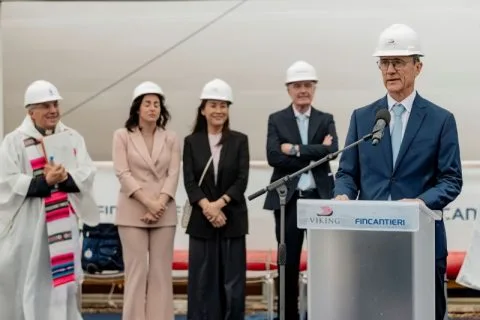
Viking’s latest ocean ship, the Viking Astrea, was launched at Fincantieri’s Ancona shipyard.
With a propulsion system partially powered by liquid hydrogen and fuel cells, the vessel is said to represent a further step in the development of innovative technological solutions for an increasingly sustainable cruise industry.
With a gross tonnage of approximately 54,300 tons, a length of 239 meters and accommodating up to 998 passengers in 499 cabins, it is scheduled to sail its maiden cruise in June 2027.
The Astrea’s godmother is Francesca Baldinelli, who works in the production control department at the Ancona shipyard.
Other than her, the launch ceremony was attended by Gilberto Tobaldi, director of Fincantieri’s Ancona Shipyard and Ghislain Lemarie, Viking’s vice president of ship development and construction.
“We are redesigning the future of navigation on a strategic and technological level,” Luigi Matarazzo, general manager of the Merchants Ships Division at Fincantieri, told Cruise Industry News.
“The ships we are building will increasingly resemble large, hyper-connected, energy self-sufficient, lighter and greener, propelled floating cities, capable of recycling up to 90 per cent of the waste produced onboard.
“With the technologies already available today, we can thermally recover up to 20 per cent of the energy contained in the fuel,” he continued.
“And the efficiency measures recently introduced in non-propulsion systems onboard have led to further reductions. For example, a ship of about 130,000 tons is able to reduce its fuel consumption up to 1,200 tons per year, which corresponds to about 7 per cent of the ship’s annual fuel consumption.
“We have validated and applied a series of initiatives on the ships we are building. Examples of energy-saving solutions include fan coil installations in cabins and public areas, variable-speed electric motors, recalibration of fresh-water production systems, LED and other high-efficiency lighting and automatic lighting controls, and much more. Each of these solutions can reduce fuel consumption from 48 to 290 tons per year. This is the path we are on.”
Playing a fundamental role in the green transition will be hydrogen and hydrogen carriers, such as ammonia, liquid hydrogen carriers and synthetic hydrocarbons derived from hydrogen, according to Matarazzo. But this will require the creation of a supply chain based on renewable energy sources, which is able to meet the increased demand without negative side effects on global warming, he added.
“On the technological level, the main obstacles are generated by constraints in terms of space and weight. Fuel cells, batteries, fuel tanks, energy recovery and auxiliary systems have a significant impact on the onboard space and weight of a ship.
“However, I want to stress that the challenges do not lie solely with the cost-efficient application of new technologies. In fact, there are important non-technological barriers.
“In terms of resources, there is still no clear and well-defined scenario regarding the future availability of hydrogen and its derivatives, which will also certainly drive pricing (of fuels).
“Production capacity and a network of supply hubs will be key enabling factors to accelerate the decarbonization of the shipping sector.”
Since 2021, Fincantieri has been committed to implementing measures to improve its yards’ impact on the environment. The latest initiative is solar farms being built at five of the yards to generate more green electricity while also reducing the energy bill, said Matarazzo. Installations will feature 22,000 solar panels covering an area of more than 50,000 square meters, able to produce about 10 MW.
Fincantieri is also part of a public-private partnership launched by the European Commission and the Waterborne Technology Platform to decarbonize waterborne transport, as well as several joint ventures with private companies and research organizations exploring new fuels.
Meanwhile, the next 18 months will be busy for Fincantieri.
“In Monfalcone, by the end of this year we will deliver the MSC Seascape, the second EVO class ship and the fourth vessel in MSC Cruises’ Seaside class, and then, in 2023, Explora I, the first of six luxury ships ordered by MSC’s Explora Journeys brand,” Matarazzo said.
“Also next year, Marghera will deliver the second ship in Norwegian Cruise Line’s Prima class, the Norwegian Viva, followed by Cunard Line’s Queen Anne. The Sestri yard will deliver the Vista, the first of two new-generation ships that will start the Allura class for Oceania Cruises; a fourth ship for Virgin Voyages; a ninth and tenth ship for Viking Cruises; and the newest ship for Regent Seven Seas Cruises.”
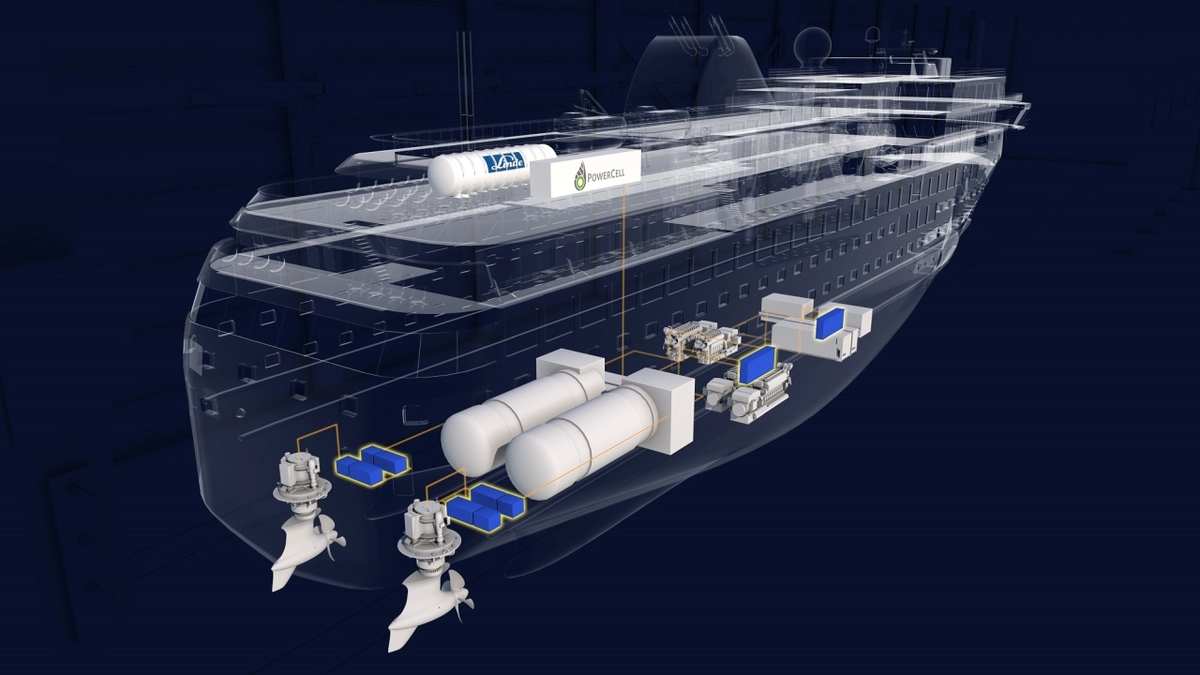
Illustration of hydrogen propulsion systems with integrated LH2 tank and fuel cells (photo: Havyar)
A Norwegian-funded project aimed at developing ‘the biggest of it’s kind’ hydrogen propulsion system for large maritime vessels is moving closer to testing a prototype system
Norwegian shipbuilder Havyard, which won an Nkr104M (US$11.4M) technology development grant from the Norwegian Government in late 2018, has signed an agreement with separate suppliers for tanks and fuel cells for its prototype hydrogen system.
Havyard Group said its companies would work with cryogenic equipment supplier Linde Engineering and fuel cell technology developer PowerCell to design the hydrogen system, formally entering the approval phase in the project’s certification process.
Havyard said the tank design was key to the project ultimately gaining approval.
“We believe they are the right partner for finding solutions that will ensure safe storage and control barriers for cryogenic hydrogen on board ships,” Havyard said in a statement. “The regulations for these solutions have not yet been developed, and we are pleased to have Linde on board when entering the approval process, which we expect to be very challenging.”
PowerCell, which will deliver hydrogen fuel cells for the project, has a core fuel cell technology the company has developed for use in the automotive industry.
Havyard Group Free CO2ast project manager Kristian Osnes said the fuel cells have similarities with the battery technology that NES already worked with in a number of ferry projects.
Havyard companies are working with Sintef and Prototech research institutions on designing the hydrogen fuel cell system which will be installed on one of four cruise ferries under construction for Norwegian coastal ferry operator Havila Kystruten.
The vessels are scheduled to start sailing in January 2021, and Havila Kystruten’s contracts with the Norwegian Government have a fixed duration of 10 years.
Havyard’s agreement is part of the Pilot-E project, a government-financed initiative for Norwegian business and industry established by the Research Council of Norway, Innovation Norway and Enova.



 Wetravel2u's Weblog