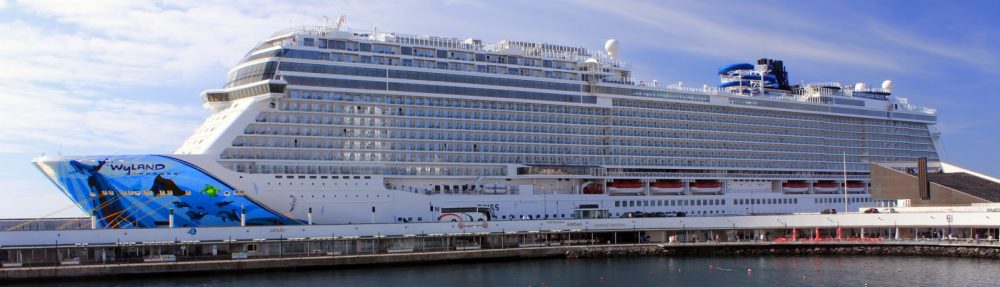
Fuel efficiency and floating on air

By Tom Stieghorst
*InsightIt’s funny how visions of the future can be both wrong and right.

I had that thought after viewing a museum exhibit of designs by modernist Norman Bel Geddes, including one for a cruise ship.

Bel Geddes’ big idea was streamlining and in the 1930s, he turned out everything from vacuum cleaners to passenger buses with that teardrop profile meant to increase speed. His cruise liner — with room for 2,600 passengers — is a thing of beauty, although it looks as much like a submarine as a surface ship. The exhibit included side views showing how wind eddies swirled around the superstructure of the conventional ships of the time.*TomStieghorst

Today, however, it isn’t wind resistance that is the focus of cruise industry streamlining, but water resistance. And the object is no longer to be the fastest across the Atlantic, but to cut fuel costs.

That accounts for the bulbous projection at the bow of every cruise ship, an innovation that pushes water quietly aside and improves efficiency. Cruise ships in recent years have been slathered in silicon compounds or other coatings to make them shed marine slime and slip through the water more easily.

The newest streamlining idea is set to debut on the Quantum of the Seas, the first full test of an air lubrication system that uses microbubbles to provide a cushion for the ship to ride on.

Royal Caribbean Cruises Ltd. (RCCL) has tested the system in a small way on the Celebrity Reflection, but installed a full system on the Quantum as part of the ship’s technology emphasis.

The idea is to form and inject tiny air bubbles below the hull that reduce drag as the ship plows forward. Ironically for Bel Geddes, air is the instrument to provide extra cruise ship streamlining.

Other firms have tried this before, but Royal Caribbean has developed its own method of making the bubbles so that they’re small enough to be effective. It involves first heating the bubbles to shrink them, and then cooling them to prevent them from turning to steam as they hit seawater.

“We’re not only riding on air, we’re riding on air-conditioned air,” quipped RCCL Chairman Richard Fain, on a recent tour of Quantum in Germany.

The system — which only works when a ship is traveling at speed — could knock 7% to 9% off of propulsion costs, even taking into account the energy needed for heating and cooling, Fain said.

Tui places £4bn order for new-generation B737s

Tui places £4bn order for new-generation B737s

By Lee Hayhurst

Tui places £4bn order for new-generation B737sTui Travel has today unveiled a multi billion-pound investment in new-generation aircraft.

Europe’s largest travel group is to order 60 Boeing 737 MAX aircraft worth £4 billion with options on a further 90 of the narrow-body type.

Deliveries will start in January 2018 and run until March 2023.

The 737 MAX aircraft utilises a new-technology engine type claimed to result in a 13% improvement in fuel efficiency and a 40% reduction in noise over today’s main competitors.

The new 737s will provide lower per seat costs than current-generation aircraft, according to Tui.

Around 80% of the group’s passenger flew on 114 narrow-body aircraft across six airline brands including Thomson Airways in the last financial year.

“In order to maintain cost competitiveness and support Tui Travel’s aim to minimise the environmental impact of its activities, the existing narrow-body aircraft will need to be replaced in the next decade,” the company said.

“The proposed transaction will ensure that the group has sufficient aircraft to fulfil its long-term plans and that the expected accrued value justifies the cost of the purchase.”

Chief executive Peter Long said: “A major part of Tui Travel’s strategy is to provide our customers with unique holiday experiences they can only get from us.

“This multi billion-pound investment in the B737 MAX – representing the future generation of more fuel-efficient aircraft for our short and medium-haul programmes – will be a further driver in delivering this.

“It comes as the first of our Boeing 787s touches down in the UK to commence replacement of our long-haul fleet with best-in-class aircraft.

“We are leading the way in redefining mainstream holidays, and putting our customers at the heart of everything we do is integral to our continued growth.

“I can confidently say that being able to offer our customers the most advanced, comfortable aircraft, whether they are travelling with us to short or long-haul destinations, while reducing our environmental impact, will only strengthen our position.”

Thomson Airways’ first Boeing 787 Dreamliner is due to arrive at Manchester airport this morning. It has flown from the Boeing Everett Factory in Seattle and will be followed with the delivery of a further three Thomson 787 aircraft this summer.

View a timelapse video of Tui’s Dreamliner production

 http://bcove.me/y2fphluo

Thomson will fly the aircraft from Gatwick, Manchester, East Midlands and Glasgow airports on long-haul routes to Sanford, Florida and Cancun in Mexico.

Chris Browne, managing director of Thomson Airways, said: “After much anticipation we are very excited to welcome the 787 Dreamliner to our fleet, and as the first airline in the UK to take delivery we hope our customers will enjoy the unique experience of this revolutionary aircraft.

“The introduction of the Dreamliner is a major milestone in our journey of modernising the holiday experience. Customers will be amazed at the unique look, feel and service – all of which will ensure the unique Thomson holiday experience starts as soon as they step on board this fabulous new aircraft.

“The extended flying range of the Dreamliner also unlocks a host of new and exciting holiday options for our customers, increasing the range of long-haul destinations available with Thomson Airways, from four UK airports this summer.

“This winter we’ll fly the Dreamliner direct to Phuket in Thailand and from summer 2014 we will be introducing holidays to Mauritius and Puerto Vallarta, flying direct on our new 787 aircraft.”

The Thomson 787 Dreamliner will carry 291 passengers.

Thomson Airways will be taking delivery of eight Boeing 787 Dreamliners in total, up to May 2015.