The race to build the world’s biggest cruise ship is over

Image result for symphony of the seas

Royal Caribbean’s Symphony of the Seas
Can we call it now?
The race to build the biggest cruise ship ever is over, I think.
And the winner is Royal Caribbean International.
Will anyone ever build a cruise ship bigger than Royal’s Oasis-class ships, the fourth of which was delivered last week? It might happen, but the evidence suggests that it won’t. The reason why I think not is that many cruise companies, including Royal itself, have had a chance to design something bigger since the Oasis of the Seas first took to the oceans in 2009.
No one has.
Of the 36 cruise ships over 120,000 gross tons delivered since 2009, none are bigger than the 228,081-ton Symphony of the Seas, which is on its way from the shipyard in France to Barcelona, Spain, where it will begin seven-day cruises on April 7.
Of the 43 cruise ships over 120,000 gross tons on order or about to be delivered, none are bigger than the Symphony.
Those orders include ships for nearly every major cruise operator besides Royal Caribbean Cruises Ltd., including Carnival Corp., Norwegian Cruise Line Holdings, Walt Disney Co., MSC Cruises and Genting Hong Kong.
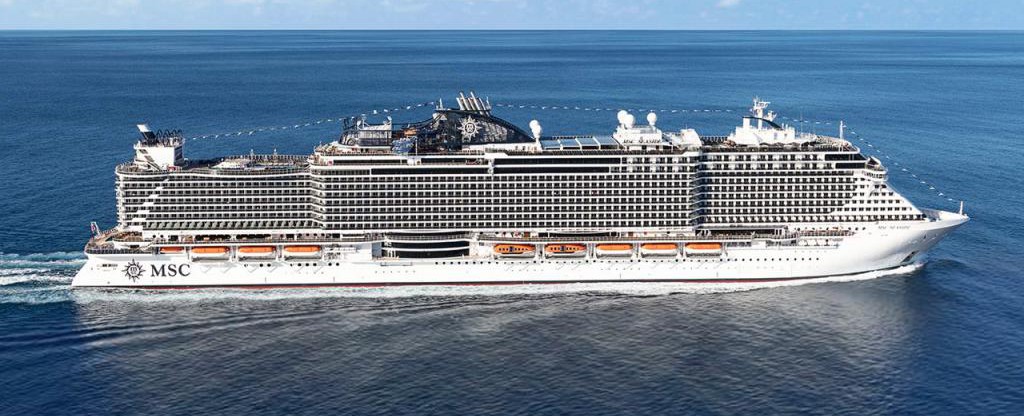
Image result for msc seaside
MSC Seaside.
Each had an opportunity to design the new biggest cruise ship in the world. The closest will be Dream Cruises, which is building a pair of 204,000 gross ton Global class ships for delivery in 2020 and 2021.
Royal Caribbean also has had two chances to top itself but has designed the smaller Quantum class at 168,666 gross tons and the upcoming Icon class at 200,000 gross tons. Royal is still cranking out Oasis-class ships the next is due in 2021. So perhaps when it is finished with that class, it will design something bigger.
For decades, the biggest cruise ship in the world was the 70,327 gross ton Queen Elizabeth 2, which reigned for 21 years from 1967 to 1988 when the 73,192 gross ton Sovereign of the Seas de-throned it.
Image result for rms queen elizabeth 2
RMS Queen Elizabeth 2nd
Thereafter, in the 20 years from 1988 to 2009, a series of newbuilds followed that each topped the last in size. Now there has been a nine-year lull. To match the QE2’s longevity as No. 1, the Symphony of the Seas would have to be the biggest until 2039.
Maybe that won’t happen. There’s always economies of scale to be reaped by building bigger, although the evidence seems to suggest that beyond 5,500 passengers, operators reach a point of diminishing returns.
But for now, long live the Symphony of the Seas.

MSC Meraviglia: ‘8 Golden Pearls’ from Bureau Veritas

Sergio Castellano, Environmental Director, MSC Cruises  --  Philippe Donche-Gay, President Marine & Offshore, Bureau Veritas  --  Mattia Manzi, Master of MSC Meraviglia

Bureau Veritas has recognized MSC Cruises with the “8 Golden Pearls” award for sustainability and environmental stewardship onboard the MSC Meraviglia, the company announced. MSC becomes the first cruise line to take home the honours.

Philippe Donche-Gay, President Marine & Offshore, Bureau Veritas commented: “MSC Cruises has demonstrated its commitment to reducing the environmental impact of their operations and we commend the company for its wide-ranging, ongoing efforts in this space. The various sustainable and environmental technologies installed on the MSC Meraviglia put the ship at the forefront of cleaner cruise operations. The Bureau Veritas 8 Golden Pearls award reflects MSC Cruises’ commitment to excellence and continual improvement in environmental performance.”

Bud Darr, Executive Vice President Maritime Policy and Government Affairs, MSC Group said: “We are honoured to receive this award, and we thank Bureau Veritas for their recognition and ongoing support. They are an invaluable partner on this journey and we look forward to continuing making further progress in the area of environmental stewardship.”

Image result for msc meraviglia

Among the highlights onboard are an exhaust gas cleaning system and advanced wastewater treatment.

In addition to the wastewater treatment, the ship has a holding capacity and Non-Discharge Operation for two days allowing for more autonomy and more flexible navigation, the company said.

In addition, the ship meets the high ISO 22000 standard for food safety. This certification covers food safety management systems across the entire food supply and preparation chain from “farm to fork.”

Cruise lines’ Dubrovnik deal seen as a way to combat overcrowding

T0319DUBROVNIK
Last year, Dubrovnik received 742,000 passengers on 538 ships.
FORT LAUDERDALE — Carnival Corp. CEO Arnold Donald said a new agreement in Dubrovnik, Croatia, illustrates how fears about crowding in favourite tourist areas can be managed by the cruise industry.

Speaking as part of a CEO panel at the Seatrade Cruise Global convention here, Donald took the occasion to disclose that major cruise lines have agreed to coordinate their schedules this summer in Dubrovnik.

That could mean some ships arrive later or depart earlier to keep their time in port from coinciding, or it could mean moving some ships to arrive during the week rather than on weekends.

The walled Old City of Dubrovnik was named a Unesco World Heritage site in 1979, but Donald said its mayor requested a meeting with cruise officials because it had been threatened with delisting by Unesco.

Donald and other cruise officials met several times with mayor Mato Frankovic, most recently in January when an agreement was apparently reached.

“In the end, our guests don’t want to go to a place that’s overcrowded,” Donald said. “If the sites that everybody wants to see are being abused, our guests won’t go. It’s in our self-interest, but it’s also in the interest of the places we go.”

Last year, Dubrovnik received 742,000 passengers on 538 ships. The city recorded about 3.4 million overnight stays, with many visitors drawn by Dubrovnik’s status as a filming location for the HBO series “Game of Thrones.”

Donald said cruise lines need to “listen with empathy for the issue of what some would call over tourism, not necessarily driven by cruise companies but by the fact that we’re a very visible symbol for it; our ships are large, and so forth. We have to listen with empathy to the ports that are out there and make sure we work with them to get the proper infrastructure.”

Dubrovnik’s over tourism concerns are shared by several other destinations in the Mediterranean, including Barcelona, Venice and the Greek island of Santorini.

Travel journalist Peter Greenberg, who moderated the CEO panel, said the World Travel and Tourism Council in a recent study listed “destination degradation” as one of three critical issues facing the travel industry.

Others on the panel took issue with the label “over tourism.”

“I think it’s a misnomer,” said Royal Caribbean Cruises Ltd. chairman Richard Fain. “What we’re really talking about is sustainable tourism.”

Fain cited Royal Caribbean’s development of Falmouth in Jamaica to offer an alternative to Montego Bay and Ocho Rios, as another successful response to crowding concerns.

After Falmouth opened in 2011, the number of cruise visitors actually rose, but they were more spread out.

“There were more people but less density,” Fain said.

“The opportunity, really, is to work together in these communities,” Fain said. “We work with them, and we find solutions that are to both of our benefits. And those we work with are very happy. You see that over and over again. Those who just want to make headlines, that’s a different story.”

The Celebtity Reflection in Dubrovnik.
The Celebrity Reflection in Dubrovnik.

Greenberg said that two cities where over tourism has been a hot-potato issue — Venice and Barcelona — are in the backyard of MSC Cruises, which has its headquarters in Geneva and its operations in Naples, Italy.

MSC executive chairman Pierfrancesco Vago said some perspective was in order.

“When you’re talking about Venice’s 30 million visitors a year, the cruise industry is 1 million of that,” Vago said.

He added that unlike the general tourism population, which ebbs and flows individually, cruise tourists come in groups that can be managed.

“We can actually coordinate,” Vago said. “We can actually ensure that there will never be an overflow, and we can control embarkation and disembarkation.”

A 2015 Unesco report recommended that the number of cruise passengers at Dubrovnik should not exceed 8,000 a day, arguing that when more than 8,000 visitors are inside the walls of the old city “tourist blight” becomes inevitable.

Research from the Port of Dubrovnik found that in 2016, arrivals exceeded 8,000 on 18 out of 243 total cruise days and that arrivals exceeded 10,000 on four days that year.

MSC has been looking for new destinations in the Adriatic to supplement hot spots like Dubrovnik. Last year, for example, MSC began calling at the port of Sarande, in southern Albania.

“Nobody knew that in Sarande, there were 10 different Unesco sites,” MSC CEO Gianni Onorato said in a recent interview. “This is the opportunity the cruise industry can give because there are options. That’s the only way to solve this problem.”