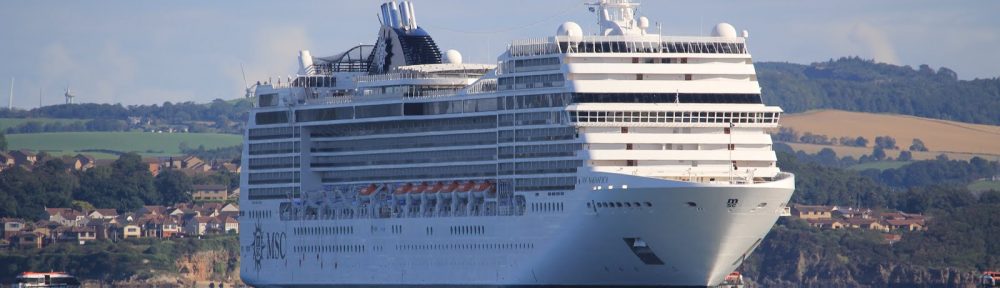
Royal Princess a subtle entry in ship size war
 SOUTHAMPTON, England — When cruise lines get the chance to grow these days, they don’t take the opportunity for granted. With each new class of ships, the stack of decks lined with balcony cabins seems to multiply. Not willing to cede anything to rivals, lines must compete in the size war or get left behind.
Princess Cruises has delivered its first new ship design in 10 years with the Royal Princess, and it is chock-full of spaces that Princess describes as the largest ever for its brand.
But the Royal Princess doesn’t reach for spectacle as readily as some competitors. For example, although the atrium area, the Piazza, is bigger than on the class that began with the Caribbean Princess in 2004, it is still only three decks high.
The buffet restaurant, Horizon Court, has been expanded to seat more than 1,100, and some of its space is given to a pastry shop that turns out baked goods morning, noon and night.
The Royal Princess’ theater is the largest in the fleet, seating 925, but it looks smaller than theaters on similar-size ships.
 The adults-only Sanctuary space is also 20% larger than on other Princess ships, and the Lotus Spa has more treatment rooms than its predecessors, but neither feels gargantuan.
Only the 34-by-20-foot screen for Movies Under the Stars calls attention to its size. It is 30% larger than on any other Princess vessel and is the largest such screen at sea.
Of all these areas, the standout is the Piazza, a beautifully executed forum surrounded by appealing restaurants, bars and other areas that will draw guests.
Notable are two semicircular bar areas nested one above the other. The larger one, Bellini, on Deck 6, takes its name from Venice’s signature peach-and-prosecco cocktail. The smaller, Ocean Terrace Seafood Bar, on Deck 7, serves sushi, oyster shooters and other “a la carte ocean treasures.”
Also bordering the Piazza is Crooners, a 1960s-style martini bar; Alfredo’s, the 121-seat Neapolitan pizza restaurant; and the ship’s photo gallery, updated with touch-screen face-recognition technology to make it easier for guests to find and manipulate photos.
All of these surround an elegantly crafted room fashioned in tan-and-brown marble and translucent onyx-like materials, pulled together with gold trim and illuminated with rose-colored lighting.
Part of the reason the Piazza works is that guest-service functions, such as the purser’s desk and shore excursion station, have been relocated to a mini-Piazza in an adjacent lobby.
The Royal Princess has its own take on several ideas that have worked on other ships for other lines.
 Its acclaimed “over-the-edge-of-the-ship” feature is Seawalk, which bows out 28 feet from the side of the ship on the 16th Deck, affording passengers a look down through Plexiglas panels to the ocean below (and to a number of midship passenger balconies, as well).
The Seawalk’s port-side counterpart is the Seaview Bar, which also extends beyond the ship’s lip, but not so far as to make anyone on a bar stool nervous about the location.
The Royal Princess is catering to an upper premium clientele with the addition of its first-ever concierge lounge for suite guests and the expanded adults-only Sanctuary.
The Sanctuary has a number of cabanas for rent, an idea used by Celebrity Cruises’ Solstice-class ships. It costs $15 for a half day and $25 full day even to gain access to the Sanctuary.
Adjacent to the Sanctuary is the Retreat Pool, open for free to all adults but rimmed by cabanas, which rent for $50 per half day, with picnic lunches starting from $40.
Another revenue generator that has been expanded is the Lotus Spa, where the thermal suite has tripled in size and the number of treatment rooms has grown to 18, including two designed for couples.
The conference room in previous ships has been ditched for Princess Live, a 280-seat TV studio where some form of entertainment is scheduled throughout the day. It will be interesting to see if Princess Live can draw enough guests to make it a viable space.
One of the best ideas on the ship was to line its corridors with photos submitted in a contest by past passengers. Many are terrific. Putting bars next to related restaurants, such as Vines wine bar adjacent to Sabatini’s Italian restaurant, also makes good sense.
It was hard to judge the new dancing waters fountain and larger Music Under the Stars area on the Royal Princess because of several nights of dreary weather here.
Another new area that works is the shimmering Chef’s Table Lumiere, a 12-seat private table in the middle of the Allegro dining room, surrounded by a lighted curtain.
Less successful is the ship’s gelateria, another first, where the silky texture and vivid flavor of true Italian gelato is missing. Baked goods from the Pastry Shop were not bad, but less special than one might have hoped.
Of the 3,560 passengers Royal Princess can carry at double occupancy, nearly 2,800 will enjoy a balcony. There are 36 suites, 314 minisuites and 720 “deluxe balcony” rooms, a new category with more space and a smattering of suite-style amenities.
One nice improvement is electrical sockets spaced farther apart to accommodate multiple plugs. But the bathroom toilet paper dispenser is rather awkwardly placed and a metal cover makes it hard to use.
The Royal Princess will spend the summer cruising in the Mediterranean before relocating to Fort Lauderdale for a winter Caribbean season.
Channel surfing on the Royal Princess
 The Royal Princess sailed all night to the Channel Islands, and I woke up to disappointment: Our day ashore in Guernsey had been cancelled. It was a fine, sunny morning, but the winds were over 30 knots. Tendering from the anchorage would be too dangerous.
Now I had unscheduled day at sea.
What to do?
I decided to check out something new to a Princess cruise that, until now, I didn’t think I’d have time for. It was the line’s in-cabin, on-demand TV system.
Princess executives are very excited about it. According to Rai Caluori, executive vice president of fleet operations at Princess, the line had been searching for a long time for a system that satisfied all its requirements.
The result is a simple-to-use library of TV shows and movies along with live television channels, music stations and information like local weather and a map of the ship’s position.
It also carries Princess’ own programming, such as “The Wake Show,” a rundown of ship and shore activities delivered by cruise director Ron Goodman in an entertaining talk-show format.
TV options include news, sports and dozens of comedies and dramas, but the real treasure is the movie channel. There are 26 entries in the “just added” category alone, and more in the comedy, action, romance, drama and family channels.
I brought up “The Three Stooges” at first, but I didn’t have the patience to get through the opening, so I exited and tried “Searching for Sugar Man,” a documentary about a long-lost musician that hooked me immediately.
Halfway through I paused for lunch. When I came back, I simply hit resume and started watching again.
So for clients who worry about bad weather or unexpected itinerary changes, or simply have extra time on their hands, the Royal Princess has a new answer.
Add it to the list of positive things to say about taking a cruise.

 he retirement of MSC Melody underscores one of the most remarkable transformations in the cruise business.
 Wetravel2u's Weblog