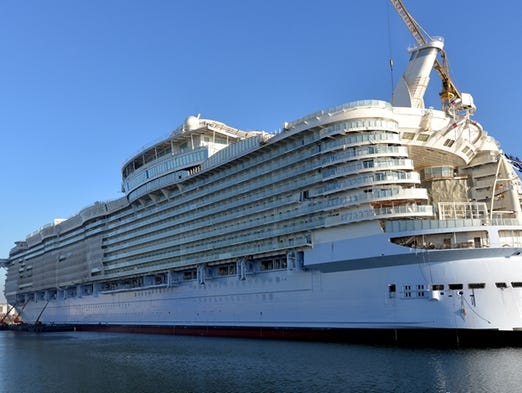
World’s largest cruise ship, Symphony of the Seas, nearing completion

The exterior of Royal Caribbean's soon-to-debut Symphony
Symphony of the Seas

The giant is almost ready.

New photos from the shipyard building Royal Caribbean’s Symphony of the Seas — the largest cruise ship ever — show the vessel rapidly approaching the finishing stages of construction.

As seen in the carousel above, the new images of the 230,000-ton ship show an exterior now gleaming with a finishing coat of paint and work well under way on outdoor decks including the Boardwalk amusement zone. Boardwalk will be home to a classic carousel, diner, rock climbing walls, the base of a nine-deck-high slide and more.

Another highlight of the Boardwalk area, an “aqua theater” that will boast daring high-diving and aerial performances, also can be seen nearing completion in the photos.

Royal Caribbean revealed earlier this month that Symphony would be ready weeks ahead of schedule. Now debuting in March instead of April, the vessel has been under construction for more than two years at the giant STX France shipbuilding facility in St. Nazaire, France.

Symphony was floated out from a dry dock at STX France in June, a construction milestone that marked the end of basic exterior work. It is now undergoing months of finishing work to its interior.

Image result for symphony of the Seas float out

Behold the largest cruise ship ever built, Royal Caribbean’s Symphony of the Seas. USA TODAY

Symphony will be more than 3,000 tons bigger than the current size leader in the cruise world, Royal Caribbean’s 226,963-ton Harmony of the Seas. Like Harmony, Symphony will be part of Royal Caribbean’s record-breaking Oasis Class of ships, though it won’t be an exact copy of its sisters. Royal Caribbean has unveiled several new features for the vessel including a first-of-its-kind, two-deck-high family suite with a slide between floors.

Symphony is scheduled to sail to the Caribbean out of Miami starting in November 2018. It’ll move to the city after spending its first few months operating voyages in the Mediterranean.

What Would It Take for California to Lure a New Mega Cruise Ship?

What Would It Take for California to Lure a New Mega Cruise Ship?

PHOTO: Disney Cruise Line’s Disney Wonder docked in San Diego, California. (Photo by Jason Leppert)

By JASON LEPPERT

As a native resident of San Diego, I’ve recently lamented the lack of brand new cruise ships sailing from Californian home ports. Short of some more recent vessels passing through on repositioning cruises on their way to seasonal Alaska, most are older with the newest ships almost always being earmarked for Florida.

So, now I ask this: what could California and nearby destinations do to warrant the latest mega cruise ship sailing from the west coast?

Destinations

From Florida, the Caribbean is the classic destination with access now to countries from Cuba to Mexico, but there’s actually a greater variety leaving from Los Angeles or San Diego, also including Mexico. In fact, itineraries can feature Mexican Riviera, Hawaiian or California Coastal varieties, and, in the case of Holland America Line, some combo voyages feature two different routes consecutively. The bottom line, though, is the Caribbean is a more popular cruise destination than either of California’s accessible trio.

Thankfully, the Mexican Riviera is picking back up after a recent slump when it was perceived as dangerous for a period of time, but a wider selection of individual ports could help further. The number of available stops in the Caribbean is massive compared to frequented Cabo San Lucas, Mazatlan and Puerto Vallarta. Adding to that list, however, are the likes of Acapulco which is also on the rebound and ports in the Sea of Cortez. The problem is that sailings to these areas are often longer than the week long sweet spot for cruise duration.

The solution though might be to feature at least one Sea of Cortez port in combination with fewer of the classic ports as well as developing them all to be more convenient. True of Hawaiian and Californian cities besides those in Mexico is that many can only be visited via tender. If Cabo San Lucas, Catalina or Lahaina, for instance, were to have docks, they would be more enticing to new mega cruise ships. Or perhaps newly developed ports could be an answer as well.

Homeports

The other variable in the equation are turnaround home ports themselves—that is: could San Diego and Los Angeles’ San Pedro and Long Beach handle high volumes of passengers embarking and disembarking?

Carnival is investing in its facility at Long Beach for this very reason to soon accept the larger 3,006-guest Carnival Splendor, but it would take more to be able to process 4,000-passenger-plus vessels like Norwegian Cruise Line’s upcoming Norwegian Bliss heading for Alaska. Seasonally, this new ship would’ve been ideal in California when not north, but it too opted for Florida in the winter.

If the facilities could scale up to support the newest cruise ships in California, there would be plenty of other conveniences to tout, especially in San Diego. The ease of transportation from America’s Finest City is exemplary. Nearly a stone’s throw away from the port is the train station and within only three miles is the international airport. In fact, it’s so close you can watch the planes take off and land from onboard the cruise ships just across the bay.

Ultimately, what would make it happen is a cruise line taking a chance to trust in the “build it, and they will come” philosophy. That is, Florida’s cruise traffic may be less a result of the Caribbean’s popularity and more a result of the newest ships drawing people there. If a cruise line decided to put their latest in California instead and of course the facilities existed to support them, cruise travellers would very likely follow to experience it wherever it goes.

Future ships that might still fit the bill in California are Carnival Cruise Line’s third Vista-class ship, Royal Caribbean International’s fourth Oasis-class ship or even Norwegian Cruise Line’s fourth Breakaway Plus-class ship.

With such a glut of new vessels coming online, surely one of them will eventually have to first make it to California.
Fincantieri’s Bid for STX France Viewed Favorably by French Government

FILE PHOTO Shipbuilders ride past a giant poster November 9, 2016 at the STX Les Chantiers de l'Atlantique shipyard site in Saint-Nazaire, western France. REUTERS/Stephane Mahe/File Photo

FILE PHOTO Shipbuilders ride past a giant poster November 9, 2016 at the STX Les Chantiers de l’Atlantique shipyard site in Saint-Nazaire, western France. REUTERS/Stephane Mahe/File Photo

By Emmanuel Jarry

PARIS, Jan 4 (Reuters) – A leading French minister expressed support on Wednesday for a bid by Italy’s Fincantieri’s for shipbuilder STX France, adding that the government would aim to keep the shipbuilder’s main site running at Saint Nazaire.

“We said we wanted a European, industrial company … Fincantieri is a European, industrial company. So it would be hard for us to say ‘no’ to them,” French Industry Minister Christophe Sirugue told RMC Radio.

The sale of STX France, which specialises in building cruise ships at the Saint-Nazaire shipyard and is profitable, forms part of a broader sell-off of businesses following the demise of the South Korean STX shipbuilding group.

The French state owns 33 percent of STX France, and Sirugue said the government was keen to keep the Saint Nazaire site in the west of the country.

Italy’s 230-year old Fincantieri makes a wide range of vessels from cruise ships to military aircraft carriers, and acquiring STX France would boost its presence in the cruise shipbuilding part of the market.

Sirugue said France wanted state-controlled military shipbuilder DCNS, in which Thales holds around 35 percent, to take a minority stake in STX France that would definitely be below 50 percent of the company.

Saint Nazaire’s high point last year was production of the largest passenger ship ever built, the ‘Harmony of the Seas’. (Reporting by Emmanuel Jarry; Writing by Sudip Kar-Gupta; Editing by Richard Balmforth)