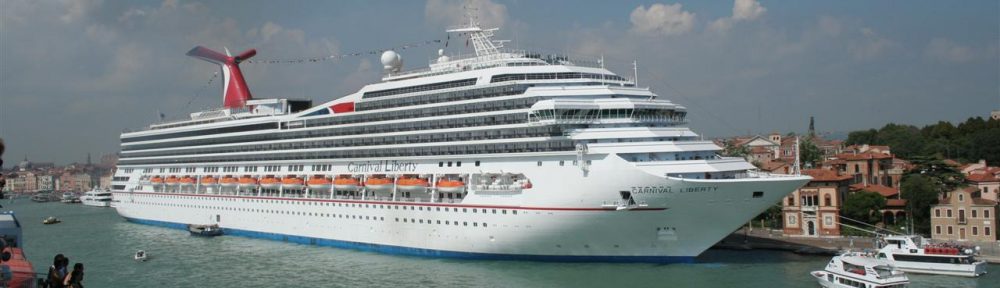
Carnival to create Chinese brand in joint venture

Carnival Corp. said it is moving forward with plans to form a joint venture with China State Shipbuilding Corp. that would operate a new domestic brand in China.

In an announcement timed to the visit of the Chinese premier to London, Carnival announced that China Investment Corp. will also be a partner in the venture.

The partners formalized the venture at a signing ceremony held today at the Mansion House in London with British Prime Minister David Cameron and Chinese President Xi Jinping in attendance.

“This cruising joint venture is a significant step forward for the cruise industry in China and a tremendous opportunity for us to work together with [China State Shipbuilding Corp. and China Investment Corp.] to grow awareness, interest and demand for cruise vacations amongst domestic Chinese travelers,” said Alan Buckelew, global chief operations officer for Carnival Corp. & plc.

In announcing the venture, Carnival and its partners did not name it or say when its first ship is expected to be ready for sailing. The announcement described the new brand as “the first world-class, multi-ship domestic cruise brand in the Chinese market.”

The parties said the addition of China Investment Corp. to the venture was a sign of China’s “commitment to developing a strong domestic cruise presence and growing demand for cruising as a key driver of the expanding Chinese tourism market.”

One of the largest sovereign wealth management funds in the world, China Investment Corp. has $740 billion of assets under management, Carnival said

Majestic Princess: Princess Cruises names new €600 million ship designed for Chinese

Majestic Princess will be based in China

Majestic Princess will begin sailing to Japan and South Korea from its homeport of Shanghai in summer 2017

Princess Cruises’ newest ship, launching in summer 2017, will be called Majestic Princess. The 3,560-passenger vessel is the third “Royal Class” ship for the cruise line and has been designed with Chinese passengers in mind.

The ship will carry a Chinese name on the hull, 盛世公主号 (Shèng Shì Gōng Zhǔ Haò) – chosen by Carnival plc’s China employees and interpreted as “Grand World” or “Grand Spirit.”

“We’re excited to be the first line to offer a genuine premium cruise option to Chinese vacationers,” said Jan Swartz, president of Princess Cruises.

“[Majestic Princess] represents our brand’s long-term commitment to the continuing growth of the China market.”

T’ai chi at sea, ballroom dancing, subtitled Hollywood movies, Chinese satellite TV channels and a souped-up designer shopping experience are among the “Princess Class” experiences being rolled out to the Chinese market. Priority will be placed on food, amenities and shopping. In addition to the 24-hour buffet at sea, a wide variety of traditional Chinese dishes will also be offered for breakfast, lunch and dinner.

The rapidly expanding Chinese cruise market has seen a parade of international ships moving to China. MSC Cruises announced last month that it will deploy its 1,976-passenger MSC Lirica to Shanghai, while Royal Caribbean’s Quantum of the Seas sails from Shanghai. Following its launch in China next April Ovation of the Seas will sail from Tianjin.

China has the potential to deliver 83 million cruise passengers a year according to a recent study by the Hong Kong Tourism Board.

• China plots domination of the global cruise market

Princess ships began homeport cruising in China in 2014 with an inaugural season of Shanghai-based cruises aboard Sapphire Princess, which visited cities including Seoul (Incheon), Busan and Jeju Island in South Korea and Fukuoka (Hakata), Kagoshima, Okinawa and Nagasaki in Japan. Majestic Princess will be based in China year round and will begin sailing to Japan and South Korea (ports not yet confirmed) from Shanghai in summer 2017.

Weighing in at 143,000 grt and with a build cost of €600 million Majestic Princess is being built at the Italian shipyard Fincantieri, where P&O Cruises’ Britannia, Princess’s Royal and Regal Princess and Carnival Magic were built.

Carnival’s Fathom brand melds cruise, charity for new kind of vacation fun

Distributing ceramic water filters is one job passengers will do along with local residents on a Fathom cruise in the Dominican Republic. Fathom President Tara Russell is at far left.

AMBER COVE, Dominican Republic —When Carnival Corp.’s new Fathom brand docks for the first time here next April, guests will emerge onto the pier of the newest port in the Caribbean. Everything about it will say vacation, from the duty-free store at the foot of the pier, to the shopping village full of souvenirs, to the thatched-roof cabanas sitting Polynesian-style on platforms over the water.

But Fathom travelers will be on a decidedly nontraditional vacation. Instead of choosing which beach to visit, they’ll be surveying options for how they can help the residents on the north coast of this country, where the per-capita income is about $11,680 a year. Many homes in the countryside lack electricity or running water. Wood fires are common for cooking.

Fathom is not a conventional travel product, especially in the fun-and-sun cruise sector. But the brand’s managers hope to make the case that combining travel and social responsibility can be its own kind of fun.

“It’s a meshing of what in many households would be two different spheres of their lives,” said David Drier, Fathom’s vice president of sales and former CEO at Clipper Cruise Line.

Drier said a simple way of thinking about Fathom is that people budget different time and money for travel and charity each year. “Now, we’re melding those two buckets together.”

Drier and his sales team have a bit more than six months to fill Fathom’s 710-passenger ship, which will alternate between weekly visits to this port and a second itinerary in Cuba.

Meanwhile, several agents have reached out with interested clients, including Barbara Silver, manager of OmniTours in Deerfield, Ill.So far, Drier has focused on explaining Fathom to major consortia such as Signature Travel Network and Ensemble Travel Group; the latter recently named Fathom a preferred supplier.

Silver said she is trying to book a Fathom trip for a group of about 40 in a central Florida retirement community in the fall of 2016. The group leader is in her early 80s, Silver said, and honeymooned in Cuba.

“She’s very anxious to go back there and visit and bring her travelers with her,” Silver said.

Cuba is the more expensive of the two itineraries, with prices beginning at $1,800 per person for an inside cabin. Comparable cabins on Dominican itineraries are $974.

Nevertheless, Cuba seems to be outselling the Dominican Republic early on, even though Fathom’s program there is less developed. Fathom’s president, Tara Russell, said that Cuba’s appeal is singular because of the decades-long travel ban for Americans.

“The object for travel is totally different” than in the Dominican Republic, she said, where the social impact work involved in a Fathom cruise has to be the primary selling point.

“The latent demand for the Dominican Republic is smaller,” she said. “There is less curiosity.”

In the D.R., Fathom passengers will spend three days docked at Amber Cove, the new $85 million port near Puerto Plata.  From there, they will fan out on buses to help Dominicans with a range of projects.

One impact activity takes place in Altamira, about 20 miles from port in the hills above Puerto Plata. There, Fathom passengers will help out at Chocal, a cooperative formed by 30 local women so that they wouldn’t have to move to bigger cities to find work and leave their families.

Chocal makes artisanal chocolate out of the cacao trees that thrive on the tropical island.

The U.S. Agency for International Development has loaned the money for equipment, but to pay the loans and hold down expenses, none of the cooperative members draws a salary.

“They can’t afford to hire more people now until they pay off their loans, so this volunteer program is just amazing,” said Caroline Bucher, a consultant for Fathom in the Dominican Republic.

At Chocal, some passengers will help separate cacao beans from their shells, a tedious process that can be only partially mechanized. Others will assist with cutting, folding and gluing wrappers to the finished chocolates or make fertilizer for a nursery that produces young cacao trees.

Elsewhere in the Puerto Plata region, Fathom cruisers will visit schools to help with English instruction.

A group of Fathom employees and journalists on a “sampler” tour at the Maria Isabel Meyreles school in Cupey sang a song in English with a class of about 30 students. Afterward, the volunteers helped the students do a worksheet that had them finish fill-in-the-blank questions about the English lyrics.

Sabina Rodriguez, a regional educational administrator, said foreign language skills in particular help Dominicans get jobs in the tourism sector.

On another day, Fathom passengers might find themselves at a factory helping to sift clay and mix materials for inexpensive ceramic water filters that can turn river water 99% pure. A lunch of traditional Dominican fare awaits after a morning’s work. The next day, they will help distribute the filters and hear stories about how better water access improves families and communities.

Russell said Fathom’s programs were developed with variety in mind so that travelers will get a different type of experience each day.

To help agents promote such a new and different product, Fathom is offering an across-the-board 15% commission through Oct. 15 for agencies that register as Fathom Founder’s Circle members.

In the Dominican, Fathom is also offering a 1-for-9 tour conductor credit during that time frame. For bookings of back-to-back cruises to Cuba and the Dominican Republic, Fathom is offering a 10% discount on the fare for each departure.