Royal Caribbean Cruises Ltd posts $1.4bn Q1 loss

Royal Caribbean Hurricane Irma & Maria Relief - Make a Donation

Royal Caribbean Cruises Ltd has reported a net loss of US$1.4 billion for the first quarter of 2020.

The parent company of Royal Caribbean International, Celebrity Cruises, Azamara and Silversea paused all operations amid the global Covid-19 pandemic on March 13.

In a trading update today,  the company said the pandemic was expected to have hit production at shipyards, meaning delays to new-build Royal ships.

RCCL said the pandemic had led to the cancellation of 130 sailings, which equated to a 20% reduction on its planned sailings and was 17% down on last year’s programme.

The company posted a profit of $249.7 million in the first quarter of 2019 and said it expects to report an overall net loss in 2020.

RCCL withdrew its full-year trading guidance in March, and the update noted: “The magnitude, duration and speed of Covid-19 remain uncertain. As a consequence, the company cannot estimate the impact of Covid-19 on its business, financial condition or near or longer-term financial or operational results with reasonable certainty.”

It expects non-operating expenses of between $590 million and $610 million for the remainder of the year.

Bookings for the remainder of 2020 are “meaningfully lower” than 2019 with lower prices, RCCL reported but noted that before the pandemic took hold it was in “a strong booked position and at higher prices” than 2019.

Looking ahead, it said “the booked position for 2021 is within historical ranges when compared to the same time last year” with 2021 prices “up mid-single digits compared to 2020”. The company stressed it was “still early in the booking cycle”.

RCCL brands had offered customers booked on cancelled cruises either a cash refund or future cruise credit note and said that, as of April 30, 2020, approximately 45% of guests had requested cash refunds.

As of March 31, 2020, the company had $2.4 billion of cash in customer deposits.

RCCL estimates its cash burn to be, on average, in the range of approximately $250 million to $275 million per month while operations are suspended but noted it had “taken significant actions to enhance its liquidity, preserve cash and secure additional financing”. These included securing a $4 billion increase in financing and knocking $3 billion off its 2020 capital expenditure.

“We have taken swift and substantial actions to bolster our financial position by significantly reducing our operating and capital spend and leveraging our strong balance sheet to raise additional capital,” said Jason Liberty, executive vice president and chief financial officer.

As of April 30, 2020, the company had liquidity of approximately $2.3 billion all in the form of cash and cash equivalents, RCCL reported. And on May 19, 2020, it completed a $3.3 billion senior secured notes offering, improving its liquidity position by approximately $1 billion.

RCCL noted that as of May 19, 2020, the expected debt maturities for the remainder of 2020 and 2021, are $0.4 billion and $0.9 billion, respectively.

“Responding to the dramatic change in business conditions caused by COVID-19 has required focus, dedication, ingenuity and improvisation from all our people, and their efforts have been nonstop,” said chairman and chief executive Richard Fain. “We understand that when our ships return to service, they will be sailing in a changing world.  How well we anticipate and solve for this new environment will play a critical role in keeping our guests and crew safe and healthy, as well as position our business and that of our travel agent partners to return to growth.”

RCCL is due to complete its repatriation of crew members to their home countries, and said the company’s future focus now turns to four key principles:

  • Ensuring the safety of guests and crew
  • Proactively enhancing liquidity
  • Protecting the Company’s brands, and
  • Defining and preparing for a “new normal.”
Royal Caribbean puts up 28 ships as collateral for $3.2bn bond

Fleet guide - Royal Caribbean Discussion - Royal Caribbean Blog
Royal Caribbean fleet fact sheet.

Royal Caribbean Cruises has launched a $3.2 billion bond offering while pledging 28 of its ships and “material intellectual property” as collateral.

The move followed the world’s second-largest cruise group forecasting heavy losses for the first quarter of the year as Covid-19 brought global sailings to a standstill.

The company expects to report a preliminary first-quarter net loss of $1.44 billion compared to a profit of $249.7 million a year earlier.

Royal Caribbean, which was forced to suspend its cruises globally and cut about 23% of its US workforce, said the health crisis has dented its quarterly net income by about $453 million.

Preliminary total revenue for the three months ended March 31 fell 16.7% to $2 billion against the same period last year.

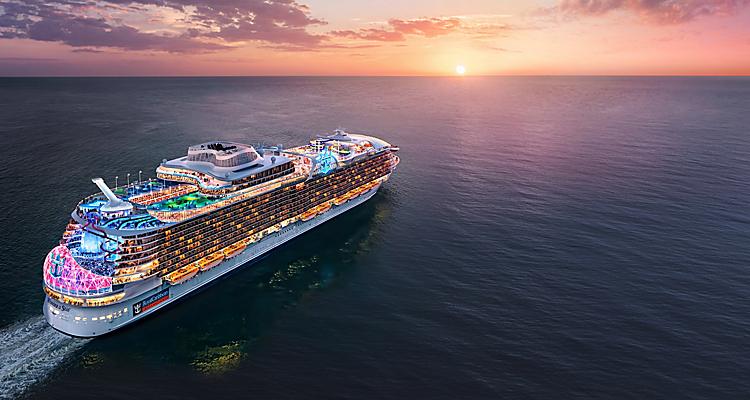
Royal Caribbean declined to specify which ships it had pledged for its debt offering. It had vessels with a net book value of about $22.7 billion as of December 31, including Symphony of the Seas, the world’s largest cruise ship.

The net proceeds from the offering of the $3.3 billion notes will be used to repay a $2.35 billion 364-day loan.

The remainder will be used for “general corporate purposes, which may include repayment of additional indebtedness”.

The parent company of Royal Caribbean International, Celebrity Cruises, Azamara and Silversea, estimates its cash burn to be about $250 million to $275 million a month during a prolonged suspension of operations.

Cruise lines make progress with seafaring women at the helm

The Celebrity Edge had its first all-female bridge and hotel officer team for a roundtrip cruise on March 8, International Women’s Day.

While women remain a minority in the top echelons of the cruise industry, they are starting to make their mark in a big way.

On March 8, International Women’s Day, the Celebrity Edge sailed the first cruise featuring an entirely female bridge and hotel officer team.

It was helmed by Kate McCue, the line’s first American female captain. Guests on the Fort Lauderdale roundtrip sailing were treated to lectures, documentary screenings and networking opportunities, all dedicated to, in Celebrity Cruises’ words, “inspiring a new generation of girls and women to pursue careers in the maritime field.”

The cruise line said that in four years, it had boosted the percentage of women working across its fleet from 3% to 27%.

The Regent Seven Seas Splendor debuted this February with a female captain: Serena Melani, who grew up in Italy. She has spent 30 years in the cruise industry, 10 of those with Regent Seven Seas Cruises, where she started as a bridge officer. With the debut of Regent Seven Seas Splendor, she became the first woman to captain a new ocean ship at launch.

CLIA has made gender diversity a key goal. For last year’s World Maritime Day, its theme was “Empowering Women in the Maritime Community.”

CLIA CEO Kelly Craighead said, “Elevating women to leadership positions in the cruise industry makes good business sense. Research shows women hold the purchasing power when it comes to decisions and bookings in the multitrillion-dollar travel and tourism industry. It’s more important than ever to have women at every level of leadership in the cruise industry bringing better representation and customer understanding.”

There was a time when maritime training institutes wouldn’t even open their classrooms to women. But that has changed, partly at the urging of the International Maritime Organization. Still, the organization said, even now, women represent only 2% of the world’s 1.2 million seafarers.

Ally Cedeno, a 2008 graduate of the U.S. Merchant Marine Academy, recalled, “I often sailed as either the only woman on board or one out of just a few women. There were times throughout my career when I needed a mentor, someone who could provide guidance and understanding regarding challenges [I faced] as a female seafarer.”

When she graduated from the academy, 10% of the class was female. With today’s class, that percentage is more than 25%.

Capt. Kate McCue helms the Celebrity Edge.
Capt. Kate McCue helms Celebrity Edge.

At the State University of New York Maritime College, the percentage of female students has grown from about 9% in 2014 to 14% in 2019.

Cedeno founded WomenOffshore.org to support female seafarers around the world. In three years, it has grown to 700 members, with a mentoring program that has about 150 women in it.

Other cruise lines have hired female captains in recent years, including Windstar Cruises, which made Belinda Bennett its first female captain, on the Wind Star. She was also the first black female captain in the commercial cruise industry.

And there are women in leadership at the corporate level, including Christine Duffy, president of Carnival Cruise Line; Ellen Bettridge, CEO of Uniworld Boutique River Cruise Collection and U River Cruises; Jan Swartz, president of Princess Cruises; and Lisa Lutoff-Perlo, CEO of Celebrity Cruises.

Carnival Corp. does not have female captains, but it does have nearly 70 female crew members in a variety of deck, engine, security and hotel positions. The cruise company held its first Inclusion Diversity Equity Aspiration conference in January, bringing together many up-and-coming leaders.

Lutoff-Perlo said in an interview last fall that she had made recruitment and promotion of women a focus at Celebrity since she took the top role at in December 2014.

“I decided … I should embrace the fact that I am [a woman] and that I have this really great opportunity,” she said. “I get to pay it forward, and I get to help other women achieve what they want to achieve in an industry that perhaps has not been as welcoming or … aggressively trying to bring more women in.”

Celebrity recruits female cadets from the maritime academies and fills some higher positions from cargo and container companies and other cruise lines. In addition, it relies on the social media presence of some of its officers to help showcase life onboard. McCue, for example, has 127,000 followers on her Instagram account @CaptainKateMcCue.

Lutoff-Perlo said, “It’s hard to underestimate the effort it takes to go from 3% to 22% of women on the bridge when there aren’t that many women out there who are studying and graduating from the maritime academies or who choose a career at sea. This is complicated. It’s not that easy.”

McCue said her interest in sailing started when she was 12 years old and her parents took the family on a Bahamas cruise. Her family encouraged her to pursue her dream of sailing for a living, and she ended up graduating from the California Maritime Academy in 2000.

But she didn’t get a job right away.

“I applied to every cruise line in the industry,” McCue said. “For about a year and a half, I didn’t hear anything, so I changed my CV and applied to be a bartender on a cruise ship. [One cruise line] said I was not qualified to be a bartender as I had never served a drink in my life, but I was qualified to drive their ship, so I joined as a third mate.”

Shortly after that, she moved to Royal Caribbean and spent 13 years working her way up to staff captain, a ship’s second in command. In 2015, she got the call from Celebrity inviting her to become the line’s first female captain. She accepted right away.

“With only 2% of the industry being female, it is obvious that we’re not tapping into 50% of the population and available workforce,” McCue said. “When you diversify and focus on inclusion, it increases creativity and productivity, benefiting the industry as a whole.”

Likewise, Melani spent years working her way to where she is now. She began her nautical career at the age of 16, working on cargo ships in her hometown of Livorno, Italy, on the Tyrrhenian Sea. She graduated from Nautical College in 1993 and was one of only a few women working on oil tankers, cargo and container vessels.

In 2016, she became the company’s first female master captain and has also led the Seven Seas Explorer, Seven Seas Mariner and Seven Seas Navigator.

“This is really the cherry on the cake of my entire professional life,” Melani said aboard the Seven Seas Splendor’s inaugural cruise.

To other women out there in maritime schools and working their way up the ranks at cruise lines, Melani has a message: “Never losing sight of your goal is important. You can do anything you want. You can reach anything you want.”