
Germany, Italy and Spain join calls for suspension of EU airline refund rules

After the Brexit: Quo vadis, EU? | Heinrich Böll Stiftung ...

The governments of Germany, Italy and Spain have joined 12 others in the EU demanding a suspension of airline refund rules.

Under EU 261 denied boarding regulations, airlines must refund customers within seven days of a flight being cancelled.

However, many airlines are facing drastic liquidity issues and are unable to issue cash refunds within that time frame.

The European Commission has issued new guidance and sanctioned credit notes being issued instead of cash only when passengers accept them.

Last Wednesday 12 EU governments called on the union’s executive body to suspend the rules and yesterday Germany, Italy and Spain were reported to have joined them.

French transport minister Jean-Baptiste Djebbari said in a statement: “I’m glad a very large majority of member states are supporting my request to authorise airlines and maritime groups to temporarily use vouchers when trips are cancelled, so as to relieve their cash reserves while protecting passengers’ rights to a refund.”

Governments in favour of a temporary change in the rules have said vouchers should be valid for a set period and include the right to reimbursement if they are not used before the expiry date.

They also want to ensure that financial protection is provided in the case of airline bankruptcies.
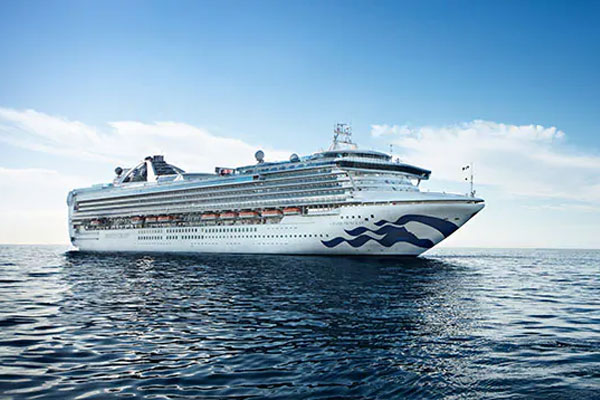
Carnival Corporation to ‘fully co-operate’ with a congressional inquiry

Carnival Corporation to ‘fully co-operate’ with congressional inquiry

Carnival Corporation has said it will fully co-operate with the US House Committee on Transportation and Infrastructure after it opened an inquiry into the company’s handling of the coronavirus crisis.

Bloomberg reported on Friday that letters had been sent to Carnival chief executive Arnold Donald, the US Coast Guard and the Centers for Disease Control and Prevention asking for internal documents and correspondence relating to outbreaks onboard its ships.

The letter asked Carnival to clarify its plan for improvement in the areas of public health and passenger safety which it said: “has not been seen up to this point”.

It also said the cruise giant appeared to be “still trying to sell this cruise line fantasy and ignoring the public health threat”.

A statement from Carnival said it was reviewing the letter and would fully co-operate with the committee.

The statement said: “Our goal is the same as the committee’s goal, to protect the health, safety and well-being of our guests and crew, along with compliance and environmental protection.”

In a call with journalists on April 16, Donald refuted suggestions the cruise industry was slow to react to the outbreak of coronavirus.

And he argued that cruise was one of the best-placed sectors of travel to cope with anticipated stricter health and safety protocols in the future.

He said: “The cruise industry put a pause on the cruise before anybody else did. Before hotels or restaurants and other places of social gathering.

“Cruise ships are not the cause. Neither are they the reason for the spread.”

Royal Caribbean boss says numbers ‘likely to be restricted’ when cruising restarts

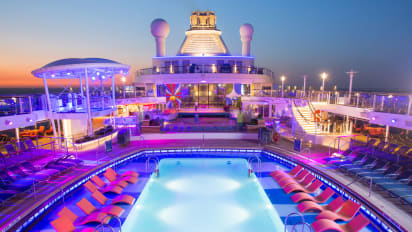
Anthem of the Seas: Wired, weird future of cruises | CNN Travel

Cruise ships are likely to be restricted to carrying fewer guests to allow for “more natural space” when cruising first re-starts after the Covid-19 pandemic, according to the boss of Royal Caribbean UK.

Speaking at the line’s first ‘Café Royal’ webinar for trade partners, vice president EMEA Ben Bouldin said that as well as enforced reduced load factors, cruise lines are also anticipating more automation at check-in, increased screening and enhanced medical facilities and capacity on board.

He said lines were also looking at new procedures to disembark guests quickly from ships in the event of a future Covid-19 outbreak and said social distancing measures in dining rooms and around the pool decks are all likely for post-pandemic cruising.

“Until there’s a vaccine, we’re trying to understand what the new normal is. Things will be really different. Be reassured we are looking at absolutely everything,” Bouldin said.

“It’s incredibly complex. We have to get the right balance of accommodating changes to make sure everyone is safe, while not undermining our guests’ enjoyment of their holiday.”

Bouldin added that there had been confirmation from Clia in the US that a medical letter would not be required to travel and he said that he did not expect to have to give mature travellers any special treatment. He also hopes the line would continue to be able to support guests with disabilities.

“We are not expecting to have to treat people over 70 any differently. We are confident we have the ability to look after them,” said Bouldin.

“And we hope to be able to support guests with all sorts of disabilities. Our intention is absolutely to remain an inclusive holiday experience.”

Bouldin said the line was preparing to “shout loud and proud” about its health and safety protocols when it returns to service and said the re-introduction of ships into the market would be “staggered” to allow it to complete the “mammoth task” of getting crew in the right places.