Evacuees Leave Puerto Rico by Cruise Ship


People line up to board a Royal Caribbean cruise ship that will take them to the U.S. mainland, in San Juan, Puerto Rico, September 28, 2017. REUTERS/Alvin BaezThousands of people lined up at San Juan harbor on Thursday to board a cruise ship that will take them from Puerto Rico to the U.S. mainland in one of the largest evacuations since Hurricane Maria slammed Puerto Rico more than a week ago.

Maria, which came ashore as the strongest storm to hit the island in nearly 90 years, has created a humanitarian crisis. The powerful storm knocked out the nation’s electric grid and has crippled communications networks, transport and the water supply for the territory’s 3.4 million people.

The devastation is likely to feed an exodus that has driven tens of thousands of Puerto Ricans from the economically struggling island in recent years in search of opportunity on the mainland.

“I’m sorry to be leaving Puerto Rico, but I have to. I prefer home, but it’s impossible with these conditions,” said Ada Reyes, 85. She was in a wheelchair and traveling on the Royal Caribbean cruise ship bound for Florida with her granddaughter, Maria Fernanda, 19.

Fernanda planned to drop her grandmother in Florida, then head to Boston to look into colleges. A second-year student at the University of Puerto Rico, the teenager did not know when classes there would resume.

Royal Caribbean International said its Adventure of the Seas cruise ship will carry 3,800 passengers from Puerto Rico and the U.S. Virgin Islands. A company spokesman said the cruise line is providing the passages free of charge and that travelers were registered with the help of local officials.

The ship will make humanitarian calls in the hurricane-hit U.S. Virgin Islands, where it will drop off supplies. It will then head to Fort Lauderdale, Florida, with a planned arrival of October 3.

The cruise line said it will work with airlines to make travel arrangements for passengers looking to meet up with friends and family on the mainland.

“This is a humanitarian mission on behalf of Royal Caribbean,” company spokesman Owen Torres said.

At San Juan’s main airport, flights are slowly returning. Major carriers including Southwest and JetBlue are still operating at reduced schedules as the airport works to restore power and return to full staffing levels.

JetBlue typically has about 40 flights a day to Puerto Rico but on Thursday it had only seven, which it said was still more than any other airline flying to the U.S. territory.

ONE WAY OR ROUND TRIP?

People have waited for days for a flight out, with some Puerto Ricans wondering if they will stay once they reach the U.S. mainland.

Lilliana Pastor, 34, of San Juan, decided on Tuesday to buy a one-way ticket to Florida for her and her 7-year-old daughter, Leah Aguayo.

“Right now we don’t know about the electricity. We don’t have running water,” Pastor said. “I’d rather go to Miami where we have family and see what happens.”

As U.S. citizens, Puerto Ricans can easily move to the United States. Migration to the mainland has soared in recent years, fueled by Puerto Ricans’ desire for economic stability, jobs, schools and access to medical care.

Between April 2010 and July 2016, the population of Puerto Rico dropped by 8.4 percent, the U.S. Census said, the largest percentage drop of any U.S. state or territory.

Nearly one-third of those born in Puerto Rico now live on the U.S. mainland, economists wrote in a research report published on a blog site run by the Federal Reserve Bank of New York.

The migrants are mostly younger workers, tilted toward the lower end of the skills and earnings spectrum. The loss of these taxpayers is a blow to the island’s already reeling economy, the economists wrote in an August 2016 post for Liberty Street Economics.

Puerto Rico, which earlier this year filed the biggest bankruptcy in U.S. municipal history, is struggling to regain economic stability in the face of a $72 billion debt load and near-insolvent public health and pension systems.

ECONOMIC DETERIORATION

The out-migration has accelerated the aging of Puerto Rico’s remaining population, further straining government services, the economists said.

“If people continue to leave the island at the pace that has been set in recent years, the economic potential of Puerto Rico will only continue to deteriorate,” their research said.

Back at San Juan’s port, Lara Brown, 42, who runs a child care center, was fighting back tears. She was sending her son, 14, and daughter, 12, to Miami to live with her sister-in-law, where she says life for them will be easier.

“They have no electricity. Sometimes they have water, sometimes they don’t,” Brown said. “I’m afraid to leave them at home alone.”

Brown started to cry.

When Your Cruise Ship Rattles and Creaks

Image result for cruise ships construction
Creaks and groans are eliminated at the construction stage.

It shouldn’t come as a surprise that cruise ships move like a hotel tower sways and flexes.

Unlike a stationary building, however, a vessel will periodically exhibit creaks and rattles as a result. These can either be annoying or embraced as part of the sailing experience.

To be sure, modern cruise ships are quite stable and typically do not pitch, roll or yaw too uncomfortably. However, even the slightest motion can cause the structure to make some noise. To many, this is part of the ship’s unique personality and is cherished.

It’s also indicative of how the ship was constructed and what finish hardware was installed.

The steel superstructure is engineered to flex to a degree, but the paneling and fixtures that infill might be a bit stiffer and prone to friction and vibration sounds. If a steel frame contorts any, the wall material in between must give way too, but the material it’s composed of will produce any number of different noises. Plastics, for instance, do not respond to pressure the same way metals do.

Thus, you may find yourself lying in bed trying to fall asleep only to hear wall panels snap, crackle and pop. The best ship builds will take this into account and provide more gaps for expansion and contraction at seams and miters.

When Your Cruise Ship Rattles and Creaks

Such sounds are rare enough. More common are rattles from loose hardware. Even a slight ship vibration or shutter might cause sliding closet doors to rattle or an entry door to creak at its latch.

As a side note, cabin location is something also to consider for what noises may occur nearby: A stateroom just below the pool deck or above the show lounge, for example, is likely to hear more from the activities therein.

Any of this is more likely to be a problem for light sleepers, though they can become annoying even to a heavy sleeper like me from time to time.

The solution in many cases is to call up maintenance and ask for a quick tightening of any screws or bolts. However, sometimes the hardware is just poorly designed to begin with and there is nothing to be fixed.

Then, towels are your friend. Believe it or not, simply placing a small face or hand towel between sliding doors or in the jam of an entry door can be just enough to put pressure against the rattling offender and silence it. It’s a homegrown trick I’ve used on many a cruise.

As for any moans coming from paneling, there’s little that can be done, though sometimes applying outward pressure with your own hands massages the creaks out.

Generally, there really is nothing to be concerned about. Ships do make some noise, but newer ones tend to be better than older ones. Just like an older car might make itself heard more than one fresh off the lot, ships can be the same.

These sounds give vessels character. It reminds you that they are alive riding the waves. Of course, there is also comfort in knowing there are some means to quiet them down if you wish as well. And if all else fails, there are always earplugs or noise-canceling headphones.

I say: Embrace the ship sounds—for a time at least and then employ a towel.

Cruise ship considered to house migrants in Greece

Image result for migrant cruise ship

Photo thanks to EuroNews

by Phil Davies

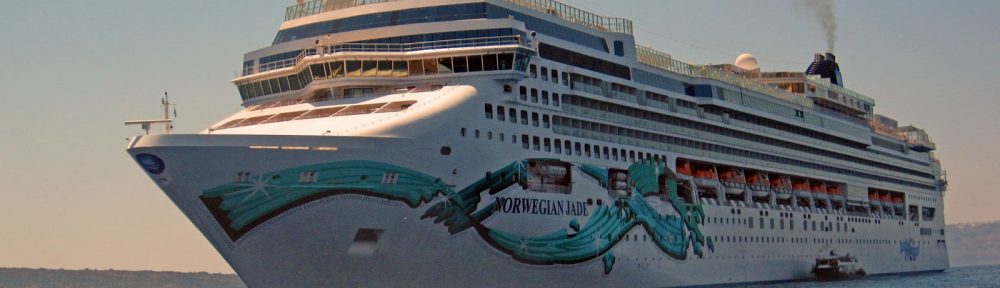
Leasing a cruise ship is one of the options reportedly being considered to use as emergency accommodation for thousands of migrants stranded in the Greek island of Lesbos after a fire gutted their camp.

Hiring a local stadium is also in contention after the island’s overcrowded refugee detention centre went up in flames on Monday night after clashes between rival factions.

Riot police have been sent to the island to bolster security in Moria, a hilltop village near the camp.

About 3,000 migrants who fled have since been caught and escorted back to the camp, but at least 2,000 others remain unaccounted for, with officers searching fields and olive groves to track them down.

The island’s mayor, Spyros Galinos, demanded that the Greek government move the asylum seekers off the island and find a more permanent answer, The Times reported. There were more than 5,700 migrants in a camp built to house 2,500.

“We don’t want temporary solutions,” he said. “We need a boat to start shipping these people out of here, to other places in Greece. We don’t need additional flash points, especially as the situation remains explosive here.”

Witnesses said dozens of tents and prefabricated units were destroyed by fire after reports circulated that the authorities were planning to deport hundreds of migrants to Turkey. At least 200 children have been transferred to a shelter in Mytilene, the capital of Lesbos.

More than 500,000 migrants crossed from the Turkish coast to Lesbos last year. A deal between the EU and Turkey initially helped to stem the tide, but the number has increased again in recent months, leaving 60,000 people trapped in Greece.

Under the EU deal, all new migrants should be sent back to Turkey, but only after any claims for asylum have been heard in Greece. The plan allows for those accepted as refugees to go to the top of the queue for relocation into the EU — once they have returned to Turkey.

An estimated 13,000 asylum requests have been filed since March, creating a backlog that understaffed officials in Greece have been unable to handle.

Each asylum request takes up to four months to process, creating friction among those stranded in detention centers such as Moria, while opposition to the arrivals appears to be growing, the newspaper reported.

“The situation is out of control,” Galinos said. “We’re like a powder keg about to explode.”