Virgin Voyages doesn’t hold back on design partners

Virgin Voyages CEO Tom McAlpin announced several key design partners for Virgin Group’s first cruise venture, including the team behind hipster hotel chain Ace Hotels.

At a steel-cutting ceremony in Genoa, Italy, for the first of three 110,000-gross-ton ships that Virgin Voyages has on order from Fincantieri, McAlpin on Wednesday listed off the numerous designers and architects who are helping Virgin’s vision of cruising come to life.

“Thanks to them, our ships will be a complete departure from the ordinary,” said McAlpin against the backdrop of a “Make ship happen” banner. “That style that we see in some of the coolest places on land, soon we will see on the seven seas.”

The creative team includes Roman and Williams, the design team behind numerous Ace hotels and the Standard High Line hotel in New York; Concrete, an edgy Amsterdam design company; cruise ship design firm GEM, which has designed vessels for Silversea, Cunard and Princess Cruises; HOSTUDIO, a London-based brand development agency; New York-based architecture firm WORKac; creative agency Chandelier; and global design company HKS.

The first Virgin Voyages ship is slated to enter service in 2020, with two additional ships to follow in 2021 and 2022.

Wednesday’s steel-cutting ceremony is expected to be followed by a keel-laying event toward the end of 2017.

The 2,700-passenger vessels will carry 1,150 crew members.

Where will all the passengers come from?

Image result for norwegian bliss

Norwegian Escape above, Norwegian Bliss to set sail in April 2018.

Where are all the passengers going to come from?

I have to think this question troubles cruise executives now and then more than they let on.

One of the best answers I have heard in awhile comes from Riccardo Casalino, chief marketing officer at MSC Cruises’ headquarters in Geneva.

Over lunch in at semi-permanent catering tent at the Fincantieri shipyard in Manfalcone, where MSC is building several vessels, Casalino shared some of MSC’s perspective on various cruise issues, including supply and demand.

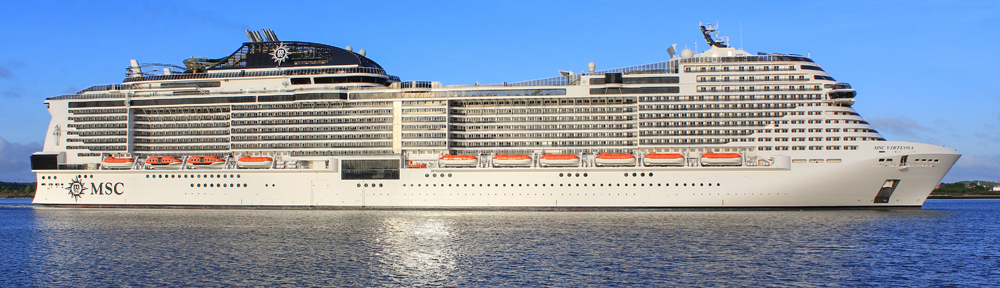
The question is as critical for MSC as any cruise line out there. It has 11 large ships on order through 2026, having already grown its capacity by 800% since 2003.

Image result for msc meraviglia

Of course, MSC is looking to North America for growth, by devoting its MSC Seaside to year-round Caribbean cruises from Miami. MSC executive chairman Pierfrancesco Vago perhaps spilled the beans a bit early by announcing at a shipyard event that MSC would have three ships in Miami during the 2019-2020 winter season.

And there’s further growth afoot in MSC’s European back yard, Casalino said.

But another opportunity is the emerging middle class in countries all over the world that are making the transition from third world to first world.

China, clearly, is everyone’s favorite example. But Casalino cited another country with an intriguing new population of potential cruisers: South Africa.

There, tens of thousands of black residents that were oppressed and kept out of the middle class during the country’s apartheid years are discovering leisure travel for the first time.

“They’re in a country where for most of them, it’s a new thing for society at large to take a packaged vacation,” Casalino said.

The level of education on how to do that is understandably low. In South Africa, MSC gets questions that it would hardly ever field in the U.S. or Europe.

“They call us up and want to know if they should bring bed linens,” Casalino said. “Or whether they should bring food along for us to cook. They want to know how it works.”

The vast potential for growth among the new to cruise has become somewhat of a cliche at conferences where panel discussions debate cruise topics.But MSC is showing that behind the cliche there are real people and real potential customers waiting with new hopes and new dollars to find out how it works.

Is a shipbuilding duopoly good for the cruise industry?

In the modern facilities, the most technologically sophisticated cruise ships are being built.
 
Before the end of 2017, it looks like there will be a worldwide duopoly in the business of building cruise ships. Can this be good for cruise lines, their customers or travel agents?
It would come about if Italy’s Fincantieri buys the French shipyard in Saint-Nazaire where Royal Caribbean International’s Harmony of the Seas, and a string of other ships, have been built. (Fincantieri won’t buy all of the Saint-Nazaire yard. The French government will hold onto a one-third stake.)
The yard is currently operating under the name STX France, but the STX parent company, based in Korea, has been trying to sell it to consolidate its way out of financial trouble.
A South Korean court recently approved Fincantieri as the approved bidder.
STX already sold its yard in Turku, Finland, to Germany’s Meyer Werft, the other big name in cruise ship building. Together, Fincantieri and Meyer Werft would dominate cruise shipbuilding the way Boeing and Airbus control the world’s output of commercial jetliners. (Fincantieri has built almost all of the recent Carnival Corp. brand vessels while Meyer Werft has delivered most of Norwegian Cruise Line’s latest ships, among others).
The business of building jets and cruise ships is similar. Both are capital intensive businesses, with a need for specialized labor and a network of subcontractors. Both are subject to wicked swings in the business cycle that can leave them with either more work than they can handle or none at all.
Big cruise lines spend billions of dollars annually on new ships. Yet it is telling that there were no bidders other than Fincantieri for the French yard. It is a very specialized and risky business.
Does it matter to the cruise lines that there are only two suppliers left to do business with?  It doesn’t seem to matter much to the airlines, who haven’t been cornered by the Airbus-Boeing duopoly. One difference may be that there are dozens of customers for the plane makers, but less than a dozen for cruise yards.
Image result for fincantieri
Fincantieri’s yard in Trieste. Credit: Fincantieri
One well-informed source in the industry rated Fincantieri’s takeover of STX France as “neutral to slightly negative” for cruise operators. The reduction in negotiating partners is a negative, while the stability of having the yard in the hands of a familiar, known entity somewhat offsets that.
There are some other players in the shipbuilding game. Genting Hong Kong bought several German yards, which will build the future ocean and river ships for Crystal Cruises, the line Genting acquired in 2015, and the Chinese government, which has partnered with Fincantieri to begin building ships in China.
Neither poses much of a current threat to the duopoly. So for the foreseeable future, if you want to build a big cruise ship, the choices are Meyer Werft or Fincantieri.
Let’s hope it doesn’t mean anything negative for the cruise lines or their travel partners.