Fincantieri: Building the Future

“We are redesigning the future of navigation on a strategic and technological level,” Luigi Matarazzo, general manager of the Merchants Ships Division at Fincantieri, told Cruise Industry News.

“The ships we are building will increasingly resemble large, hyper-connected, energy self-sufficient, lighter and greener, propelled floating cities, capable of recycling up to 90 per cent of the waste produced onboard.

“With the technologies already available today, we can thermally recover up to 20 per cent of the energy contained in the fuel,” he continued.

“And the efficiency measures recently introduced in non-propulsion systems onboard have led to further reductions. For example, a ship of about 130,000 tons is able to reduce its fuel consumption up to 1,200 tons per year, which corresponds to about 7 per cent of the ship’s annual fuel consumption.

“We have validated and applied a series of initiatives on the ships we are building. Examples of energy-saving solutions include fan coil installations in cabins and public areas, variable-speed electric motors, recalibration of fresh-water production systems, LED and other high-efficiency lighting and automatic lighting controls, and much more. Each of these solutions can reduce fuel consumption from 48 to 290 tons per year. This is the path we are on.”

Playing a fundamental role in the green transition will be hydrogen and hydrogen carriers, such as ammonia, liquid hydrogen carriers and synthetic hydrocarbons derived from hydrogen, according to Matarazzo. But this will require the creation of a supply chain based on renewable energy sources, which is able to meet the increased demand without negative side effects on global warming, he added.

“On the technological level, the main obstacles are generated by constraints in terms of space and weight. Fuel cells, batteries, fuel tanks, energy recovery and auxiliary systems have a significant impact on the onboard space and weight of a ship.

“However, I want to stress that the challenges do not lie solely with the cost-efficient application of new technologies. In fact, there are important non-technological barriers.

“In terms of resources, there is still no clear and well-defined scenario regarding the future availability of hydrogen and its derivatives, which will also certainly drive pricing (of fuels).

“Production capacity and a network of supply hubs will be key enabling factors to accelerate the decarbonization of the shipping sector.”

Since 2021, Fincantieri has been committed to implementing measures to improve its yards’ impact on the environment. The latest initiative is solar farms being built at five of the yards to generate more green electricity while also reducing the energy bill, said Matarazzo.  Installations will feature 22,000 solar panels covering an area of more than 50,000 square meters, able to produce about 10 MW.

Fincantieri is also part of a public-private partnership launched by the European Commission and the Waterborne Technology Platform to decarbonize waterborne transport, as well as several joint ventures with private companies and research organizations exploring new fuels.

Meanwhile, the next 18 months will be busy for Fincantieri.

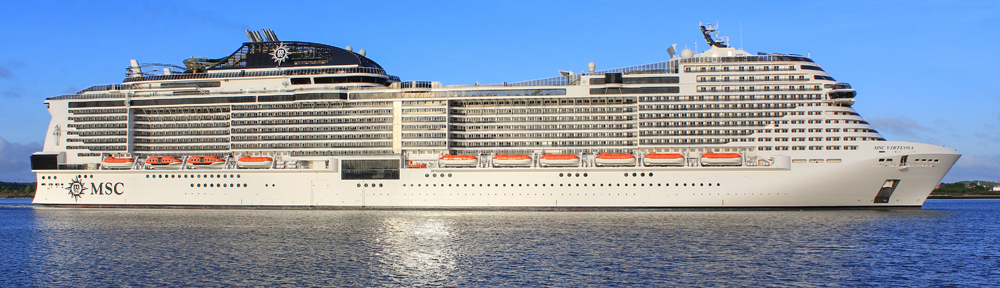
“In Monfalcone, by the end of this year we will deliver the MSC Seascape, the second EVO class ship and the fourth vessel in MSC Cruises’ Seaside class, and then, in 2023, Explora I, the first of six luxury ships ordered by MSC’s Explora Journeys brand,” Matarazzo said.

“Also next year, Marghera will deliver the second ship in Norwegian Cruise Line’s Prima class, the Norwegian Viva, followed by Cunard Line’s Queen Anne. The Sestri yard will deliver the Vista, the first of two new-generation ships that will start the Allura class for Oceania Cruises; a fourth ship for Virgin Voyages; a ninth and tenth ship for Viking Cruises; and the newest ship for Regent Seven Seas Cruises.”

Excerpt from Cruise Industry News Quarterly Magazine: Fall 2022 

Fincantieri is to build four more ships for Viking

Viking Venus cruising down the River Mersey into Liverpool Photo credit Spacejunkie2 (Flickr)

Fincantieri is to build four more ships for Viking after the companies put into effect contracts for the third and fourth ships and signed new contracts for a fifth and sixth, all of which were additional options in an initial agreement signed in March 2018.

The design of the batch of six ocean vessels was developed by Fincantieri in partnership with Viking, upgrading the design of the cruise line’s previous 10 vessels with new safety and navigation systems. The ships are also designed to be able to make use of hydrogen fuel cells once they are available.

The total value of the agreements is around €1.7 billion ($1.72 billion). Deliveries are scheduled in 2026 and 2027, followed by a further two ships in 2028.

Princess Cruises unveils next-generation ship

Princess Cruises has revealed the brand’s largest ship, a bespoke ship platform that will run on dual-fuel LNG and accommodate more than 4,000 guests


Currently under construction at the Fincantieri shipyard and scheduled to debut in early 2024, the 175,500-tonne vessel is the largest Princess ship ever constructed and embraces Italian heritage by featuring a next-level Piazza and The Dome, an entertainment space inspired by the terraces of Santorini. Sun Princess will also feature Princess Medallion, extending Princess’s position in delivering personalised experiences.

Sun Princess is a new and bespoke ship platform, designed to simultaneously embrace Princess heritage while boldly pressing into the future with iconic, elegant and pure lines unique to our brand,” said Princess Cruises president John Padgett. “A show-stopping, first-of-its-kind Dome on the top deck and suspended glass Piazza in the centre of Sun Princess offer innovative designs showcasing expansive ocean views for incredible opportunities to connect with the sea.”

The cruise line also announced Sun Princess will sail an inaugural spring/summer season of Mediterranean cruises followed by western and eastern Caribbean voyages out of Port Everglades, Florida in Q3 2024.

The line’s Piazza spans three stories, forming an architectural feature offering guests an outward-looking suspended space with comfortable seating and areas to enjoy the ocean views in every direction. An LED screen is also showcased in the centre of the Piazza that can be moved and configured to deliver live entertainment. Adjacent to the Piazza Atrium will be Coffee Currents coffee shop, Bellini’s Cocktail Bar, along with Princess favourites like Crooners’ Bar and Alfredo’s Pizzeria.

The other stand-out structure onboard Sun Princess is The Dome. Princess Cruises said, “Inspired by the terraces of Santorini, it is a multi-level covered deck and the first true glass-enclosed dome ever constructed on a cruise ship. During the day, the Dome features an indoor/outdoor pool and unique water features in a comfortable and relaxed space. At night, the pool becomes a stage, and the Dome transforms into an entertainment venue with a South Beach vibe, state-of-the-art lighting effects and the ability to deliver stunning aerial performances.”

With 2,157 staterooms, including 50 suites and 100 connecting rooms, 21-deck Sun Princess features more outdoor balcony space and all-balcony accommodations feature an in-room sofa.

Also launching exclusively on Sun Princess will be a new level of suite accommodations, the Signature Collection. In addition to premium stateroom amenities, Signature Collection suites include access to the Signature Restaurant, Signature Lounge and Signature Sun Deck, a private area of the Sanctuary.

With Sun Princess, Club Class accommodations on board this ship, and all Princess ships will now be called Reserve Collection, which is the best-located mini-suite staterooms. Within the Reserve, Collection will be Reserve Collection Cabana rooms, resort-style staterooms that offer a balcony and private cabana, and extra-large outdoor lounge space. These premium accommodations also include access to the Reserve Collection Restaurant.

Sun Princess is part of Carnival Corp’s green cruising focus and is one of 11 new ships in the corporate fleet powered by LNG fuel technology.

A second, next-generation Sphere-class ship is also on order, slated to be delivered by Fincantieri in Q2 2025.