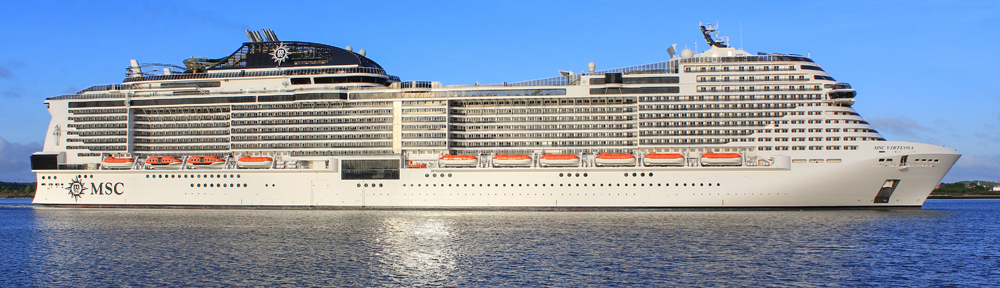
It seems like U.S. agents are having to wait longer to see brand-new ships, or to send their clients on them, unless they want to fly to Europe.
Nearly all the ships coming out of European shipyards this year will be dedicated in Europe and spend the summer and fall sailing there.
The exception is the Seabourn Encore, which will be even farther away, in Singapore, when it is christened next January.
Once the primary window for ships to be delivered was in the fall, when they could be pressed into service in the Caribbean. That was the case in November when the Norwegian Escape was christened by Pitbull and began a series of cruises from Miami.
But while the Carnival Vista, the Koningsdam and the Harmony of the Seas will all arrive in South Florida in November, and will have occasions for travel agents to tour them or sail on them, they will be six months into their service by the time that happens.
I don’t know when the shift began. Clearly the larger cruise lines have enough ships in their fleets that leaving newbuilds in Europe for the summer doesn’t disrupt their plans for North America.
That may be different from the past, when every ship counted in the strategy to beat the competition.
And it may be good luck that Carnival Cruise Line, Royal Caribbean International and Holland America Line have some of their most attractive ships in Europe at a time when that region needs a boost.
Ironically, the next big ship introduction scheduled for North America comes in November 2017 when a European-based cruise line, MSC Cruises, debuts its MSC Seaside in Miami.
In this April Fool’s Day-inspired rendering, a new Royal Caribbean ship is Boaty McBoatface of the Seas.
Royal Caribbean international is seeking name input on future ships from the British man who coined “Boaty McBoatface” for a U.K. research vessel. The cruise line says it’s not an April Fool’s Day stunt.
James Hand submitted the childish sounding moniker in an online contest to name a $288 million Antarctic survey vessel. Hand’s suggestion leads in online voting, which closes April 16.
Now he’s been invited to sail on Harmony of the Seas and possibly spice up Royal Caribbean’s somewhat predictable “of the Seas” ship name series.
“The people of the United Kingdom know the name of a great ship when they see it,” said Royal Caribbean President Michael Bayley. “Like the rest of the world, we fell in love with the name Boaty McBoatface when we heard it, and we knew immediately that Royal Caribbean could use James Hand’s talent to name our next ship.”
Hand told USA Today that the offer came as a “massive surprise” as has all the attention he’s received since he submitted the name.
Passengers wishing to cancel cruises will face an earlier penalty period for their deposits with Royal Caribbean International. Starting March 7, the final payment deadline for bookings goes from 60 to 75 days on short cruises (four days or less) and from 75 to 90 days on longer ones. Cancellation terms even closer to departure also changed in many cases. Vicki Freed, the senior vice president of sales, trade support and service, spoke with cruise editor Tom Stieghorst about why the line made the changes.
Q: Why did Royal Caribbean change its policy to make it harder for passengers to cancel?
A: Actually, we simplified the policy. If you look at the old policy, we used to have five different [product categories, now reduced to two]. So it was really hard for travel agents to remember, ‘OK, does this fall in this bucket, or in this one or this one? Was it a holiday sailing, what do you view as a holiday sailing?’ There was a lot of confusion, so we wanted to just simplify it.
Q: Did you get travel agent feedback before you made the change?
A: We ran it by our travel agent advisory board back in January, and they said, yes you should do it. We said, is this going to affect bookings, what do you think? And they said, “No, we like a much stricter cancellation policy because it allows us to encourage people to buy travel insurance, and it makes the bookings stickier; people are more committed.” They were saying, “This is a no-brainer. You should do it.”
Q: Why do it now?
A: We did not want to do anything during Wave [season]. That was our decision as a brand. We wanted to do it with new deployment, which we’re … just releasing now. [Royal releases schedules for the Caribbean, Bahamas and Northeast regions for 2017-18 on March 7]. So that’s why we’re doing it now.
Q: Simplifying the policy sounds logical, but couldn’t you have simplified it and kept the same final payment period you had previously?
A: Yeah, I suppose we could have. If you really look at the differences, when you compare it, the 75% of the total price [penalty] for the shorter cruises remains the same, from 28 to 15 days, 50% [penalty] went from 29 days to 56, versus 29 to 42, so that’s a little bit more of a window. The [loss of] deposit [penalty] went from 59 days to 74, so there were some small tweaks. They weren’t anything significant.
Q: What was the biggest change?
A: On five nights or longer, the first penalty starts at 89 days versus 74.
Q: How does the price integrity policy factor into this?
A: With our new no-discounting within 30 days of departure, we’re training the consumer to book further out, and so we don’t want a bunch of space dumped back to us close in when we don’t really have an opportunity to resell it. If someone’s going to cancel now, with 90 days out, it gives us two more weeks to resell that space. Because remember, all bets are off the table at 30 days out. That’s the motivation and the reason why we did this. And our travel agent advisory board suggested we do it. And to help travel agents sell more insurance.
Q: How many people cancel before the penalty period to get their money back?
A: I don’t think it’s many. I think it’s a small percentage. But that’s why we encourage travel agents to urge consumers to buy travel insurance.