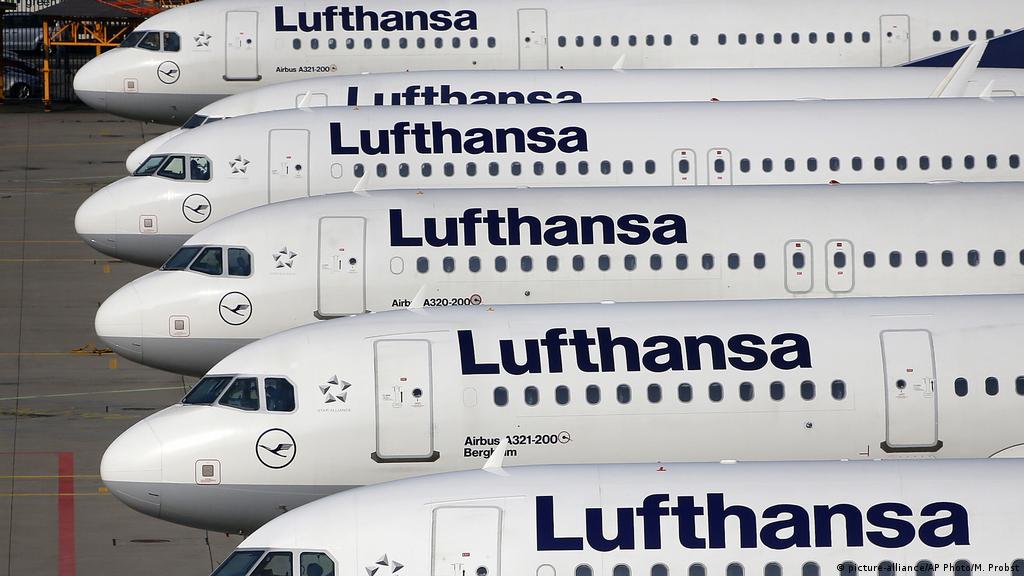
Lufthansa expects air passenger demand to return so slowly that it plans to have 300 of the group’s aircraft still parked in 2021 and 200 in 2022.
Europe’s largest airline group, Lufthansa currently has 700 of its 763 aircraft grounded.
More: Cash refund demands ‘endangering entire travel industry’ – Lufthansa boss
‘Demand won’t return quickly’, warns Lufthansa chief
It reported: “Even after the end of the crisis, expected in 2023, the group expects its fleet to remain 100 aircraft smaller.”
Lufthansa secured €9 billion in German state aid this week after agreeing to EC demands to surrender slots at Frankfurt and Munich, but it plans to downsize sharply.
The group revealed customer demands for refunds are adding to the pressure to slash jobs, with hundreds of millions of euros per month been paid out on top of operating costs.
Thorsten Dirks, Lufthansa finance and digital chief officer reported: “Our [operating] cash burns runs at around €800 million a month. We expect cash consumption to run at a similar level for months. New bookings will remain far below normal.”
But in addition, he warned: “Cancellations mean customers can claim up to €2.5 billion in refunds.”
In the circumstances, Dirks said: “The stabilisation package we have secured in Germany marks a milestone.
“In order to repay the loans quickly, we will have to significantly increase our cash flow though global demand for flights will remain below pre-crisis levels for years.”
Group chief executive Carsten Spohr warned: “We have to make cash flow our focus and this has to be tough. We will carry an annual additional burden of €1 billion in interest and repayments. We will have to go through significant restructuring.”
Spohr insisted: “We want to avoid lay-offs as much as we can. But the business will become much smaller, [and] we have to share by everybody working less and making less money. The more we can do this, the fewer jobs will have to go.”
He insisted Lufthansa would “not give any concessions” to one group over another.
Restructuring is already underway at group carriers Brussels Airlines, which plans to cut its workforce by 25%, and Austrian Airlines which will reduce wage costs by 20%.
Spohr added: “The impact of the crisis on aviation will stay for some time, but at least the complete grounding of our fleet is behind us. Countries have begun to relax travel restrictions and travel bans. Demand continues to be far below normal standards.
“Our aim is to serve many destinations, using smaller aircraft and fewer frequencies.”
Lufthansa increased its schedule for June and July this week and plans to operate up to 40% of its original schedule by September, with services to 90% of its previous short-haul destinations and 70% of long haul.
The German state-aid package will see the German government take a 20% equity stake in Lufthansa and two places on the supervisory board.
Spohr said: “Before the coronavirus, a 20% government stake was nowhere in our plans. But we still have a smaller government stake than any of our three [main] competitors – Air France-KLM, IAG and Turkish Airlines.”
The governments of France and the Netherlands hold more than 28% of Air France-KLM, Qatar Airways – which is wholly state-owned – holds a 25% stake in British Airways and Iberia parent IAG, and the Turkish government owns 49% of Turkish Airlines.
Lufthansa Group reported an adjusted operating loss of €1.2 billion for the first quarter to the end of March and a net loss of €2.1 billion.

 Wetravel2u's Weblog