The race to build the world’s biggest cruise ship is over

Image result for symphony of the seas

Royal Caribbean’s Symphony of the Seas
Can we call it now?
The race to build the biggest cruise ship ever is over, I think.
And the winner is Royal Caribbean International.
Will anyone ever build a cruise ship bigger than Royal’s Oasis-class ships, the fourth of which was delivered last week? It might happen, but the evidence suggests that it won’t. The reason why I think not is that many cruise companies, including Royal itself, have had a chance to design something bigger since the Oasis of the Seas first took to the oceans in 2009.
No one has.
Of the 36 cruise ships over 120,000 gross tons delivered since 2009, none are bigger than the 228,081-ton Symphony of the Seas, which is on its way from the shipyard in France to Barcelona, Spain, where it will begin seven-day cruises on April 7.
Of the 43 cruise ships over 120,000 gross tons on order or about to be delivered, none are bigger than the Symphony.
Those orders include ships for nearly every major cruise operator besides Royal Caribbean Cruises Ltd., including Carnival Corp., Norwegian Cruise Line Holdings, Walt Disney Co., MSC Cruises and Genting Hong Kong.
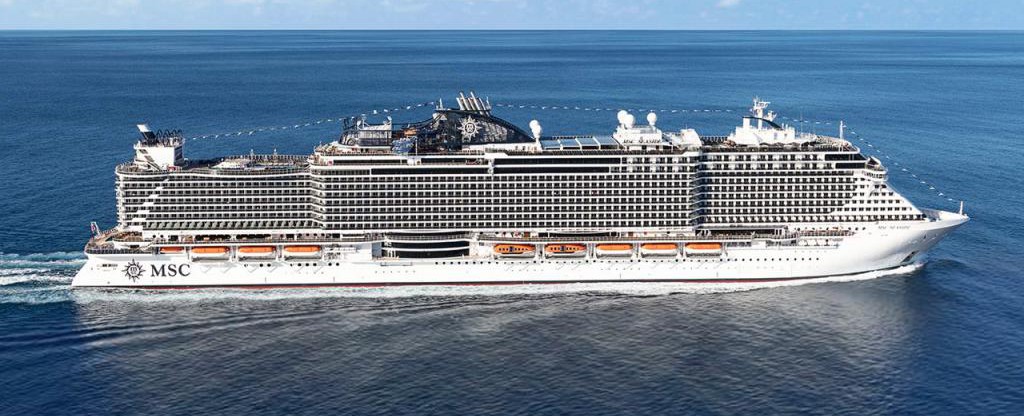
Image result for msc seaside
MSC Seaside.
Each had an opportunity to design the new biggest cruise ship in the world. The closest will be Dream Cruises, which is building a pair of 204,000 gross ton Global class ships for delivery in 2020 and 2021.
Royal Caribbean also has had two chances to top itself but has designed the smaller Quantum class at 168,666 gross tons and the upcoming Icon class at 200,000 gross tons. Royal is still cranking out Oasis-class ships the next is due in 2021. So perhaps when it is finished with that class, it will design something bigger.
For decades, the biggest cruise ship in the world was the 70,327 gross ton Queen Elizabeth 2, which reigned for 21 years from 1967 to 1988 when the 73,192 gross ton Sovereign of the Seas de-throned it.
Image result for rms queen elizabeth 2
RMS Queen Elizabeth 2nd
Thereafter, in the 20 years from 1988 to 2009, a series of newbuilds followed that each topped the last in size. Now there has been a nine-year lull. To match the QE2’s longevity as No. 1, the Symphony of the Seas would have to be the biggest until 2039.
Maybe that won’t happen. There’s always economies of scale to be reaped by building bigger, although the evidence seems to suggest that beyond 5,500 passengers, operators reach a point of diminishing returns.
But for now, long live the Symphony of the Seas.

MSC Meraviglia: ‘8 Golden Pearls’ from Bureau Veritas

Sergio Castellano, Environmental Director, MSC Cruises  --  Philippe Donche-Gay, President Marine & Offshore, Bureau Veritas  --  Mattia Manzi, Master of MSC Meraviglia

Bureau Veritas has recognized MSC Cruises with the “8 Golden Pearls” award for sustainability and environmental stewardship onboard the MSC Meraviglia, the company announced. MSC becomes the first cruise line to take home the honours.

Philippe Donche-Gay, President Marine & Offshore, Bureau Veritas commented: “MSC Cruises has demonstrated its commitment to reducing the environmental impact of their operations and we commend the company for its wide-ranging, ongoing efforts in this space. The various sustainable and environmental technologies installed on the MSC Meraviglia put the ship at the forefront of cleaner cruise operations. The Bureau Veritas 8 Golden Pearls award reflects MSC Cruises’ commitment to excellence and continual improvement in environmental performance.”

Bud Darr, Executive Vice President Maritime Policy and Government Affairs, MSC Group said: “We are honoured to receive this award, and we thank Bureau Veritas for their recognition and ongoing support. They are an invaluable partner on this journey and we look forward to continuing making further progress in the area of environmental stewardship.”

Image result for msc meraviglia

Among the highlights onboard are an exhaust gas cleaning system and advanced wastewater treatment.

In addition to the wastewater treatment, the ship has a holding capacity and Non-Discharge Operation for two days allowing for more autonomy and more flexible navigation, the company said.

In addition, the ship meets the high ISO 22000 standard for food safety. This certification covers food safety management systems across the entire food supply and preparation chain from “farm to fork.”

Global Ambitions

Pierfrancesco Vago, executive chairman of MSC Cruises
Pierfrancesco Vago, executive chairman of MSC Cruises.

“In three years we will double our capacity and in 10 years we will triple it,” said Pierfrancesco Vago, executive chairman of MSC Cruises.

In 2018 MSC will operate a fleet of 14 ships with an average size of 2,892 guests at double occupancy and is expected to be the largest operator by capacity in Europe. It has ambitious expansion plans in North America and China and is the market leader in South America and South Africa. By 2028 the company will have 24 ships in service, with an average size of 3,734 passengers.

“Our objective is to deliver a holiday experience which is unique to our customers and to tourism in general,” Vago told Cruise Industry News. “It’s also to expand the concept of cruising to the world,” Vago added.

Between now and 2026, MSC will take deliveries of ships on the Seaside, Meraviglia, Meraviglia Plus, Seaside EVO and the LNG-powered World Class platforms.

Vago described MSC as a global brand, with a premium level product offering at a contemporary price.

“Our common denominator is that we are a Mediterranean brand with the capability to fine-tune the experience to the area of operation,” Vago said. “We can fine-tune the product delivery.”

While its peers have a house of brands competing in the cruise market, MSC has a single brand with large ships.

“MSC has traditionally believed in organic growth,” Vago said.

But that doesn’t mean they may not one day explore other market segments as customers grow with the brand.

The MSC Seaside

In Europe, Vago said the company has realized their ambition to conquer the market, also entering the business later than all their competitors.

That strategy is now expanding to the rest of the world, he said, and the plans will follow demand.

In China, the MSC Splendida is replacing the Lirica on a seasonal basis, upping summer capacity out of Shanghai. In South America, the new Seaview will sail from Brazil for winter 2018-2019.

In North America, the new Seaside is year-round, to be joined by the 2017-built Meraviglia come 2019.

“We have customers travelling to the Caribbean and we needed to introduce new ships, with a different platform,” Vago said. “We had the need to put more cabins and a new offering into the North American market if we wanted to evolve our brand there.

“We had one ship (in North America) and she was filled with customers from Europe. We did not have the opportunity to grow,” he continued. “There is an opportunity for MSC to grow in North America but we needed to create both the hardware and the software for the market. That is the vision behind the building of a very new platform and prototype, the MSC Seaside.

“The Seaside is a spirit of our leadership in many ways. We are setting the pace for innovation and we will see many reflections of this platform for years to come.”

The Seaview, a sister ship, will be delivered this summer. The Seaside EVO platform, essentially an enlarged version with more staterooms, will be launched in 2021, with a second ship scheduled for a 2023 delivery from Fincantieri.