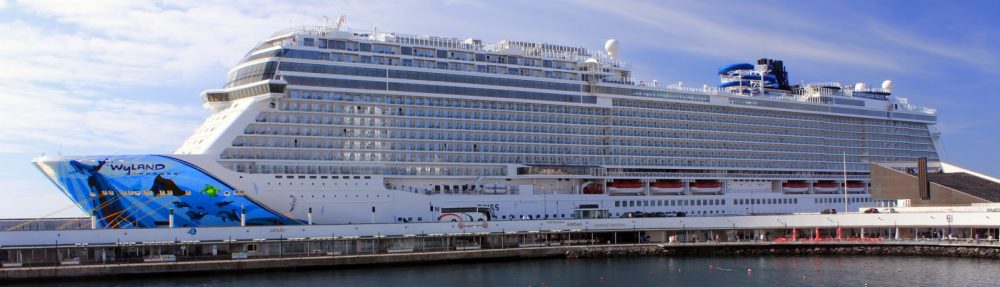
Norwegian Escape cruisers are learning the ropes

Norwegian Escape ropes adventure course.

Norwegian Cruise Line has developed its own signature top deck attraction, one that will emerge in a spectacular way in the coming weeks on the Norwegian Escape.

Just as Carnival Cruise Line has made the water slide its own, and Royal Caribbean International adopted the rock climbing wall as its emblem for top deck adventure, Norwegian has become the cruise line with the ropes course that leaves all others behind.

Norwegian started its love affair with the ropes course on the Norwegian Epic, and has continued it with the Norwegian Breakaway and Getaway. The 4,200-passenger Norwegian Escape, due in Miami next month, will take everything one shaky, scary, thrill-inducing step further.

The ropes course on the Escape is a dizzying construction of beams, platforms, tracks, ladders and lines. It will have three levels, up from two on the Getaway and Breakaway, and 99 individual elements, nearly double its predecessors.

An element unique to Norwegian is the Plank, a 6-inch steel beam extending eight feet out over the side of the ship, daring harnessed plank-walkers to venture out to the end.

There will be two planks on the Escape, one on either side of the ropes course, up from a single one on earlier ships.

Another over the edge element will be a bowed zip-track, one of five “Sky Rails” that are included in the course.

The challenge of the ropes course is tailor-made for teens but also a good family activity. It provides an exhilarating view from the very top of the 20-deck ship.

The only drawback to the ropes course is its vulnerability to bad weather, including high winds on a sunny day.

Other cruise lines have ropes courses, too, including four of Carnival Cruise Lines’ most recent vessels. The MSC Seaside from MSC Cruises is expected to have a unique take on ropes when it is delivered in 2017.

But for now, when the Norwegian Escape arrives in Miami in late October, spectators won’t be able to mistake her profile for any other ship, partly because of the most elaborate ropes course at sea.

The “Escape” runs tomorrow from the North Sea

If the parking lot of the Meyer shipyard in Papenburg an RV park is like and many people flock to the levees of the river Ems, this has always been the same reason: The conversion of a cruise ship is waiting. Tomorrow is expected to be back so far.Around midday – so the current state of planning – to leave, according to the Meyer Werft shipyard in the harbor basin of the North Sea, the “Norwegian Escape”.”However, the weather conditions have to be right,” limited company spokesman Peter Hackmann on a demand of NDR.de. Due to the better maneuverability of the cruise giant takes over the Ems passage backwards in attack. Accompanied by several tugs as the bottlenecks at the Friesenbrücke in Weener and Jann Berghaus Bridge are happening in Leer. NDR.de transmits the spectacle live here in the video stream.

Ocean liner is ready for the bottleneck Ems

The undocking on 15 August the “Escape” is the outfitting pier of the yard.According to information from Hackmann last work on the interior fittings are made ​​currently. “It all goes to plan, we’re pretty far,” Hackmann had stressed in an interview with NDR.de recently. The 326 meter long and 41 meter wide luxury liner was composed of a total of 70 blocks. He is the first ship of the Breakaway Plus class for Norwegian Cruise Line. The “Escape” has 18 decks and thus one more than the previous “Norwegian Breakaway” and “Norwegian Getaway”, which had been delivered in April 2013 and in January 2014th Overall, the “Escape” can accommodate more than 4,200 passengers and 1,700 crew members.

Thousands of kilometers of cables and pipelines

For interior of the luxury liner include a theater with 815 seats, 15 restaurants, eight bars, a cinema and various spas.The maritime painting with tropical fish, stingrays and sea turtles at the bow of the vessel was applied to a design by artist and conservationist Seafood Guy Harvey with a laser. The 59-year-old Jamaican had taken a picture of the work in Papenburg in July itself. The total weight of the ink used is around 300 tons, as well as 2200 km cable and 400 kilometers of pipelines were laid. In mid-October, the ship should be passed to the shipping company

.

Why Falkland Islands’ cruise ship tourism is booming, with 60,000 visitors expected to arrive this year.


By MICHAEL GADD FOR MAILONLINE

  • The return of Norwegian Cruise Lines’ visits provides a massive boost
  • Falkland Islands expecting 60,000 arrivals by cruise ship this season
  • Last year’s arrival figures rose to 43,437 after a low of 29,000 in 2012-13
  • Nature tourism is the main draw with many marine bird species and seals 

Falkland Islands tourism has made a remarkable comeback in the past few years with the number of cruise ship visitors rising from less than 30,000 in 2012-13 to potentially double that this year.

The boost comes thanks in no small way to the return of the Norwegian Cruise Line’s services to South America this season from October to March, including stops at Falklands’ capital Stanley.

Their Sun vessel, which has a maximum passenger capacity of 1,900 and spends the Northern Hemisphere summer around Alaska, is planning nine stops at Stanley as part of its cruise around Cape Horn this season.

Stanley-based vessel agent Sulivan Shipping estimates 60,000 arrivals by cruise ship this year, following last year’s official figure of 43,437 passengers, despite six trips cancelled by poor weather.

Should Mother Nature be kind and the estimate ring true, the Falklands could be nudging their heights of 2007-08 and 2008-09 when they welcomed more than 62,000 visitors before the global economic crisis hit and numbers slumped to 29,000 three years ago.

‘Of course we are very much at the mercy of the weather here in the Falkland Islands,’ Samantha Marsh, Tourism Coordinator for Sulivan Shipping, tells MailOnline.


The Norwegian Sun cruise ship, which holds 1,900 passengers, is planning nine stops at Stanley this year

‘Large ships need to tender their passengers into Stanley harbour so high winds which are a characteristic of summer in the Southern Hemisphere can cause issues.

‘On average we will have six cancellations a season due to unfavourable weather. So the anticipated estimate seems very high in comparison to last year’s actual landed figures, but when we take into account some cancellations due to bad weather, we are probably looking at a conservative estimate of 50,000 landed.’ Even so, it remains a substantial period of growth for the archipelago with a resident population of less than 3,000

And with a Falklands’ Tourism Board office opening in London this year, further building a bond with the UK after an overwhelming 98 per cent majority voted to remain under the Union Jack amid continued tensions with Argentina, that figure appears only set to rise. They are also pushing to attract more visitors from the US and other untapped markets.

Marsh adds that the growing capacity of expedition and research ships has also boosted numbers.

‘When I first started working here, many years ago, the average expedition vessel had an average 50-80 passenger capacity. These ships are now around 150 in average capacity,’ she says.

‘The increase in numbers can only be a positive for the local economy, but as a small Island, we do quite often find it difficult to meet the demand in the way of excursions.

‘With practically zero unemployment, many people will take the day off to drive a coach, or to take guests to visit the penguins in order to cater for a large ship visit.’

The first passenger boat this season will be the Russian research and tourist vessel Akademik Sergey Vavilov on October 17, one of eight smaller ships in the first month also including the Sea Adventurer and the Akademik Ioffe.

In November come the big cruise ships, starting with the 1400-berth Zaandam and followed by the return of Norwegian Cruise Lines’ to Stanley when the Norwegian Sun makes its first visit on December 10.

It returns for a bumper day on December 28 when it will arrive with Star Princess and MS Marina whose potential 5,600 passengers almost double the Falklands’ entire population.

So what do visitors see when they arrive? By far the greatest attractions of the Falklands is its abundance of unspoiled wildlife, the marine bird species in particular.

Tourists walk by the Falkland Islands' visitor information centre found near the jetty on arrival

After arriving in Stanley, a town with a mostly English feel and British food the predominate offering, visitors usually seek out the five species of penguin, four species of seal and many other creatures who call the islands home.

Albatross, petrels, the Falkland Flightless Steamer duck geese, and birds of prey including hawks, falcons and the Striated Caracara (Johnny Rook), which is found only on the Falklands and on small islands off Cape Horn at the bottom of South America. Porpoises and dolphins can also be seen in playing in the waves.

Another draw for the more than 3,000 UK visitors expected this year are the memorials marking the 1982 Falklands War with Argentina as interest in military history is boosted by the 100th anniversary of the First World War.

Tours of the battlefields of Goose Green and Mount Tumbledown are available while a recently-opened museum at Port Stanley has a section focussed on the conflict in the South Atlantic, also recalling the islands’ long maritime history.