
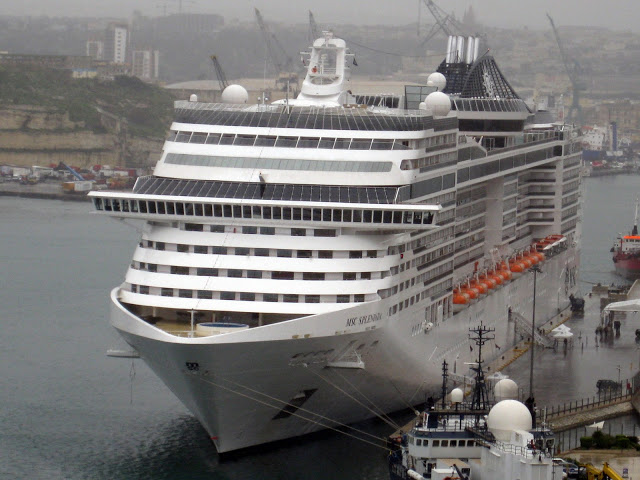
With the outbreak of the Corona Virus in China the cruise ship MSC Splendida had to cancel the voyage for guests leaving the crew on board without work at this time. The ship has docked in Nagasaki for 3 days and with the quandary as related to no work for crew members at this time the company appears to have made some drastic decision as related to releasing their Chinese crew members who contracts appear to have been originally set until the end of February as the ship was set to sail to Europe in March of this year. With this, the same said crew members previously made arrangements for their return appropriately without considering the possibility of a nationwide outbreak of the Corona Virus. However, it appears that the ship authorities have informed the same crew members in a last-minute notice that they will be sent back to China with sign off dates earlier than expected and told that they need leave the ship in the following days.
The Chinese crew members and several of their concerned fellow colleagues sent messages to Crew Center with outcry and outrage as related to the disconcern, inappropriate arrangements and lack of empathy for the welfare and wellbeing of the Chinese crew members. Based on the messages received, concerns are related to the ability to utilize international airports, but the inability to assure travel arrangements to the more local destinations of the home hubs of the Chinese crew members. In other words, while the international airports are still functional with precaution measures, it is informed that the more local and national airports are not completely accessible leaving the Chinese crew members potentially stranded without resources and means to assure their return to their final destinations. Furthermore, as many of the Chinese crew members informed they have pleaded and requested to finish their contracts even if not receiving their normal pay in order to assure their health-related welfare and wellbeing as many of their family members and friends have informed of the outbreak affecting the more localized areas.
“Chinese crew feel very sad, feel like they are abandoned by the company now, all we need is just to have a safe place to stay we don’t want to go to dangerous places, even if it’s our country, our home. My father today just told me to try to request and stay on board, because here at home is dangerous. We still can work, even no salary, just keep us safe, enough I just heard from other departments, all the Chinese crew will be sent home.” says one Chinese crew member.
This brings us to the general question as to what is the responsibility of the cruise lines towards their crew members as related to the MSC Splendida in the event of any disaster whether natural, medical or otherwise.
Does the responsibility lie in assuring the wellbeing and safety of the crew members? Absolutely! The responsibility of an employer is to safeguard and protect the employees. As the MSC Splendida is preparing to disembark the Chinese crew members fearing for save passage and travel, as well as their general health and medical wellbeing, the remaining nationalities aboard the ship will not be experiencing the same fear as they will be accompanying the ship back to Europe.

Other cruise lines are following in the lines of safeguarding and protecting their crew members regardless of the cost to the cruise company with a loss of revenue due to no paying guests. For instance, the Royal Caribbean cruise ship Spectrum of the Seas which is also based in Asia for the duration of the outbreak has issued the following notice to its crew members:
“Royal Caribbean Chinese crew members currently onboard due to disembark over the next few days will be offered to stay on board (extend their contracts).”
With the outreach from crew members, from other cruise companies such as the previously mentioned RCCL ship, who empathize with the Chinese crew members aboard the MSC Splendida report that their experience has been nothing but supportive and positive as the company has taken steps to assure their medical and health wellbeing regardless of the revenue cost and report it as
“Royal Caribbean is looking after its staff on Spectrum of the Seas and try to make the best of the current situation.”
Unfortunately, this is not the experience of the Chinese crew members on the MSC Splendida who report that:
“There is an outbreak of Coronavirus in China and the company just throws us back to a dangerous place. Our home has been blocked we don’t know where we should go after the flight” and “our manager approached us this afternoon, he asked us if we have any airport to go to China. We all cried that we can’t go back since even we back by flight the transportation to home already stopped. Bad news all come that we had our tickets information one by one this evening. We have nowhere to go.” says one Chinese crew member.
This also begs the question, if the MSC Splendida is ending the contracts prematurely are they also liable and responsible to assure the arrival of their Chinese crewmembers safely to their final destination, as well as what all that would entail? Without a question, the company should have this responsibility and in the event that the crew is prevented to access their final destinations, the company should have the responsibility to assure their lodging and food until able to return safely home.
The Chinese crew aboard the MSC Splendida continue to inform that they feel abandoned by the company without any concern to their safe travel, ability to return to their final destinations and health-related wellbeing. Many reports that they will not be returning to their next contract since there is a great difference in treatment by the company in comparison to other companies. And while the MSC Splendida may be concerned about the loss of revenue due to cancelled cruises and cost that is associated with maintaining the Chinese crew members on board, the cost to the company may be greater as those trained Chinese crew members who have become proficient in working aboard ships with Asian destinations may consider their employment options to other cruise lines.
If we take into consideration past events as related to natural and medical disasters, while operation aboard cruise ships may not be guest-related often major companies such as RCCL and CCL have taken alternative approaches instead of liquidating the crew and sending them to their homes. Case in point as related to the Katrina hurricane which whipped out not only the homes of people in Louisiana and Texas leaving people homeless but also reduced the revenue of RCCL and CCL which cruise ships were porting in those states. However, they yet again made the best of a bad situation by either relocating their crew members on other ships or maintaining them aboard to support local humanitarian forces by providing shelter to locals. And while this was all done in humanitarian efforts, this nonetheless has a similar connotation as related to calling out the MSC Splendida to consider a humanitarian effort as related to the Chinese crew members at this time. We are aware that companies are about money, numbers, revenues, stocks, and so on; however, when is it time for a company to reach into the humanitarian side and consider its crew members not just as numbers, but also as human beings.



 Wetravel2u's Weblog