Cruise-Line Size Race Is Over; Now It’s About Amenities

Symphony of the seas sea trial

Photo: Royal Caribbean

By Christopher Palmeri (Bloomberg) — When the $1.35 billion Symphony of the Seas steamed out of Barcelona on its maiden voyage in April, it instantly claimed the title of world’s largest cruise ship.

At 228,000 gross tonnes, Symphony is a tad larger than the previous titleholder, its two-year-old sister, the Harmony of the Seas. But dive deeper into the stats and the victory looks iffy. It’s actually the same length and carries fewer passengers, a maximum of 6,680.

Owner Royal Caribbean Cruises Ltd., which has continually led the industry with its ever-larger vessels, says size won’t matter as much as it used to. Of the 16 ships the company has on order, only one will be larger than Symphony, and just barely. Icon, the new class of ships the company is building in a Finnish shipyard, will be smaller.

“We don’t expect that there will be a leap in the size,” said Harri Kulovaara, the naval architect who has led new ship construction at Royal Caribbean for 23 years. “There might be some tweaks, but not quantum leaps.”

Instead, the Miami-based company is focusing on how to make guests happier on those big boats, which can run close to a quarter mile in length. With eight of the 10 largest cruise ships in the world, Royal Caribbean is looking to speed the boarding process and get the fun started sooner. It’s introducing technology to give guests more control over their vacations and is creating onboard entertainment that’s more personal in nature.

“It’s not, ‘Everyone now goes into the theatre to see a great show,’” said Richard Fain, Royal Caribbean’s chief executive officer since 1988. “People want something that’s just for them.”

The cruise-line industry is in the midst of a building boom, and that added capacity is coming online at a time when some markets are starting to look weak. Carnival Corp., the industry’s largest player, said on Thursday that its revenue would be lower than expected next year, news that sent the shares of cruise operators tumbling.

Royal Caribbean, the second-largest player in the cruise business after Carnival, has always been an innovator. Its original ship, the Song of Norway, was launched in 1970 as the first purposely built for warm-weather cruising, with a pool on the deck instead of lifeboats. Other innovations include the first buffet, on the Song of America in 1982, and an atrium, in 1988’s Sovereign of the Seas, the largest in its day.

In 1998, Royal Caribbean created a splash with Voyager of the Seas, which featured the first ice-skating rink and a rock-climbing wall. It wasn’t easy. The rink required extensive testing of cooling equipment and materials to create a surface that wouldn’t crack when the ship rocked. And Fain admits he didn’t expect the climbing wall to be a hit.
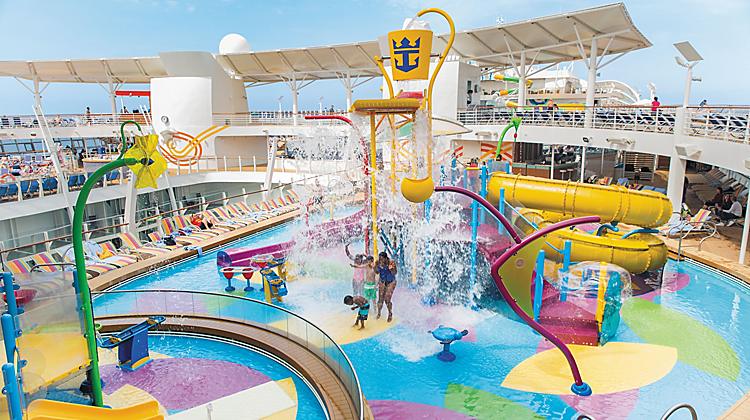
Image result for Voyager of the Seas splash

Still, he used that ship to reinforce the idea that cruising wasn’t just for older folks who wanted to eat and watch Broadway-style shows. He introduced Voyager in a TV campaign featuring the Iggy Pop song “Lust for Life.”

“It was a very visible manifestation that this was not a sedentary, not a passive vacation,” Fain said in an interview.

The number of guests cruising industrywide has increased threefold since then to an estimated 30 million this year.

Fain’s push for the new and exciting seems to come naturally. He has been known to challenge guests to an onboard surfing competition on one of Royal Caribbean’s FlowRider machines or learn to pour seven martinis at once for an employee party.

“Most people would not categorize me as a millennial,” the 71-year-old executive said. “I feel like one.”

Over the past two years, Fain has sought to make Royal Caribbean’s creative process part of its culture, opening an innovation lab next to its dockside Miami headquarters and hiring talent from competitors such as Walt Disney Co. Some 150 employees work in the lab, meeting with shipyard officials and executives from Royal Caribbean’s six brands, including the higher-end Celebrity and Azamara lines. Some projects are visualized in a space called the Cave, where staffers don 3D goggles for virtual walk-throughs of new designs.

Downstairs, a warehouse floor holds prototypes of projects in the works. On a recent day they included a new cabin design, a pirate-themed game, a tropical signpost for one of the company’s private islands and a cart that looks like something Jules Verne would have designed — if the science-fiction writer had wanted a vehicle that mixed cocktails.

Image result for royal caribbean xray bridge view
Augmented reality will become a navigation aid on the cruise ship

Many of the more personalized experiences Fain is emphasizing are evident on ships the company launched this year. Stairs on the Symphony of the Seas, for example, light up and play music like a scene from the movie “Big.” A musician wheels a piano around the ship and takes requests, even in elevators. Guests on deck 12 can hold their smartphone up to a painting and see an “X-Ray” view of the bridge crew working behind the wall.

“I’m very cynical — I have been on over 150 cruises,” said John Maguire, who runs the travel booking site CruiseDirect.com and who sailed on the Symphony recently. “They do wow me.”

On another new vessel, the Celebrity Edge, diners watch an animated chef prepare their food on a video projected onto their table, then the real dishes are delivered.

At new port facilities Royal Caribbean has built in Miami and Fort Lauderdale, Florida, guests can upload passport information and a headshot, then use facial-recognition checkpoints to speed boarding — “from car to bar” — in under 10 minutes, according to Jay Schneider, who heads the company’s digital initiatives.

Over the next few months, Royal Caribbean will make refinements to its app, letting customers adjust the temperature in their rooms before they get there, receive alerts when restaurant reservations are available and order a Mai Tai that will be delivered to them anywhere in the ship.

“What people expect in their vacations has evolved dramatically,” Fain said. “I think one of the reasons the industry is doing so well is we keep evolving what we’re offering.”
Royal Caribbeans Major Revitalizations

Image result for independence of the seas in dry dock
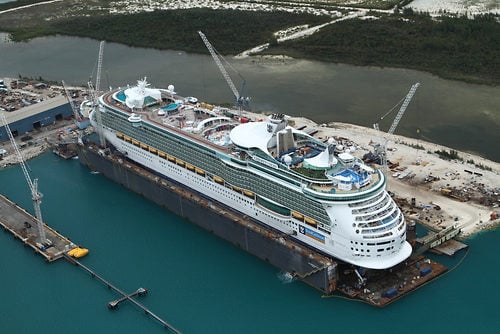
Independence of the Seas in Drydock.

Among the big out-of-water projects for Royal Caribbean Cruises, this year are revitalizations of the Adventure, Mariner and Independence of the Seas, plus the complete refurbishment and transformation of the Adonia into the Azamara Pursuit.

The company’s large-scale drydocking projects are overseen by the newbuild and innovation department, headed by up Kevin Douglas, vice president, who joined Royal in 2004 as a project manager overseeing a large-scale revitalization on the Sovereign of the Seas.

While smaller dry dockings (known as a “shave and a haircut”) are generally run by the brands, Douglas said his group comes together to plan the big changes, working closely with the operations teams to craft a program vision, whether it’s the Royal Advantage or Celebrity’s recent $400 million Edge-upgrade scheme.

With a schedule that calls for dry dockings every five years, the planning starts with a holistic look at each ship, and how they fit into the class and the brand

“The principal goal is how we improve the guest experience, offering a more meaningful product,” said Douglas. That ranges from stateroom upgrades to new restaurants and other features like the FlowRider surfing simulator. “We look at how we can add in IT and the smart ship concept, upgrading the technical experience and entertainment.”

Projects are evaluated not only on cost but in the number of containers and raw materials needed.

“We know how much material we can deal with on a daily basis, and that determines how much time we need,” Douglas said.

The technical scope of jobs is increasingly complex.

“Then we look at the stability of the ship with the increase in weight and the increase of the centre of gravity, and whether we have to add a ducktail to the stern.”

Allure of the Seas at Navantia

Another major technical project has been installing scrubbers (the company prefers to call them Advanced Emissions Purification Systems).

“They are about the size of a school bus,” Douglas noted.

Royal Caribbean has had its scrubber program going for five years, with some 20 ships outfitted with various systems from a number of suppliers with the project being overseen directly by Matti Heikkinen, vice president of newbuild.

“He and his team have done an awesome job,” added Douglas.

Under the waterline, the company has an on-going initiative to study hull coatings, with a new direction expected to be announced in early 2018.

“There is a massive benefit on fuel efficiency on drag and resistance,” Douglas said.

That project is being spearheaded by Captain Patrik Dahlgren, senior vice president of global marine operations, and Anshul Tuteja, director of energy management.

“We are looking at every type of paint, and which coatings work best in what areas,” Douglas explained. “Patrick and Anshul are looking very carefully, and we can actually track the performance of a hull coating relating to efficiency and how much fouling they are getting.

“We probably have every type of paint coating in the fleet, and are now starting to review final recommendations for future coatings.”

Royal Caribbean has also grown the scope of its drydocking work along with its shipyards, continually working to get leaner and manage bigger projects.

“Twelve years ago we were doing 12 to 16 containers a day and thought ‘wow.’ Now we are doing 50 containers a day and think nothing of it.”

And the spending is skyrocketing.

“We used to be at $800,000 per day, and now its $2.8 million; and we want to go even higher,” Douglas said.

The next hurdle may come in Asia, with a number of company ships in China. One of those ships has already been in a Chinese drydock for a repair, which Douglas said went well. SkySea also recently drydocked at a yard in China for a small refit.

Years of planning, million-dollar decisions and executing on a tight schedule, Douglas said it all came down to partnerships, whether internal, whether with the shipyards or with turnkey suppliers.

“It’s about how we do these projects in a short period of time, minimizing the risk and maximizing the planning.”

For RCCL’s Fain, onboard art helps differentiate sister ships

T0427ANTHEMGIRAFFE_HR.JPG

The giraffe wearing an inner tube, an art piece next to the climbing wall on Anthem of the Seas.

SOUTHAMPTON, England — Hanging on walls, suspended from ceilings, rising from pedestals and platforms, braving the weather on upper decks and turning stairwells into galleries, art is the singular attribute that defines and separates the personalities of the Anthem of the Seas and its structural twin, the Quantum of the Seas.

An astounding variety of media, from bricks to light bulbs, are employed onboard the Anthem, unified by the theme “What makes life worth living.”

Purchasing art for a cruise ship, it turns out, is a bit more complicated than selecting an oil painting to hang above your sofa.

There are a variety of technical as well as aesthetic considerations. For example, there’s little chance your apartment will list or roll or that the art in your home will be touched by hundreds of people every day for decades.

Or, if it’s kinetic or illuminated, that it will need circuitry beyond what’s specified for typical consumer appliances. (click the Video link to watch the Richard Fains artwork explained)

Anthem of the Seas Artwork with Richard Fain

And your backyard fountain probably isn’t programmed to shut down if the ground tilts beyond a certain angle.

Richard Fain, the chairman and CEO of Royal Caribbean Cruises Ltd. (RCCL), said during the Anthem’s pre-inaugural sailing that collectively, the art aboard the company’s ships represents a huge investment. RCCL’s spending on art is in “nine digits,” he said, though he also allowed that art is perhaps the only shipboard procurements that appreciate after purchase.

Most onboard art is acquired with the assistance of a consultancy that specializes in corporate art, though some is commissioned directly from an artist.

Over the years, there have been disappointments, even failures.

In 1987, RCCL commissioned a 9-foot-diameter clock that used tiny glass beads to tinkle, rather than chime, the quarter hour. It was for placement in the Sovereign of the Seas atrium. “I saw it work in the artist’s studio,” Fain said. “It was magnificent.”

And that was the last time he saw it work. The artist spent months tweaking it after it was installed. Engineers were brought in. But tinkling was never again heard.

“The head of [subsidiary] Pullmantur said, ‘I’ll make it work.’” But it was not to be. Today, it keeps time on a Pullmantur ship but still doesn’t function as intended.

When RCCL sells a ship, the art does not go to the buyer; it is removed, and sometimes finds a home aboard another ship.

Fain takes a strong personal interest in the art, and he can give nuanced analyses of various pieces, taking note of color saturation, light, movement, texture, technology, artistic intention and, it turns out, functionality. When he was first shown a catalog detailing the art aboard the Anthem (a catalog that was placed in every stateroom), he paused on the page of a large, illuminated piece and told an executive to check out the installation because “there are four lights out.”

Fain sees a “yin-yang” both in individual pieces and in how the Quantum’s and Anthem’s art varies. While the Quantum’s collection is by no means serious, Fain frequently used  the word “fun” to describe Anthem art. Perhaps the best examples of how the two differ are the choices of statuary on Deck 15, near the rock-climbing walls. The Quantum has a giant magenta bear, holding on to the deck above; not a serious piece, but not as whimsical as the giraffe wearing an inner tube on the Anthem.During a “Common Ground” session during the sailing, in which Fain and other executives answered questions, one agent stated, “I’m not interested in art — I don’t really have time to be interested in art — but this really opened my eyes.”

Another asked Fain, “Why a giraffe in a swimsuit?”

The curator-in-chief didn’t miss a beat in responding about what is possibly the most surreal object on the ship.

“What else would you have there?” he asked.