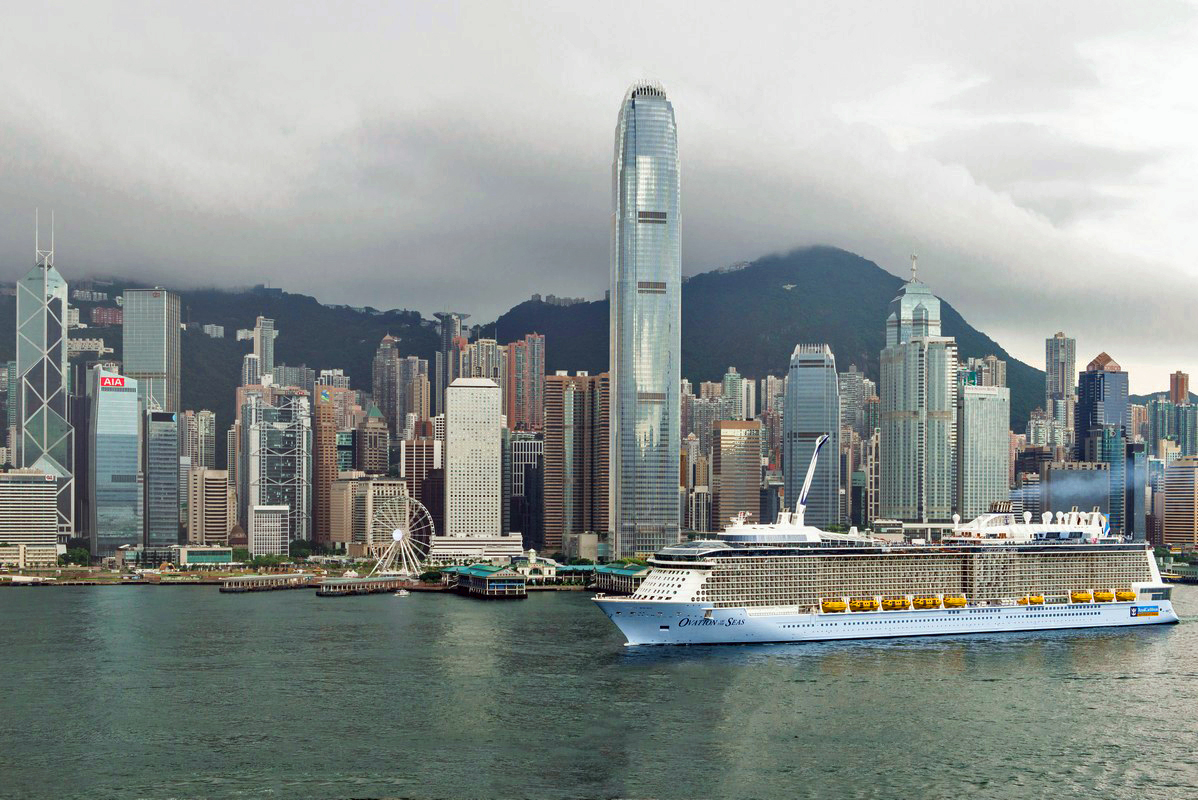
Ovation of the Seas arrives in Hong Kong in June 2016. Photo: Royal Caribbean International
By Bloomberg News (Bloomberg) — Liu Jing wakes at 7, feeds her 84-year-old mother and two-year-old grandson and then spends the day watching the boy play in the playground, with breaks for meals and his afternoon nap and perhaps a little TV in the evening.
That’s not unusual for a Chinese retiree, many of whom play an instrumental role in raising grandkids, but Liu, 57, is on board the Costa Atlantica, a luxury cruise ship packed with activities and events that she largely ignores.
“I just don’t have time to do all these,” said Liu, 57, a Beijing resident who sailed with her husband, grandson and mother from Tianjin port late last year. “Everywhere you look on the cruise, you see middle-aged people like me, with small kids.”
Lines including Royal Caribbean Cruises Ltd. and Carnival Corp. have sent an armada of luxury vessels to China to tap the world’s fastest-growing market, but they face turbulent waters. In addition to satisfying the tastes of Chinese passengers, they sail in the shadow of the region’s increasingly volatile politics. And soon, a new threat will emerge: Chinese companies are building their own big ships.
“Right now it’s a learning process,” said Ken Muskat, chief executive officer at SkySea Holding International Ltd., a Shanghai-based cruise operator. “Everybody is adapting and learning more about what the Chinese market is looking for.”
The number of passengers in China has risen tenfold in five years, to around 2 million in 2016, and the government expects 4.5 million by the end of the decade. Most make shorter trips — five days on average — and call in South Korea and Japan, the top two destinations in Asia outside of China, according to industry body Cruise Lines International Association.
With so much potential — China is still nowhere close to the 11 million plus Americans who cruise each year — companies are bringing bigger and better ships to the Yellow Sea, tailoring their offerings and seeking new destinations in an effort to persuade Chinese travelers that a cruise is more than just a form of transportation.
Royal Caribbean’s latest mega-ship, the 4,905-passenger “ Ovation of the Seas,” complete with indoor sky-diving and robot bartenders arrived at its new home port of Tianjin on May 4 for the summer season after being christened in China last year by actress Fan Bingbing. On deck, a sculpture of a mother panda reaches out to her cub on the deck below.
“We have still a huge challenge ahead of us to create more consumer awareness of what a cruise is, what that experience is like,” said Adam Goldstein, president of Royal Caribbean.
But before China’s newbie cruisers adapt to life on the ocean, the cruise lines first have to adapt to local tastes. And that starts in the kitchen.
“Whether it’s rice and congee for breakfast or different types of seafood for lunch or dinner, they’re sticklers for the authenticity of Chinese cooking,” Goldstein said.
Then there’s the entertainment. Out go the Broadway-style shows beloved in the Caribbean and in come flashy Chinese song-and-dance hits and local celebrities. SkySea invited candidates from the Voice of China reality TV singing contest to perform and staged the Miss World China Final beauty pageant on its ship Golden Era, which can carry 1,814 people.
Royal Caribbean in 2016 invited cross-talk artist Guo Degang to perform on “Ovation of the Seas” during the ship’s inaugural visit to China last year.
“There’s much more of an emphasis on shopping,” Goldstein said, adding that Chinese passengers spend two or three times as much in the on-board stores. “Plus we know that they’re shopping energetically in the ports of call.”
But perhaps the biggest difference in China is that cruises are often a mutigenerational holiday.
“Chinese cruise travelers are very family oriented” said Muskat at SkySea, which counts Royal Caribbean and Chinese online travel service Ctrip.com International Ltd. as major backers. “They like to spend a lot of time with their family whereas in North America you can put the kids in the youth program for seven days and not see them again.”
Liu said she barely tried any of the swimming pool, mahjong, shows, casino, bars and gym on her cruise ship, owned by Italy’s Costa Crociere SpA, because her grandson and 84-year-old mother required her constant attention. Costa said it invites local chefs for its China cruises and adds more extensive retail space. The company, which still keeps an Italian flavor to its voyages, said about 85 percent of its passenger accommodation is in family cabins for China cruises.
Tailoring ships to win over Chinese seafarers may provide an advantage to local cruise lines that can adapt quickly to the rapidly changing tastes of Chinese consumers, said Yu Dunde, CEO of Chinese online travel booking service Tuniu Corp.
China has “too many similar offerings,” said Yu. “To win the market, you’ll have to differentiate through activities, you have to give people something that other cruises can’t.”
Companies are trying to diversify, with more ships departing from southern ports like Guangzhou and Xiamen into the warmer waters of the South China Sea for the winter market.
China’s own operators and shipyards are also entering the market for big cruise ships. Shanghai Waigaoqiao Shipbuilding Co., a subsidiary of China State Shipbuilding Corp., is working with Italian cruise shipbuilder Fincantieri SpA to build two vessels, worth approximately $1.5 billion, according to a memorandum signed in February. The ships will be delivered to a new China-based joint venture between Carnival, CSSC and CIC Capital, and will be tailored for the Chinese market. The first, carrying about 4,000 passengers, is expected to be delivered around 2023 and the operator also has an option for four more.
The Shanghai shipyard said the order is a substantial step forward that brings local builders closer to their dream of having a cruise vessel made in China.
But for both local and foreign operators, the waters around China have become increasingly risky due to the region’s politics. Both Royal Caribbean Cruises and Costa scrapped calls to South Korean ports in March for their cruises departing from China amid escalating tensions between the two countries over the deployment of a U.S. Thaad missile defense system.
China has had similar brushes with Japan and its Southeast Asian neighbors over disputed islands.
Those risks aren’t deterring the expansion of the industry. Cruise lines are already looking to the largely untapped market of potential cruisers in China’s inland cities, a market that is becoming more accessible as the nation builds more airports and high-speed railways.
“They just can’t ignore a broader market beyond the coastal regions” Yu said. “If they can extend the market to the hinterland, then the number of cruise travelers could grow from millions to tens of millions.”


 Wetravel2u's Weblog