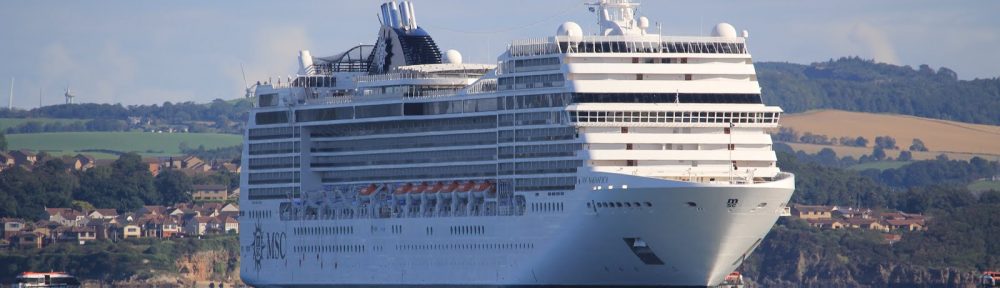
Carnival Corporation confident over long-term cruise demand

Booking trends for 2021 indicate long-term potential demand for cruising despite sailings having been cancelled since the start of the coronavirus pandemic in mid-March.
The glimmer of hope for the struggling sector came from Carnival Corporation despite reporting an average monthly cash burn of between $550 million and $770 million as dozens of ships remain idle, including some off the south coast of Britain.
The world’s largest cruise group has started a phased return to operations with Italian brand Costa and German line Aida.
Other brands and ships are expected to return to service “overtime”.
The initial cruises will continue to operate with adjusted passenger capacity and enhanced health protocols developed with government and health authorities, and guidance from medical and scientific experts.
“Many of the company’s brands source the majority of their guests from the geographical region in which they operate. In the current environment, the company believes this will benefit it in resuming guest cruise operations,” the company said.
But in a business update on Thursday, the corporation said: “Currently, the company is unable to predict when the entire fleet will return to normal operations, and as a result, unable to provide an earnings forecast.
“The pause in guest operations continues to have a material negative impact on all aspects of the company’s business, including the company’s liquidity, financial position and results of operations.”
The company expects to report an unspecified loss for the financial year ending November 30 but has a total of $8.2 billion of cash and “cash equivalents”.
Bookings in the first half of 2021 reflect expectations of phased resumption operations and anticipated itinerary changes.
However, cumulative advance bookings for the second half of 2021 capacity currently available for sale are at the “higher-end” of the historical range.
“The company believes this demonstrates the long-term potential demand for cruising,” the parent of UK brands P&O Cruises and Cunard said.
Pricing on these bookings are lower by “mid-single digits” versus the second half of 2019, reflecting the effect of future cruise credits (FCCs) from previously cancelled cruises being applied.
The company continues to take bookings for both 2021 and 2022.
About 45% of passengers affected by schedule changes have received enhanced FCCs while 55% have requested refunds.
The total customer deposits balance at the end of August was $2.4 billion, the majority of which were FCCs, compared to $2.9 billion at May 31.
“The decline in customer deposits is consistent with previous expectations,” Carnival added.
Cruise capacity
More than half (60%) of bookings taken during the three weeks ended September 20 were new bookings as opposed to FCC re-bookings, despite minimal advertising or marketing.
Future capacity is expected to be “moderated” by the phased re-entry of ships, the removal of older capacity and delays in new ship deliveries.
The company has accelerated the trimming of capacity since the pause in operations with the disposal of 18 ships, ten of which have already left the fleet.
The 18 less efficient ships represent 12% of pre-pause capacity and only 3% of last year’s operating income.
The corporation expects to receive only two of the four ships originally due for delivery this year, including Enchanted Princess which was handed over last week.
The company expects only five of the nine ships originally set for delivery by the end of 2021 to be received by then.
Nine cruise ships and two smaller expedition vessels of the 13 originally scheduled for delivery before the end of the 2022 financial year are expected to be delivered by then.
“Based on the actions taken to date and the scheduled new-build deliveries through 2022, the company’s fleet will be more efficient with a roughly 13% larger average berth size per ship and an average age of 12 years in 2022 versus 13 years, in each case as compared to 2019,” Carnival said.
President and chief executive Arnold Donald said: “We have come full circle from initiating a suspension in the early days of the pandemic, to transitioning the fleet into a pause status, right-sizing our organisation and, now, embarking on the phased resumption of guest operations, underway in two of our world-leading cruise brands, Costa in Italy and Aida in Germany.
“We have accelerated the sale of less efficient ships, enabling us to capitalise on pent up demand on reduced capacity and structurally lower our cost base, while retaining our most cash-generating assets.
“We are taking aggressive actions managing the balance sheet and reducing capacity to position us to weather this disruption and also emerge a leaner, more efficient company, reinforcing our industry-leading position.”

Enchanted Princess ‘first ship to be completed in the time of Covid’

New-build Enchanted Princess has been delivered to Princess Cruises at a shipyard handover ceremony in Italy.
The 145,000-ton, 3,660-passenger vessel expands the Carnival Corporation-owned line’s global fleet of high-technology MedallionClass vessels.
The finalisation of Enchanted Princess marks the first ship to be completed during the time of Covid.
The ship is due to arrive in North America in December for a season of Caribbean cruises provided US health officials to lift a ban on sailings imposed due to the pandemic.
The new addition to the fleet will sail in the Mediterranean next summer, bringing the number of Royal-class ships based in Europe to three.
Enchanted Princess will spend May to September operating a series of new seven and 14-night itineraries from the port for Rome before sailing between Rome and Barcelona on a series of 11-night cruises.
Sky Princess is replacing Crown Princess in Southampton from April to September 2021, running eight and 12-night British Isles cruises and a series of 12-night Scandinavia and Russia voyages.
Regal Princess will also be based in Southampton, sailing a number of itineraries ranging from four to 24 nights to destinations including Iceland and Norway, the Mediterranean, Canary Islands, the Baltic and Canada and New England.
Enchanted Princess represents an evolution of a design platform used for sister ships Regal Princess, Royal Princess, Majestic Princess and the most recently introduced Sky Princess
Enchanted Princess is the 100th cruise ship built by Italian shipbuilder Fincantieri. Crown Princess was the first ship to launch Fincantieri into the modern passenger shipbuilding business when it was delivered in 1990.
Princess Cruises president Jan Swartz said: “The heart and soul of the ship are always its teams, and I know she is in good hands with our dedicated crew watching over her with great care and pride.
“We look forward to brighter days ahead when we can officially welcome the first Enchanted Princess guests to enjoy all this beautiful ship has to offer.”

A More Profitable Carnival Corporation Expected To Emerge

A leaner, more profitable Carnival Corporation is likely to emerge following the COVID-19 pandemic, according to Cruise Industry News’ calculations.

One important aspect will be what now seems like the overdue removal of 18 existing ships from the fleet.

When Carnival Corporation announced earlier this week that it expects to dispose of 18 ships, eight of which have already left the fleet, it also said that the ships represent 12 per cent of the company’s pre-pause capacity, but only 3 per cent of operating income in 2019.

That means that the 18 ships generated only approximately $98.3 million in operating income, compared to approximately $3.2 billion for the other 87 ships (Carnival listed its fleet at 105 ships for the end of its fiscal year 2019).

Assuming that the 18 ships represented their fair share of operating costs at 12 per cent, their removal prior to year’s end 2019 would have cut operating costs by approximately $2 billion, potentially resulting in operating income of approximately $5.4 billion.

Thus, according to Cruise Industry News estimates, Carnival’s operating income and net income could have been $2 billion more for 2019 if the 18 ships had left sooner, with net income of approximately $5 billion instead of $3 billion, or approximately $7.37 per share instead of $4.32 per share.

In addition, the disposed of ships will be replaced by larger and more efficient tonnage that will likely command higher ticket revenues and onboard spending while incurring lower operating costs.