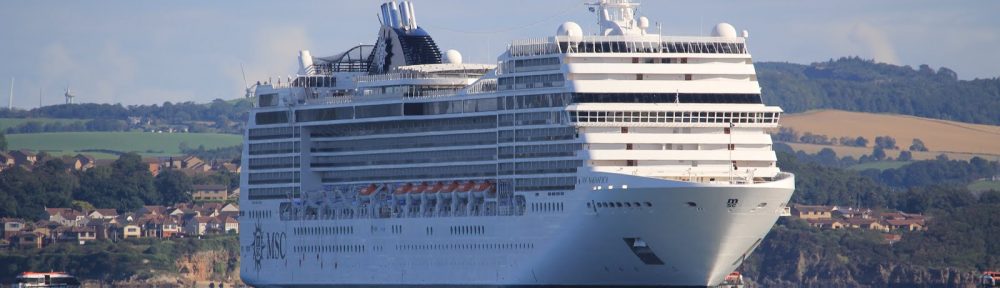
P&O Britannia in the Caribbean, photo credit Spacejunkie2
The US Centers for Disease Control and Prevention (CDC) on Thursday (30 December) strengthened its advice for cruising, upping its warning for cruise travel to level four – its highest level.
The CDC said Covid-19 was continuing to spread quickly in confined spaces, such as on a ship, and said the likelihood of infection was therefore high.
It also said there had been an increase in cases onboard cruise ships following the emergence of the Omicron variant of Covid-19, now known to be significantly more transmissible than earlier variants.
The CDC is recommending cruise passengers get tested up to 72 hours prior to embarkation, and again three to five days into their cruise – regardless of their vaccination status.
It is also urging unvaccinated cruise passengers to self-isolate for a week after disembarking.
The health authority is currently monitoring Covid-19 outbreaks on 92 cruise ships, up from 86 earlier this week.
It is colour-coding ships according to evidence of “sustained transmission” of Covid onboard; currently, no ships have been marked red.
Carnival Corp said on Tuesday a majority of its ships’ itineraries were unchanged despite a surge in cases of the Omicron coronavirus variant, which has threatened to stall recovery in the cruise industry.
The world’s largest cruise operator, however, said a few destination ports were reviewing their protocols and processes due to the fast-spreading new variant.
Many passengers and media reports, including those from CNN and Euronews, said authorities of a few ports in the Caribbean, Puerto Rico and Mexico disallowed passengers to disembark from cruise ships that were carrying active COVID-19 cases.
“Looks like my cruise this Friday is a cruise to nowhere,” wrote one Reddit user on a Royal Caribbean forum late Monday.
Carnival said on Monday it would find an alternative destination should it be forced to cancel a port.
Royal Caribbean Group did not respond to a Reuters request for comment, while Norwegian Cruise Line Holdings Ltd declined to comment.
“The cruise lines’ reaction to the substantial increase in COVID-19 cases caused by the Omicron surge is largely hit or miss,” said James Walker, a Miami-based maritime lawyer.
The U.S. Centers for Disease Control and Prevention has also identified more than 85 cruise ships with COVID-19 cases on board, the agency said on Tuesday.
On Monday, the CDC said 68 ships with COVID-19 cases had met its threshold for an investigation.
The Omicron variant has sparked concerns that U.S. health officials may reintroduce a temporary ban on cruising, just months after U.S. cruise operators resumed guest operations.
The U.S. Centers for Disease Control and Prevention (CDC) has extended the Framework for Conditional Sailing Order (CSO) with minor modifications, according to a statement, through Jan. 15, 2022.
After the expiration of the CSO, the CDC said it intends to transition to what it called a voluntary program, in coordination with the industry to detect, mitigate and control the spread of COVID-19 onboard cruise ships.
The CDC Director signed the Temporary Extension & Modification of the CSO on October 25, 2021; it is effective upon the expiration of the current CSO on November 1, 2021.
The Temporary Extension & Modification of the CSO shall remain in effect until the earliest of
The expiration of the Secretary of Health and Human Services’ declaration that COVID-19 constitutes a public health emergency;
The CDC Director rescinds or modifies the order based on specific public health or other considerations; or
January 15, 2022, at 12:01 am EDT.
After the expiration of the Temporary Extension & Modification of the CSO, CDC intends to transition to a voluntary program, in coordination with cruise ship operators and other stakeholders, to assist the cruise ship industry to detect, mitigate, and control the spread of COVID-19 onboard cruise ships.
As of July 23, 2021, the CSO and accompanying measures, such as technical instructions, are nonbinding recommendations for cruise ships arriving in, located within, or departing from a port in Florida, according to a statement from the CDC.
The CDC said in its statement that it is continuing to operate the CSO as a voluntary program for such ships that choose to follow the CSO measures voluntarily.
The CDC said it did not view the extension as “imposing any new burdens or obligations on cruise ship operators when compared to the previous CSO … the most significant change is to narrow the applicability of the CSO to ‘foreign-flagged cruise ships operating in U.S. jurisdictions that do not routinely exercise public health jurisdiction nor maintain public health programs that conduct surveillance, inspections, investigations, and management for communicable diseases with potential for significant morbidity and mortality on board foreign-flagged ships.”


 Wetravel2u's Weblog