Carnival Horizon: the differing factors compared to Carnival Vista

<i>Carnival Horizon</i>: the differing factors compared to <i>Carnival Vista</i>
The welding of the box with a coin during the launching ceremony of Carnival HorizonFrom it’s hull shape and coating to the lifts, Carnival Horizon has been made as energy efficient as possible. Rebecca Moore spoke to its shipbuilder Fincantieri

The new cruise ship Carnival Horizon shares many of the same features as first-in-class Carnival Vista but it has two key elements that distinguish it from its sister.

Carnival Cruise Lines’ 133,500 gt Vista-class ship, which is being built by Fincantieri, is due for delivery in March this year. The focus on energy efficiency found in sister ship Carnival Vista – delivered in 2016 – has been even further boosted on Carnival Horizon.

An example is how the passenger lifts, manufactured by Schindler, are managed. This is a key distinguishing element from the first-in-class ship, as software is used to decrease energy consumption and increase the lifts’ efficiency. Not only is the system new to the Vista class, but it is the first time that it has been used on a ship.

This is significant, as Fincantieri project manager for the ship, Marco Lunardi, told Passenger Ship Technology. “We paid a lot of attention to the efficiency and environmental aspects of the lifts,” he said. “Passengers will spend less time waiting for the lift and the traffic is managed in a more efficient way to reduce the energy consumption of the lifts.”

This has been achieved by collecting destination information from passengers before they enter the lifts via a touch screen. This advance information is processed by software created especially for the lifts that combines all the passenger selection information and optimise lift availability according to the requests. Mr Lunardi said that this gave an average reduction of 30% waiting time at peak times.

The other main difference between Carnival Horizon and Carnival Vista relates to hull coatings – the former uses Hempel’s silicone hull coating, which uses a combination of hydrogel and silicone technology to combat fouling. A hydro gel microlayer prevents fouling organisms firmly adhering while the silicone polymers facilitate self-cleaning. This allows a longer period between drydock, Mr Lunardi said, because silicone paint can last more than five years.

Carnival Vista uses a “traditional” Hempel self-polishing antifouling tin-free coating. The principle on which the traditional self-polishing antifouling paint works is chemical, while the silicone one is mechanical, which means that it is a more environmentally friendly process.

A new hull

Apart from these aspects, Carnival Horizon shares technical innovations with Carnival Vista. One aspect that Mr Lunardi particularly drew attention to was the Vista-class hull. “It was very challenging to find the right hull lines,” he explained. The main reason for this was the hull had to optimised for two design points: its service speed of 18 knots and a maximum speed of 22.6 knots.

Mr Lunardi continued “This was really challenging in terms of testing and finding the right shape of the bulb and involved an external consultancy to help with knowledge.”

Extensive use of CFD calculations and in-tank model testing were deployed. “We fine-tuned the solution through several adjustments. We had to make sure that the hull lines met both service speed and maximum speed, so we needed to find the right compromise between different configurations.”

This led to a “different” and “new” hull shape compared to the rest of Carnival Cruise Lines’ fleet. In order to optimise it to meet the speed range, the bulb is more narrow than usual, compared with the usual cruise ship bulb.

An engine configuration was chosen to benefit the hull optimisation on Carnival Horizon. It consists of five MAN Diesel & Turbo engines, with two engines providing 16.8 MW of power each plus three smaller engines rated at 9.6 MW each. The two engines are type 14V48/60CR and the three are type 8L48/60CR. They are placed in the aft third of the vessel.

“They are the right size to manage the vessel in different conditions and can be used separately or in combination,” said Mr Lunardi, adding that this arrangement adds redundancy and allows the operator to meet safe return to port requirements.

Boosting energy efficiency

Energy efficiency is boosted by a steam turbine that recovers energy from the exhaust gas boilers, which would otherwise be lost. It is placed between the engines and generates 1.35 MW of power for use wherever needed, such as to boost hotel power. Fincantieri created and built the steam turbine, which has previously only been used on Vista-class ships within Carnival Cruise Lines’ fleet.

Propulsion is diesel-electric and ABB’s Azipod units are used, each absorbing 16.5 MW, bypassing the need for a propeller shaft. “They make it much easier to manoeuvre in bad weather and in windy conditions because using pods means that there is more efficient control,” Mr Lunardi said.

Another benefit is that there is more space inside the ship because the Azipods’ electric motors are not inside the ship.

Three scrubbers are used, with two for the two big engines and one allocated to one of the three smaller engines. They were developed by Ecospray Technologies and there were some challenges to overcome when it came to installing them, Mr Lunardi said. “The design of the scrubber was developed at the same time as the design of the vessel [and] the big challenge was to find a feasible coordination in a very narrow space,” he said.

“The technical solution was fine-tuned but there were a lot of adjustments and we created a dedicated team especially to work with Carnival on the scrubber.”

Particular attention was paid to the advanced wastewater treatment system (supplied by Scanship), which collects and treats grey and black water.

Fancoils and LED lighting are used throughout Carnival Horizon in order to save energy.

Like its sister ship, there is an emphasis on entertainment. To this end, features include an Imax 3D cinema and a brewery with onboard craft beer production. An impressive 63% of cabins are fitted with balconies.

Carnival Horizon particulars

Gross register: 133,500 gt

Length: 323 m

Moulded Breath: 37.20 m

Design draught: 8.25 m

Maximum air draught: 61.75 m

Passenger cabins: 1,987

Crew cabins: 761

Class society: Lloyd’s Register


Main equipment suppliers

Ship coatings

Hempel

Water fog system

Marioff

Lifeboats and technical boats

Hatecke

Catering

Oxin

Lifts and escalators

Schindler

Window washing system

Navalimpianti – Cofri

Public areas – carpet turnkey sub-contractor

DESSO

Public areas – stairs turnkey sub-contractor

Zago

Public areas – atrium and stores turnkey sub-contractor

IVM

Public areas – theatre, Lanai deck turnkey sub-contractor

Spencer Contract

Public areas – restaurants and spa turnkey sub-contractor

Molteni

Public areas – casinos turnkey sub-contractor

Marine Interiors

Public areas – IMAX cinema turnkey sub-contractor

Tino Sana

Cabins and corridors turnkey sub-contractor

Marine Interiors

Thrusters

Wärtsilä

Fin stabilisers

Fincantieri DSC

Main diesel engines

MAN Diesel & Turbo

Emergency generator engine

Compagnia Generale Trattori (Caterpillar)

Reverse osmosis desalinator

Case Marine

Propulsion system pod

ABB

Storage batteries technical specification

Enersys

Ship digital communication network

Tyco

Automation system and TLV

Wärtsilä A.P.S.S.

Radio systems

Telemar (equipment Sailor)

Navigation systems

Wärtsilä A.P.S.S.

Snapshot CV Marco Lunardi

Fincantieri Merchant Ships Business Unit vice president project manager Marco Lunardi is currently managing the construction of Carnival Horizon and Carnival Panorama that are currently being built in Marghera shipyard.

As the project manager, he also worked on the construction and delivery of Carnival Vista, flagship of Carnival Cruise Line, which was built in Monfalcone shipyard. Previously he has worked on Carnival Breeze and on Le Boreal and L’Austral, luxury ships for Ponant, a French cruise ship operator.

He joined Fincantieri in 2000 and, previous to being appointed project manager, he worked as the planner and financial controller and deputy project manager for the building of Carnival Group ships.

Mr Lunardi holds a degree in management engineering from the University of Padova, Italy.


MSC Cruises ‘close to ordering four luxury ships’

Image result for MSC Cruises

MSC Seaside pictured above.

MSC Cruises is rumoured to be in the midst of a deal to build four luxury cruise ships.

According to reports in the Italian press, the mainstream brand is close to placing an order with Fincantieri, with the intention of entering the ultra-luxury cruise market. The move would be a big departure from the mainstream cruise industry’s desire to build bigger ships.

The four-ship order would have a combined capacity of just over 3,000 passengers, meaning each ship would carry around 750 passengers each.

Reports in The Medi Telegraph claim the order is imminent, however, MSC Cruises is yet to confirm the plans.

MSC Cruises takes delivery of new flagship MSC Seaside

Image result for MSC seaside

MSC Cruises has taken delivery of its new flagship MSC Seaside at the Fincantieri shipyard.

It is the second new MSC ship to come into service in 2017 and will homeport in Miami for Caribbean itineraries. It is the first in MSC’s Seaside Class.

MSC Seaside weighs 169,380 tonnes and can take 5,179 passengers.

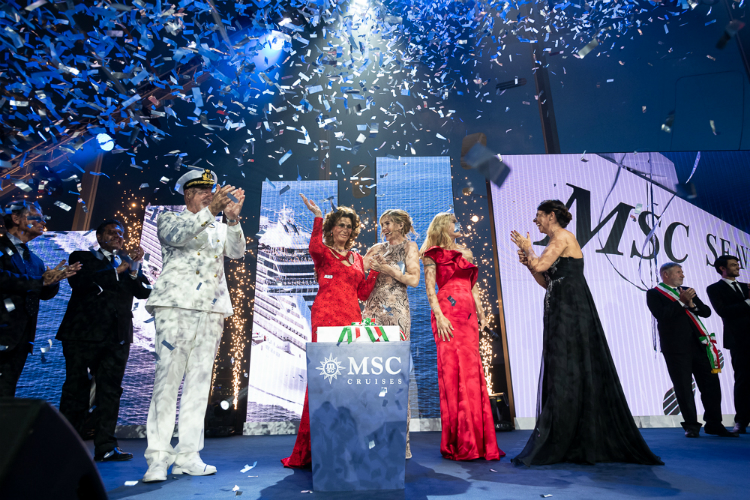
At the ceremony, in Italy, MSC Cruises and Fincantieri also signed firm orders for the €1.8 billion construction of two Seaside EVO ships.

MSC Cruises executive chairman Pierfrancesco Vago said: “MSC Seaside coming into service marks another key milestone in the history and future of our company, but she also embodies a pivotal moment for the industry. In fact, she is the first ship of the fifth new prototype that we bring into service and introduces a wholly-innovative product that sets a new standard for the industry to follow.

“The Seaside Class of ships is designed to bring guests closer to the sea and to operate in sunny waters while continuing to push the boundaries of maritime and guest-centric technology.”

Italian president Sergio Mattarella and Graziano Delrio, Italy’s minister of infrastructures and transports were among the dignitaries at the ceremony.

MSC Seaside’s sister ship MSC Seaview will come into service in June 2018, starting her summer season in the Mediterranean. At the delivery ceremony, Vago also announced that MSC Seaview will be christened in Civitavecchia, Italy, on June 2, 2018.

He added: “As we are nearing the end of 2017, we can look back on a year when we enjoyed unprecedented capacity growth. With two of the more innovative new ships in the industry have come into service in the past six months and now with the addition of two Seaside EVO ships to our investment plan, we are now even better positioned to further extend our global footprint. We are expecting the delivery of at least one new ship each year through 2026, with six to have come into service between 2017 and 2020.”

Giuseppe Bono, chief executive of Fincantieri, added: “We are proud to have accomplished such an important project: a ship, for a new customer, the largest one ever built in Italy. This demonstrates not only our ability to satisfy the needs of the shipowners but also the extraordinary operational level which Fincantieri has achieved.

“We believe we have built a highly innovative ship with MSC. She marks a further technological quality leap. Such a milestone has allowed us to gain the customer’s loyalty with another order for two new ships, which will [again] represent a real evolution.”

In total, 12 new MSC ships are to be built by 2026, for an overall investment of €10.5 billion.