Carnival Cruise Line is giving guests a first look at its new Carnival Celebration that will debut in Miami this November, revealing details on four of its six zones including Celebration Central.
The atrium will be at the heart of the ship and is known as Celebration Central.
Spanning Decks 6, 7 and 8, Celebration Central is an update to the fabulous starboard side atrium that debuted on Mardi Gras, designed as the heart of the ship’s celebratory spirit with a whole new look and the feeling of a festive party woven throughout, according to a press release.
The three-deck atrium will feature a ceiling that appears as a burst of a confetti canon made of approximately 1,400 colour-changing lighting fixtures that will transform from day tonight. Functional as it is eye-catching, the space will include 3,000-square-foot floor-to-ceiling windows on the side of the ship that will change into 16 individually controlled, six- by 14-foot LED screens to work hand in hand with the ever-changing entertainment options, including live music, special effects, aerial acrobatic performances, and high-energy shows, according to a press release.
Introducing nods to Carnival’s Fun Ship history, guests will spot pieces from former Carnival ships that will be repurposed to blend with the ship’s modern decor throughout Celebration Central and beyond.
For example, in the Aquaria Bar, ocean-themed glass murals from the Carnival Victory by Italian artist Luciano Vistosi will be incorporated into a two-deck-high decorative wall behind the bar to create an aquarium-like effect, inspiring the name.
And the Tropicale Bar is named after Carnival’s first ship to sport the line’s iconic funnel.
“From a design perspective, we are incorporating elements from our former ships, paying homage to the history of Carnival, and also showcasing Carnival Celebration as a modern, innovative and forward-looking vessel,” said Ben Clement, senior vice president of new builds, refurbishment and product innovation. “While similar to Mardi Gras with a plethora of options for dining, entertainment and relaxation, Celebration will have her own personality, one that celebrates all things Carnival, intertwining where we have been with where we are going.”
The Celebration Central will also include food and beverage options, such as JavaBlue Café, Bonsai Sushi and Bonsai Teppanyaki, and feel-good entertainment such as Piano Bar 88 and The Punchliner Comedy Club.
In addition, the centrepiece of Carnival Celebration’s Ultimate Playground (Decks 18-20 Aft) will be BOLT, The Ultimate Sea Coaster.
The Carnival Celebration’s Summer Landing zone (Deck 8 Aft) will continue to serve as one of the best chill spots at sea with Guy’s Pig & Anchor Smokehouse Brewhouse, offering smoked-onboard favourites created by Guy Fieri and an assortment of Carnival’s ParchedPig craft beers brewed on-site, in addition to pools and whirlpools, The Watering Hole poolside bar, and the Heroes Tribute Lounge honouring military personnel, according to a press release.
And the poolside zone, Lido (Decks 16-17 Aft), will feature all of the experiences from the Carnival Mardi Gras including the two-level RedFrog Tiki Bar designed to transport guests to a South Pacific paradise, Shaquille O’Neal’s Big Chicken restaurant, guest-favourite Guy’s Burger Joint, Seafood Shack, and BlueIguana Cantina, with offerings perfect for any tastebud, any time.
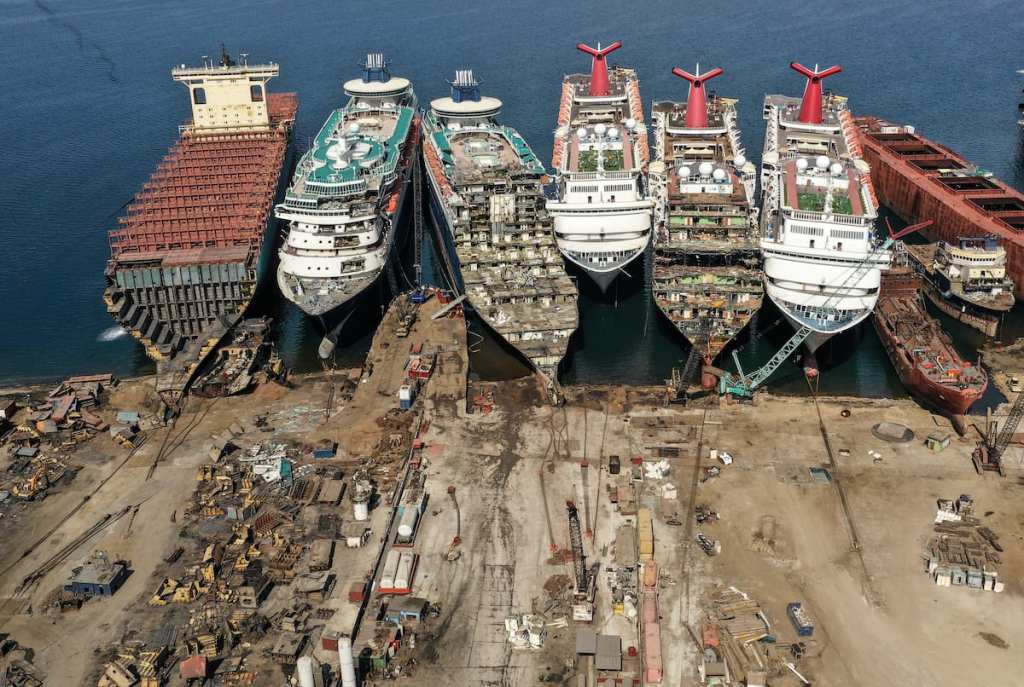
2 Royal Caribbean and 3 Carnival cruise ships can be seen, such a shame.
A drone image shows decommissioned cruise ships being dismantled at Aliaga ship-breaking yard in the Aegean port city of Izmir, western Turkey, October 2, 2020. REUTERS/Umit Bektas
Carnival Fantasy was a ship famous for its outlandish décor, all-night revelry and its size—back when 2,000 was an incredible number of passengers. The “Fun Ship” vibe it introduced in 1990 came with such whimsical spaces as an Egyptian-themed piano bar, decorated with a fake sarcophagus, and a glitzy glass-topped atrium that was the hub of the social scene.
Today the Fantasy is attracting a whole different breed of booty-seeker. In July, the 30-year-old ship sailed to the Aegean Sea, wrapping its final voyage in the shipbreaking capital of Aliaga, Turkey.
Its resting place there is a demolition yard where old cargo ships, tankers, research vessels—and now cruise ships retired during the Covid-19 pandemic—get torn apart and broken into pieces. In this case, they’re not being broken in half to get upgraded and stitched back together. Instead, circling the Fantasy’s partially deconstructed innards are buyers from all sorts of industries, looking for rock bottom deals on everything from artwork and kitchenwares to electrical wires and stainless-steel sinks.
For the cruise company, it’s an opportunity to recoup at least some value from an asset that’s currently acting as dead weight; while ships’ values decline with age, the Fantasy was originally built for about $225 million. And for the recycling companies that buy the vessel for cash and take on the hazardous task of emptying all its valuables, it’s a matter of a months-long salvage resale on steroids.
Cutting the Losses
It’s hard to gauge how exactly much money is made off of cruise ship recycling. Companies don’t immediately disclose the sale prices of the vessels after relinquishing ownership, and the resale value of their most sought-after commodity, scrap steel, fluctuates in each global market on a daily basis.
But the business is booming.
Next to Carnival Fantasy in Aliaga are two other Fantasy-class ships built in the late 1990s. And next to them are two former Royal Caribbean vessels (scrapped by Royal’s Spanish partner line Pullmantur Cruceros). The ships all had big fan bases, even as they aged. Fantasy and its sister ships started 2020 full of passengers bent on fun-in-the-sun activities in the Caribbean, Bahamas, and Mexican Riviera.
A drone image shows decommissioned cruise ships being dismantled at Aliaga ship-breaking yard in the Aegean port city of Izmir, western Turkey, October 2, 2020. REUTERS/Umit Bektas
The ships would have left the fleet in coming years even in a healthy industry; the pandemic sped up the process, with owners of idled vessels haemorrhaging cash and looking to cut their losses.
In its third-quarter filing, Carnival Corporation said it planned to sell 18 “less efficient” ships in 2020, resulting in a 12% reduction of its nine-brand fleet. “Those ships were giving us a bad drain,” Carnival CEO Arnold Donald said during a recent webinar with the Society of American Travel Writers.
Going, Going, Gone
Without much of a market for second-hand tonnage, the main worth of the ships is the steel that makes up the superstructure.
If, for instance, Carnival Fantasy has 15,000 tons of steel in its superstructure, the scrap may sell for upwards of $4.7 million based on current global market prices—though other factors also come into play, such as local prices and demand.
Decommissioned cruise ships are being dismantled at Aliaga ship-breaking yard in the Aegean port city of Izmir, western Turkey, October 2, 2020. REUTERS/Umit Bektas
Along with the risk of these market fluctuations, the buyer also takes on the uncertainty of just how much metal can be salvaged. Pre-1990s ships tend to have more steel in their hulls and underwater plating, but those built in the ’90s and after can bear lighter and stronger alloys.
Either way, steel and metal scraps will travel to a smelter to make rebar for construction projects around the world. Steel from some other dismantled ships can find its way to Turkey’s large car manufacturing industry, where it might become parts for a Toyota or a Ford.
Aluminum, copper, and stainless steel are also salvaged and resold, along with other valuable commodities that mostly remain in Turkey. The ripped out teak decks on Fantasy may end up in local shops, restaurants, and homes. Theatre scenery and lighting may find its way into show productions. Even the tackiest artwork has some value, and can end up in restaurants throughout the country.
Buyers come to the yard for everything down to the bolts and nuts. Even if a used toilet sells for a fraction of the shelf price, multiply that amount by a few thousand—given the number of cabins and public spaces on each ship—and it can add up to a substantial sum.
According to Orbay Simsek, vice president of the Aliaga-based Simsekler Ship Recycling Company, there are even markets for kitchenware, closets, and blankets.
Basically anything and everything that can be sold sells. Everything must go. Even the sarcophagus.
Eco-friendly Shipbreaking
Taking apart ships is a controversial topic, thanks to concerns over both human and environmental risks. It’s one of the most dangerous jobs in the world, according to Wouter Rozenveld, director of Sea2Cradle (SC2), an expert in green ship recycling who was hired by Carnival to oversee the safe dismantling of its ships. Each Carnival vessel may take up to nine months to break down, he says, and the blowtorch-based work comes with constant fire hazards.
Those hazards are amplified when the recyclable component pieces, like furniture, cabling, piping, and machinery inside each deck have to be carefully taken apart and separated says Ehud Bar-Lev, who oversees assessment services at maritime specialist Lloyd’s Register.
The extra steps in disassembly also increase the potential for hazardous waste spills, containing everything from oily residues to sludge, asbestos, and coolants in fridges.
To prevent those incidents, the Turkish shipbreaking yard undertakes its work in a concrete holding area that catches debris; in similar facilities throughout India and Bangladesh, the process may happen on the beach. Rather than letting toxic chemicals spew into the water, the Turkish yard collects the materials, has them catalogued by Sea2Cradle, and then hands them over to the government-run Ship Recycling Association of Turkey for proper disposal.
Carnival Corporation saw these precautions as a marketing opportunity, making a highly unusual move to publicize its efforts as “responsible recycling.” But it was the shipbreaking yard, not Carnival, that saw the biggest windfall as a result: never before has Aliaga seen five mega cruise ships in its harbour.
There may be more coming in the months ahead.
“The longer the pandemic rages on in the world, the more cruise ships will end up in scrapyards, and my guess is at an increasingly younger age,” says Manso Ng, a maritime management professor at Virginia’s Old Dominion University. “Even if a vaccine becomes available, how many of us will be comfortable jumping right back on cruise ships?”
Occupying 1,350 square feet on the Panorama’s Deck 4, the Carnival Kitchen will feature nine cooking stations.
Will guests who pick their vacation primarily for fun find it in a classroom? Carnival Cruise Line is about to find out. The line’s newest Fun Ship, the Carnival Panorama, will be it’s first to have a culinary studio for cooking classes.
Occupying 1,350 square feet on Deck 4, the Carnival Kitchen features nine cooking stations designed for 18 students per class. With its debut, Carnival becomes the first contemporary cruise line to offer a full-time space for cooking instruction.
To date, culinary arts centres have been more common on ships that sail for premium or luxury lines, which tend to have longer, more global itineraries that involve more sea days than mass-market lines. In addition to catering to the desire for enrichment and engagement, the luxury lines’ culinary centres provide guests with something to do while their ship is travelling on long ocean legs between ports.
However, Carnival’s voyage model is the opposite: short cruises sailing from domestic ports with frequent stops.
Cyrus Marfatia, the cruise line’s vice president of culinary and dining, said he’s confident that a culinary centre can succeed, in part thanks to the line’s experience with its 16-person Chef’s Table on other ships.
“When we started, we used to do it twice a week, and maybe the second [session] wouldn’t even fill up, and that’s only 16 seats,” Marfatia said. “Now we find that on ships like the Horizon and Vista, we do six days a week and there’s always a waitlist.”
That growth resulted in revised thinking about the concept.
“We felt there is a lot of natural demand for people to deal with food and learn food, so we thought of it as ‘Why not? Why not try it?'” he said. “And we were pleasantly surprised, because when we opened it up for reservations, it was very, very positive, and it had limited awareness.”
The Carnival Panorama is scheduled to launch Dec. 14 and sail seven-day, roundtrip itineraries to the Mexican Riviera from Long Beach, Calif. Marfatia said there are three sea days on the itinerary, providing a fair chance to sample the Carnival Kitchen.
On sea days, Carnival plans to hold up to three one-hour classes during the day plus a two-hour evening session that combines a class with dinner. The day classes are $30 per person, the evening ones are $59.
On port days, the $30 buys a two-hour combined class and lunch, a little extra incentive for those who feel they might be missing something by not going ashore, Marfatia said. There is also a two-hour dinner class.
Marfatia said that because of the types of foods they will be making, guests won’t get bored. Classes come with fun course titles such as “Bake Shop & Pie Town,” “Tailgate Party” and “It’s an Ice Cream Kind of Day.”
“We have a pie-making class. We have an entertaining class, pizza. All of these are fun things to do,” said Marfatia, who added that the format is also family-friendly. “So fun and education kind of come together.”
Carnival has tapped Juliana Barrera, a Colombian chef who has worked at Carnival for several years, to run the program. In addition to teaching, she will enlist guest chefs drawn from Panorama’s diverse galleys who are experts in ethnic specialities such as Indian or Mexican.
A course titled “The Orient Unknown” may be taught by a Thai or Indonesian chef, Marfatia said.
“If there is a sushi-making class, a chef from Bonsai will come and visit,” he said, referring to the name of the line’s sushi bar.
Culinary studios took off about a decade ago with their inclusion on the Oceania Cruises newbuilds Marina and Riviera. But the 4,000-passenger Panorama is triple the size of those ships, so if the classes prove popular, they may be oversubscribed.
Marfatia said that if the sea days sell out, Carnival would consider adding more classes on port days.
Carving out dedicated space for culinary instruction is taking a bit of a chance, Marfatia admitted, because real estate comes at such a premium on a cruise ship. On other Carnival ships, sometimes even the Chef’s Table is held in a dining room annexe or in the library.
Customer research so far suggests the classes will find an audience.
“We’ll learn as we go along, and one of the strengths of Carnival is that we are able to implement and make changes on the fly,” Marfatia said. “So we’re not going to be stuck in something that doesn’t work.”




 Wetravel2u's Weblog
