MSC cruise ship demonstrates fuel-cell technology

MSC Cruises’ latest ship, 

MSC World Europa, demonstrates the company’s strategy to decarbonise by cutting greenhouse gas emissions.

This ship was delivered from the Chantiers de l’Atlantique’s shipyard in Saint-Nazaire 24 October, with the latest power and propulsion technology on board.

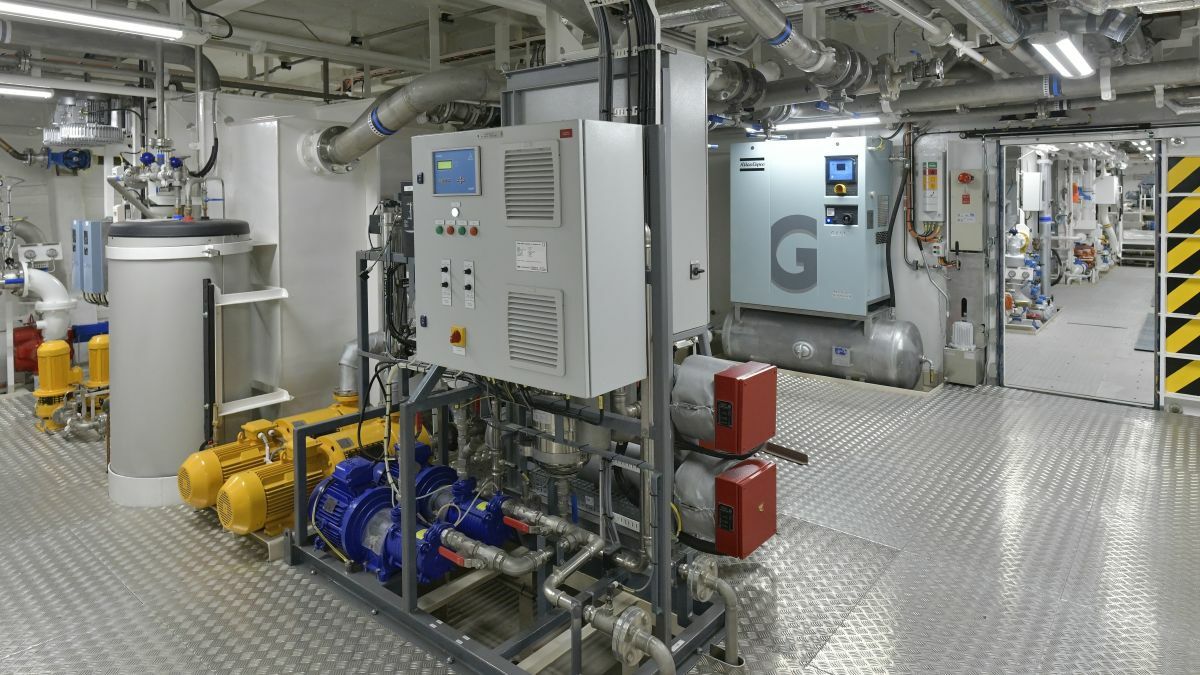
MSC Cruise Management (UK) head of electrical engineering Steven Frey said this ship is powered by LNG and has a solid oxide fuel cell (SOFC) to run as a pilot project.

He told delegates at Riviera Maritime Media’s annual Maritime Hybrid, Electric & Hydrogen Fuel Cells Conference in Bergen, Norway, 27 October, the importance of testing and investing in technology to cut carbon emissions.

“We are working to get to zero emissions from multiple fronts, including digitalisation, workshops and partnerships, hybrid propulsion solutions, shore charging and new technologies, such as SOFC,” said Mr Frey. “We are starting a demonstration of a 500-kW SOFC on a ship, and we want to scale this technology up to 20 MW.”

Using power from shore during port stays is an important method for MSC to reduce ship emissions.

“All of our newbuilds are ready for shore power and we are retrofitting the existing fleet,” said Mr Frey. “Around 50% of our ships will be ready by 2023 and 65% by the end of next year. We have also signed a memorandum of understanding with Cruise Baltic to use shore power in 32 ports from 2024 when it is available.”

He said smaller cruise vessels need around 4.5 MW of power and MSC’s largest ships to need more than 10 MW from shore power to shut down engines.

Mr Frey said a combination of shore power and technology to reduce energy consumption and fuel usage is needed to cut cruise ship emissions.

“We are looking at ways to decarbonise by reducing energy consumption on the ships, by adding LED lighting and heat recovery, reducing hotel loads and using alternative fuels,” he said.

“We have a dedicated department dealing with energy efficiency and developing solutions for tracking data from our vessels, so we have a clear view of consumption,” Mr Frey added.

On the subject of fuels, MSC has already turned to LNG to cut pollutants and will consider other sources of energy.

“We are considering hydrogen as a fuel of the future and are using LNG now. MSC World Europa uses LNG fuel and has the SOFC pilot project. Other ships could run a fuel cell and LNG,” said Mr Frey.

MSC Cruises Builds Momentum with All Ships Back in Service

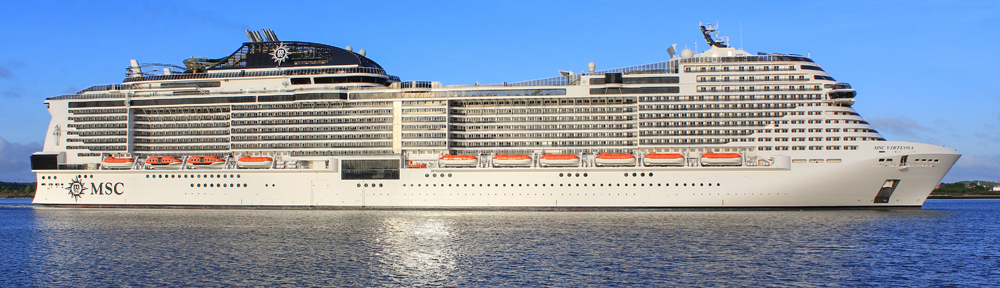
MSC Virtuosa docked in Rotterdam, Photo credit Spacejunkie2 – Flickr

When the MSC Musica started sailing in early June, the entire MSC Cruises fleet was back in service. For the summer that means 11 ships in the Mediterranean, five ships in Northern Europe, two ships in the Caribbean and one ship in the Middle East, according to Gianni Onorato, president of MSC Cruises.

“We have all 19 ships operating and are looking forward to two more new ships coming in October and November, the Seascape and the World Europa,” he said.

The 205,700-ton, 5,400-passenger MSC World Europa will be the largest and also the greenest and most efficient ship in the fleet, with a dual-fuel powerplant able to operate on LNG, while also testing a fuel cell onboard for auxiliary power. The intention is to explore a potential hybrid propulsion solution for future implementation. The new ship will also be able to plug into shore power wherever that is available.

“The market is driven by capacity and demand,” Onorato continued. “But obviously the last two years have been different and difficult as we were not able to operate as we normally do. And then as we started to ramp up, there was omicron, then the war, and then the high inflation rate. But over the last couple of months, we have seen demand picking up as people have a strong need to go on cruises again. People want to go on holidays, and we are seeing strong booking trends.”

In terms of the other challenges the industry is facing, Onorato said: “As we started sailing again before anyone else, and because we spent less time in the layup, we were able to ensure continuity of employment, and we maintained our recruitment and training centres. The turnover rate may be a little higher than normal, but manageable.

“As for the supply chain, we share some of the same issues as others in the cruise industry but have an advantage as we are also in the logistics business.

“We have also maintained our organizations in China and Japan, and we are ready to resume service, which most likely will happen next year,” he added.

Operating in many markets, Onorato said that among the selling points differentiating MSC Cruises are its beautiful ships, which, he added, reflect the soul of the family-owned company and its commitment to quality and innovations, and most of all, its maritime heritage.

“The passion we put into building our ships is also a way of expressing how much we care about the sea. We are more and more a company that is focused on sustainability and a sustainable future,” he explained.

“Another feature that sets us apart, is that as a family-owned company we offer a different atmosphere onboard, a different ambience for our customers and crew alike.

“We are also the only true international company. As our Chairman Pierfrancesco Vago likes to say, we are local and global, or glocal.

“Wherever our ships are sailing, we also adapt our product to local tastes and preferences,” Onorato added. “I think we are the only company operating ships in Brazil for Brazilians, in Argentina for Argentinians and in South Africa for South Africans.

“Our ships in the Middle East also have a high ratio of local customers onboard, and in Northern Europe, most of our customers are from countries in that region. And in the Mediterranean, our main markets are Italy, France and Spain.

“Our cruises are always open to anyone. In the United States, for example, a large share of passengers is from outside the U.S. So, we offer a different experience; more sophisticated, more discovery, all in all a different experience than the other brands in that market.”

In the United States, MSC sails from Miami and Port Canaveral and will also have the Meraviglia year-round out of New York in April.

Meanwhile, the city will serve as the backdrop for the naming of the MSC Seascape in December. (She then sails to Miami where she will be deployed for a winter season in the Caribbean.)

And, there is more to come, Onorato promised.

Excerpt from Cruise Industry News Quarterly Magazine: Summer 2022

‘Future-proofed’ ferries ready to go electric

The hybrid-electric, Island-class ferries will be converted to full electric once shore power is available
BC Ferries’ new hybrid-electric class is ready to be converted to fully electric propulsion

Damen Shipyards Group is building all six of BC Ferries’ new Island-class vessels at its Galati shipyard in Romania. The vessels are designed to carry 47 vehicles and up to 450 passengers and crew and will be capable of full-electric propulsion from new.

Two of the ferries were delivered in February 2020: Island Discovery and Island Aurora and are part of BC Ferries’ fleet renewal programme. These will replace 62-year-old North Island Princess and 51-year-old Quadra Queen II. In November, Damen announced it had secured a repeat order from BC Ferries for four additional Island-class ferries.

Discussing the transition from hybrid electric to full electric and the impact of this on the design and construction of the ferries, Damen product director ferries Henk Grunstra says: “When BC Ferries first started looking at using LNG for fuel, it was looking at adding the new Island-class ships to its fleet. It thought LNG for smaller ships was not the most attractive solution, so investigated using hybrid electric or full electric just as the Island-class was to be built.”

He explains the Canadian ferry operator needed a long-term solution, as the vessel will be deployed for the next 40-50 years. Therefore, BC Ferries decided it wanted to run the vessels as fully electric, but needed to start with hybrid-electric power as shore charging facilities are not currently available in the areas the vessels sail.

Mr Grunstra adds: “By starting with hybrid electric, BC Ferries can make the move later relatively easily. The hybrid technology is not a goal, but the first step to making vessels full electric.

“Electric sailing in British Columbia is very attractive as it has a lot of green energy. Therefore, BC Ferries kicked off with the battery pack and hybrid and we have made them ready for future developments so they can be converted to fully electric.”

Mr Grunstra says using hybrid technology makes the design of the vessels “a little more complicated” than full electric, as it requires building an energy power system that makes decisions about when to use batteries, when to use ultra-low sulphur fuel and when to use both. “That was a challenge,” he says “and we had to look at how BC Ferries would use the vessels in different locations. Since this is a class of vessels, the ships will sail in different locations and on different routes and one of the challenges was how to cater to different locations. The software and hardware have been arranged so they can be retuned for a specific operation.”

Island-class ferries have two battery rooms, each with 400 kW of batteries

Peak shaving

The hybrid-electric system will be used, among other ways, for peak shaving, to give the engines the most efficient load possible. Mr Grunstra says checking data from AIS and filtering out the way existing vessels operate was key to ensuring the engines were optimised. “These details determine the way the ship is operated. We had to start with the existing situation and see how the vessels were operating. Then we designed the hybrid solution for optimised operation.”

Over the next several months, the crew will be trained to sail the optimised system and the system may require fine-tuning.

The Island-class ferries have two battery rooms, each with 400 kW of batteries. There is room for these locations to be extended to each house 1,000 kW of batteries once the vessels are converted to fully electric.

Mr Grunstra says: “The electric systems in the ferries can cope with bigger batteries and they have been sized to do this; this means there is space in the switchboards. The only uncertainty is how the vessels will be charged – how the vessel connects to the existing infrastructure needs to be decided. But there are so many options this is not seen as an issue.”

Currently, within the hybrid-electric system, the engines charge the batteries. “We aimed for the engines to run at their most optimised setting,” he says. “The goal to make them fully electric means the energy savings will be much bigger than now.”

The Orca Energy batteries have been provided by Corvus, whose chief commercial officer Halvard Hauso explains: “These batteries are 800 kW which means they are not big enough for zero-emissions operations, but they are prepared for it. We sized the battery to the operational profile before shore power was installed. Once shore power is available, they will have room to expand the battery installation, by adding more to the same system. A hybrid ferry reduces costs and emissions by reducing fuel and at the same time reduces the need for maintenance as the engines are running fewer hours and at optimal loads. When they go full electric, they will save even more maintenance and emissions.”

Another strength of the Island-class ferries is the greatly reduced noise and vibration levels they offer.

Mr Grunstra says: “They are diesel-electric, which reduces noise and vibration and ensures the vessels are very quiet. The propellers are sized generously, so there is not a lot of load on the propulsion system, resulting in a very quiet ship. You can isolate the sources of noise easily on these ships and the electric-driven thrusters also reduce load noise. The propellers have a moderate load, which makes it easier to reduce vibration.”

Damen is also building two road ferries for Ontario that have a similar platform to the BC Ferries’ Island-class, but which will have shore charging included from the start. “They have bigger batteries and are charged at the shore after each run,” Mr Grunstra says. “They will run as full-electric all the time unless there are exceptional conditions.”

Henk Grunstra (Damen):“The hybrid technology is not a goal, but the first step to make vessels fully electric"

Henk Grunstra (Damen): “The hybrid technology is not a goal, but the first step to make vessels fully electric”

Snapshot CV

Damen Shipyards product director ferries Henk Grunstra has a long track record at Damen, starting in 1985 in the engineering department, later being responsible for high-speed and naval craft, luxury yachts and currently ferries