Legend of the Seas Delivered to Royal Caribbean Ahead of July Debut

Legend of the Seas Delivered to Royal Caribbean Ahead of July Debut

Royal Caribbean has welcomed the Legend of the Seas, its third Icon-class ship, to its fleet.

Following nearly two years of construction at the Meyer Turku shipyard in Turku, Finland, and sea trials that started in April, the ship is ready to make its European debut in July 2026, the cruise line said in a statement.

More than 1,200 crew members and partners gathered for a ceremony led by Royal Caribbean Group Chairman and CEO Jason Liberty, Royal Caribbean President and CEO Michael Bayley, and Meyer Turku CEO Casimir Lindholm.

The event marked the transfer of ownership between Royal Caribbean and Meyer Turku.

“Today’s delivery of Legend of the Seas marks another important milestone in our ambition to continuously redefine the vacation experience. This new ship reflects the strength of the vacation ecosystem we are building – combining industry-leading ships, innovative technology, and exceptional experiences for our guests,” noted Liberty.

“It is an achievement only possible through the extraordinary partnership and expertise of Meyer Turku and the thousands of talented people whose creativity and commitment continue to help us design the future of vacations.”

The ship is scheduled to travel from Turku to Cadiz, Spain, soon, for finishing touches by Royal Caribbean.

After that, it will operate seven-night Western Mediterranean sailings from Barcelona, Spain, and Rome (Civitavecchia), Italy, this summer, as part of its inaugural season.

In November, the ship will arrive in Fort Lauderdale, Florida, to deliver six-night Western Caribbean and eight-night Southern Caribbean cruises.

The delivery is part of the company’s long-term framework agreement with Meyer Turku, securing shipbuilding capacity through 2036.

Under it, the shipyard will build the Icon 5, to be delivered in 2028, as well as the sixth and seventh Icon Class ships, coming in 2029 and 2030, respectively.

“Legend of the Seas is the third Icon Class ship built at our shipyard, and constructing the series has enabled us to develop our production processes in a systematic way. We have built on the experience gained from the previous vessels and further improved efficiency with the customer and our extensive partner network,” added Lindholm.

“The ship is an exceptional project in terms of both scale and technical complexity, requiring strong expertise and seamless collaboration across the entire maritime cluster. At the same time, Legend of the Seas moves shipbuilding towards more energy-efficient and environmentally sustainable solutions.”

The Legend will be the company’s fourth ship powered by liquefied natural gas (LNG) as it continues on its journey toward introducing a net-zero cruise ship by 2035.

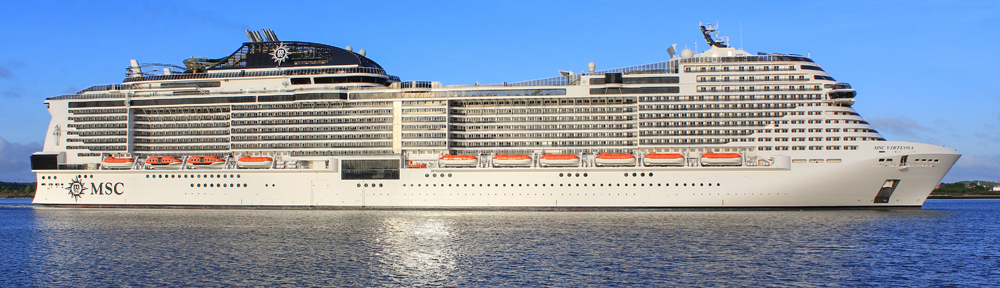
MSC World America Completes First Year of Service

MSC World America Completes First Year of Service

The MSC World America recently completed its first year of service after entering service for MSC Cruises on April 12, 2025.

As part of the company’s World-class series, the vessel was built at the Chantiers de l’Atlantique shipyard in St. Nazaire, France.

Along with its sister ship, the MSC World Europa, the 5,400-passenger ship debuted as the largest ship in MSC’s fleet.

With a series of tweaks aimed at the U.S. market, the MSC World America was designed for year-round service in the Caribbean.

After crossing the Atlantic with no guests onboard, the vessel made its official debut in Florida, following a christening ceremony at MSC’s new cruise terminal in PortMiami.

Actress Drew Barrymore served as the vessel’s godmother, cutting the ribbon that broke a celebratory bottle on the bow of the ship.

The MSC World America then kicked off a series of seven-night cruises to destinations in the Eastern Caribbean and the Bahamas.

For its maiden voyage, the LNG-powered ship sailed to Puerto Plata in the Dominican Republic and San Juan in Puerto Rico, as well as MSC’s private island destination of Ocean Cay.

As it enters its second year of service, the MSC World America will continue to offer weeklong cruises from its homeport of Miami.

In 2026, the vessel’s schedule includes itineraries to both the Western and Eastern Caribbean, visiting a range of destinations, such as Cozumel in Mexico and Roatán in Honduras.

MSC is now getting ready to add two additional World Class ships to its fleet in the near future, including the MSC World Asia.

While its name pays homage to Asia, the 208,500-ton vessel is set to offer year-round cruises in the Western Mediterranean starting in December 2026.

In late 2027, the company is welcoming the MSC World Atlantic, which will sail from Port Canaveral to the Caribbean and the Bahamas.

MSC Cruises and Eni Prove Biofuel’s Readiness for Cruise Ship Engines

MSC Cruises and Eni Prove Biofuel’s Readiness for Cruise Ship Engines

MSC Opera Photo Credit Spacejunkie2 Flickr Account https://flic.kr/ps/GkiQt

Testing by Eni and MSC Cruises has confirmed the technical feasibility of using biofuel in its pure form to power cruise ship engines, the cruise line said in a press release. 

During the tests with Enilive’s HVO (Hydrogenated Vegetable Oil) diesel, one of the MSC Opera’s engines was powered for approximately 2,000 hours with pure HVO. 

No engine modifications were made, while performance and emissions data were recorded. 

The test demonstrated that HVO can be used for marine engines with no technological upgrades needed, with performance staying in line with traditional marine fossil fuels. 

Michele Francioni, Chief Energy Transition Officer of MSC Cruises, said:” We are very pleased to have satisfactorily confirmed the technical feasibility of 100% HVO on our cruise ship as part of our continuous decarbonization efforts. 

“We believe HVO may play an important role in the decarbonization of shipping and together with other immediately available fuels such as LNG and bio-LNG, constitutes an immediate opportunity that could be deployed onboard cruise ships to accelerate the transition towards renewable fuels, bringing us a step closer to our ultimate goal of reaching net zero GHG emissions by 2050”. 

According to the press release, the test recorded lower emissions of both NOx (16 percent) and particulate, as well as a reduction in GHG emissions inherent to the origin of the HVO product of around 80 percent compared to the use of traditional fuel. 

The reduction is said to be due to the usage of 100 percent biogenic feedstocks in the HVO production process. 

Technical data on engine performance and associated emissions were collected and assessed with the support of Wärtsilä as the engine manufacturer, and Bureau Veritas, which independently validated the results. 

Stefano Ballista, CEO of Enilive, noted that his company’s marine HVO diesel has been available at the ports of Genoa, Ravenna and Venice for direct delivery from the terminal to vessels via barge for several months. 

He described the fuel as a viable solution for the decarbonization of maritime transport.