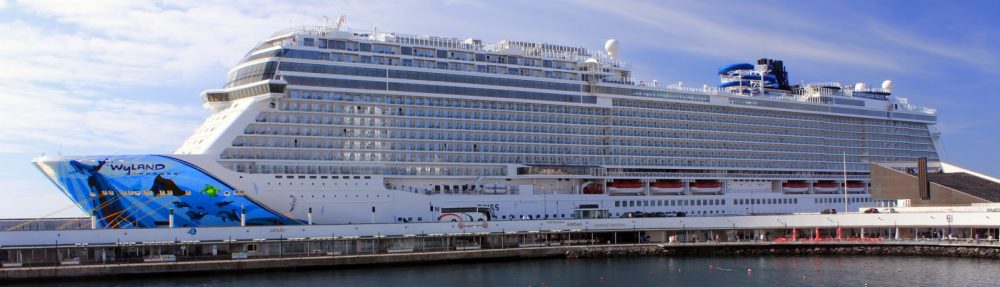
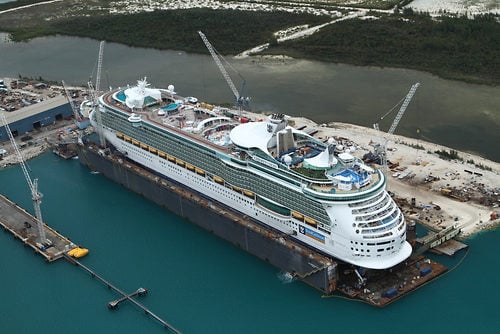
Among the big out-of-water projects for Royal Caribbean Cruises, this year are revitalizations of the Adventure, Mariner and Independence of the Seas, plus the complete refurbishment and transformation of the Adonia into the Azamara Pursuit.
The company’s large-scale drydocking projects are overseen by the newbuild and innovation department, headed by up Kevin Douglas, vice president, who joined Royal in 2004 as a project manager overseeing a large-scale revitalization on the Sovereign of the Seas.
While smaller dry dockings (known as a “shave and a haircut”) are generally run by the brands, Douglas said his group comes together to plan the big changes, working closely with the operations teams to craft a program vision, whether it’s the Royal Advantage or Celebrity’s recent $400 million Edge-upgrade scheme.
With a schedule that calls for dry dockings every five years, the planning starts with a holistic look at each ship, and how they fit into the class and the brand
“The principal goal is how we improve the guest experience, offering a more meaningful product,” said Douglas. That ranges from stateroom upgrades to new restaurants and other features like the FlowRider surfing simulator. “We look at how we can add in IT and the smart ship concept, upgrading the technical experience and entertainment.”
Projects are evaluated not only on cost but in the number of containers and raw materials needed.
“We know how much material we can deal with on a daily basis, and that determines how much time we need,” Douglas said.
The technical scope of jobs is increasingly complex.
“Then we look at the stability of the ship with the increase in weight and the increase of the centre of gravity, and whether we have to add a ducktail to the stern.”

Another major technical project has been installing scrubbers (the company prefers to call them Advanced Emissions Purification Systems).
“They are about the size of a school bus,” Douglas noted.
Royal Caribbean has had its scrubber program going for five years, with some 20 ships outfitted with various systems from a number of suppliers with the project being overseen directly by Matti Heikkinen, vice president of newbuild.
“He and his team have done an awesome job,” added Douglas.
Under the waterline, the company has an on-going initiative to study hull coatings, with a new direction expected to be announced in early 2018.
“There is a massive benefit on fuel efficiency on drag and resistance,” Douglas said.
That project is being spearheaded by Captain Patrik Dahlgren, senior vice president of global marine operations, and Anshul Tuteja, director of energy management.
“We are looking at every type of paint, and which coatings work best in what areas,” Douglas explained. “Patrick and Anshul are looking very carefully, and we can actually track the performance of a hull coating relating to efficiency and how much fouling they are getting.
“We probably have every type of paint coating in the fleet, and are now starting to review final recommendations for future coatings.”
Royal Caribbean has also grown the scope of its drydocking work along with its shipyards, continually working to get leaner and manage bigger projects.
“Twelve years ago we were doing 12 to 16 containers a day and thought ‘wow.’ Now we are doing 50 containers a day and think nothing of it.”
And the spending is skyrocketing.
“We used to be at $800,000 per day, and now its $2.8 million; and we want to go even higher,” Douglas said.
The next hurdle may come in Asia, with a number of company ships in China. One of those ships has already been in a Chinese drydock for a repair, which Douglas said went well. SkySea also recently drydocked at a yard in China for a small refit.
Years of planning, million-dollar decisions and executing on a tight schedule, Douglas said it all came down to partnerships, whether internal, whether with the shipyards or with turnkey suppliers.
“It’s about how we do these projects in a short period of time, minimizing the risk and maximizing the planning.”


 Wetravel2u's Weblog