As the first major U.S. cruise line with its full fleet back in guest service since the industry’s restart in 2021, Carnival Cruise Line has now reached the milestone of welcoming two million guests, according to a press release sent out on Thursday.
The milestone was commemorated today in Port Canaveral, Fla. aboard Carnival Freedom as the Gibbs family – Daniel and Kristi with son Mason and grandmother Theresa Campbell – from Ocala, Fla. boarded the ship. They were surprised with fanfare from Carnival Freedom’s Captain Mario Imbimbo, Hotel Director, Cruise Director and team members.
In addition, during this time, guests have taken more than 1.3 million shore excursions in Carnival’s destination ports, and two million Carnival-branded items have been sold in the gift shops fleetwide, including 150,000 items from the line’s 50th Birthday collection.
“We are so pleased to have sailed two million guests since our restart, providing much-needed vacations featuring our signature fun to an array of destinations in the Caribbean, The Bahamas, the Mexican Riviera, Alaska and Europe,” said Christine Duffy, president of Carnival Cruise Line. “All the while, providing an economic boost to those destinations and providing our crew members with opportunities to support their families.”
Carnival will restart in its 14th homeport of New York City in June with Carnival Magic and has announced plans that Carnival Splendor will restart in Australia following its Alaska season with a three-day cruise departing Sydney on October 2, 2022.
And in November, Carnival’s newest ship, Carnival Celebration, featuring a roller coaster and powered by Liquified Natural Gas (LNG), will debut in Miami.
MSC Cruises has opened sales for the MSC Euribia, the line’s most environmentally advanced ship in its fleet and its second LNG-powered ship currently under construction at the Chantiers de l’Atlantique shipyard in France, due to launch in early June 2023.
The ship will spend her inaugural season in Northern Europe from the German port of Kiel.
The Euribia will offer seven-night itineraries sailing to the Norwegian fjords with calls including Copenhagen, Denmark; Hellesylt, Norway for the Geirangerfjord; as well as Alesund and Flam, also in Norway, among others.
According to a press release, Euribia will look different from her sister ships in the Meraviglia-Plus class, thanks to “an exclusive artwork designed as a commitment by MSC Cruises to the sea.”
The cruise line held an exclusive international design competition through Talent House to create a “unique artwork” for the ship’s hull, inspired by the sea and its important marine ecosystem.
The design highlights “the steps that the company is taking towards a greener future” and will be featured on the ship’s hull permanently.
MSC said that it had designs from 59 countries worldwide submitted. The winner was German artist Alex Flaemig whose artwork will adorn the ship’s exterior.
Five finalists will have their designs displayed onboard the ship in a new art gallery, MSC said.
Executive Chairman of the Cruise Division of MSC Group, Pierfrancesco Vago, said: “In response to the growing need to protect the ocean for future generations, we have made it our mission to equip our ships with the latest and most advanced environmental technologies and solutions, with MSC Euribia showcasing the best of them to-date.
“The contest to design the hull for our latest LNG ship was launched to help us communicate our unwavering commitment to the environment as this ship sails the world.
“Flaemig’s design perfectly captured this message of passion and dedication to preserving the marine environment and its complex ecosystem and delivers a strong call to action to everyone who sees this ship to save the seas.”
Competition winner Alex Flaemig added: “In order to make people even more aware of this unique underwater world with its precious life, I have graphically placed a small section of this ecosystem on the hull of the MSC Euribia. What was important to me was not only the representation of the underwater world but also a message about how it should be preserved.“
I also want to express that an intact sea is also the basis for a healthy ecosystem on land. I want to emphasize this with the representation of birds, insects and leaves, and last but not least with the globe. It is still important to me to inspire people and encourage them to participate.”
Flaemig is a native of Dresden, Germany, and was inspired by “the opportunity to transform the hull of the MSC Euribia into a giant, floating canvas to highlight the importance of respect for the environment.”
His #SaveTheSea design features an underwater world with its precious life and weaves together the colours of the MSC Cruises and MSC Foundation logos, the cruise line said. This blending creates a gradient effect that paints sea fauna and flora across the hull.
The winning artwork was selected from entries from around the world by a panel of international judges including sand artist Jben, known for his large-scale sand frescoes that wash away with the tide, architect Martin Francis and Executive Chairman of the Cruise Division of MSC Group, Pierfrancesco Vago.
Euribia will come into service in 2023 and become the second LNG-powered ship in the MSC Cruises fleet. The cruise line said that LNG plays a “key role” in the journey towards climate change mitigation and will reduce CO2 emissions by up to 25 per cent on the Euribia compared to standard fuels while also virtually eliminating other air emissions.
As bio and synthetic fuels become available, Euribia’s emissions will be further reduced, according to the press release.
LNG is key to the development of low carbon solutions for shipping as emerging technologies such as fuel cells can be operated with LNG until zero emissions bio-LNG or green hydrogen become available at scale.
MSC Cruises said it is “actively involved” in several projects to develop and make these technologies viable in partnership with regulators, academia, shipyards and industry. This includes a project to study the use of hydrogen fuel in cruise ships in partnership with Fincantieri and SNAM, as well as a pilot project for the development of solid oxide fuel cell technology for cruise ships with Chantiers de l’Atlantique and Bloom Energy.
Euribia will utilize an advanced wastewater treatment system, as well as an underwater radiated noise management system to minimize the effects of vibrations on marine life. Multiple energy efficiency features help reduce and optimize engine use.
MSC Cruises stated it was committed to powering at least three upcoming ships with LNG, representing a total investment exceeding 3 billion euros.
The Cruise Division of MSC Group today broke ground for its new $350 million cruise terminal in Miami which when it opens will be North America’s largest, according to a statement from the company.
The four-story building with four embarkation decks will be able to accommodate up to 36,000 passenger movements a day, and feature enough berthing space to serve three latest-generation ships simultaneously, the company said.
The Cruise Division of MSC Group and Italian shipbuilder Fincantieri announced a partnership in July 2021 whereby Fincantieri Infrastructure would construct the state-of-the-art facility which will feature a striking design by award-winning global architecture firm Arquitectonica.
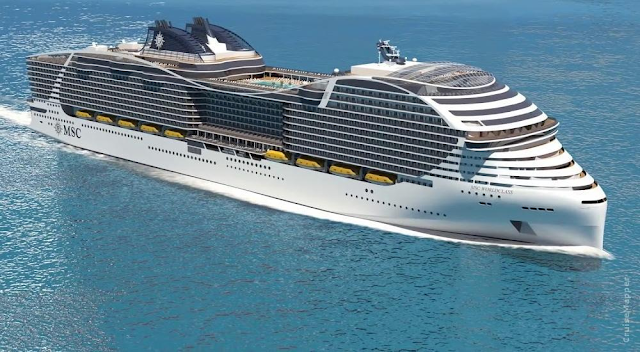
The new terminal will be able to accommodate MSC Cruises’ largest and most environmentally advanced cruise ships, including its current flagship, the MSC Seashore, and the line’s future liquified natural gas-powered World Class ships.
Most ships at berth at the new Miami terminal will be able to plug into the local power grid, in line with PortMiami’s plans to enable shore power connectivity.
Rubén Rodriguez, President, MSC Cruises USA, said, “Our new terminal at PortMiami represents MSC Cruises’ commitment to growth in North America and will help drive our expansion in South Florida by offering our guests an unbeatable experience that starts before they ever step onboard. It’s also part of our larger sustainability goals, which include deploying our most modern and environmentally advanced ships to North America, the continued development of our one-of-a-kind Ocean Cay MSC Marine Reserve, and our pledge to achieve net-zero emissions by 2050. We’re proud of our partnership with Fincantieri, PortMiami and Miami-Dade County, and it’s a privilege to be able to contribute to the region’s continued growth and vitality.”
Claudio Gemme, CEO of Fincantieri Infrastructure, added, “We are very pleased to be able to work with MSC, Miami-Dade County and PortMiami on such an ambitious project as the new terminal. It represents for us a significant result from a strategic point of view because it rewards the choice to extend to new areas the skills acquired in the field of large infrastructures. When the works are completed, here in the world cruise capital, passengers from all over the globe will be able to admire the superior quality of our work even before boarding the ship.”
Mayor Daniella LevineCava, Miami-Dade County, said, “In Miami-Dade County, we are forging ahead with future-ready investments that will stimulate growth and expanded opportunities for our local economy. As this port continues to develop, the opportunities for our community, whether in jobs, contracts, and services, can only increase. MSC’s new mega cruise terminal will significantly impact the entire region. Once complete, the facility will service three new-generation passenger vessels simultaneously, handling up to 36,000 passenger movements per day. Additionally, this architectural marvel will allow the line to deploy some of its most environmentally high-performing ships including its World-class fleet. A big thank you to MSC Cruises and Fincantieri for their partnership.”
Aside from the terminal building itself, the new complex – which is currently projected to be completed by the end of 2023 – will include a multi-level parking garage for 2,400 vehicles, new road construction to ensure traffic flows smoothly, and a total of three berths capable of accommodating the largest of cruise ships. The company will build two of those new docks; Miami-Dade County will construct the third. The project also involves the construction of related shore infrastructure, including water supply stations and four-passenger embarkation decks.


 Wetravel2u's Weblog