Global Ambitions

Pierfrancesco Vago, executive chairman of MSC Cruises
Pierfrancesco Vago, executive chairman of MSC Cruises.

“In three years we will double our capacity and in 10 years we will triple it,” said Pierfrancesco Vago, executive chairman of MSC Cruises.

In 2018 MSC will operate a fleet of 14 ships with an average size of 2,892 guests at double occupancy and is expected to be the largest operator by capacity in Europe. It has ambitious expansion plans in North America and China and is the market leader in South America and South Africa. By 2028 the company will have 24 ships in service, with an average size of 3,734 passengers.

“Our objective is to deliver a holiday experience which is unique to our customers and to tourism in general,” Vago told Cruise Industry News. “It’s also to expand the concept of cruising to the world,” Vago added.

Between now and 2026, MSC will take deliveries of ships on the Seaside, Meraviglia, Meraviglia Plus, Seaside EVO and the LNG-powered World Class platforms.

Vago described MSC as a global brand, with a premium level product offering at a contemporary price.

“Our common denominator is that we are a Mediterranean brand with the capability to fine-tune the experience to the area of operation,” Vago said. “We can fine-tune the product delivery.”

While its peers have a house of brands competing in the cruise market, MSC has a single brand with large ships.

“MSC has traditionally believed in organic growth,” Vago said.

But that doesn’t mean they may not one day explore other market segments as customers grow with the brand.

The MSC Seaside

In Europe, Vago said the company has realized their ambition to conquer the market, also entering the business later than all their competitors.

That strategy is now expanding to the rest of the world, he said, and the plans will follow demand.

In China, the MSC Splendida is replacing the Lirica on a seasonal basis, upping summer capacity out of Shanghai. In South America, the new Seaview will sail from Brazil for winter 2018-2019.

In North America, the new Seaside is year-round, to be joined by the 2017-built Meraviglia come 2019.

“We have customers travelling to the Caribbean and we needed to introduce new ships, with a different platform,” Vago said. “We had the need to put more cabins and a new offering into the North American market if we wanted to evolve our brand there.

“We had one ship (in North America) and she was filled with customers from Europe. We did not have the opportunity to grow,” he continued. “There is an opportunity for MSC to grow in North America but we needed to create both the hardware and the software for the market. That is the vision behind the building of a very new platform and prototype, the MSC Seaside.

“The Seaside is a spirit of our leadership in many ways. We are setting the pace for innovation and we will see many reflections of this platform for years to come.”

The Seaview, a sister ship, will be delivered this summer. The Seaside EVO platform, essentially an enlarged version with more staterooms, will be launched in 2021, with a second ship scheduled for a 2023 delivery from Fincantieri.

MSC Takes Digital Leadership Position

MSC for Me

Three years of research has led to the digital experience of the future aboard the MSC Meraviglia and Seaside, powered by the company’s MSC for Me app.

“The expectations of our guests were changing. The idea was to place them at the centre of the ecosystem and the centre of the stage,” said Luca Pronzati, chief business innovation officer. “We wanted to give them the possibility to get in touch with the ship for any need, at any place and anytime during their vacation.

“What you see today on the Seaside is from a three-year program involving 100 people and a major investment.”

The app, available on Apple and Android platforms, is based off a human-centred design approach, Pronzati said, that will get rid of paper, long lines and other friction points.

Perhaps more impressive is the technology powering the app, which worked seamlessly across the Seaside, and will be introduced to more ships in the near future.

Daniele Buonaiuto, the company’s CIO, said it was nothing short of a major project putting in the infrastructure to keep guests connected, which included 665 access points and some 3,275 wireless beacons across the ship.

“We can’t lose connections, so we needed a highly reliable network,” he said. “There are 900 people in the theatre getting connected at the same time, it’s a complex scenario.”

“It is one of the most advanced networks (at sea),” Buonaiuto noted.

MSC’s app can pinpoint a passenger’s location within centimetres. “Exploring a city through GPS has become a given,” he continued.

That experience is much different at sea, with a huge metal superstructure killing signals.

“For that reason we have recreated a GPS system using beacons, installed everywhere.”

The app can direct passengers, turn-by-turn, to venues, elevators, restrooms and their cabins.

Next, Pronzati said the company was looking into the robotic experience aboard.

“There has been a huge commitment from Mr Vago (Pierfrancesco Vago, executive chairman) and top management to further invest beyond what we’ve already achieved,” he added.

PortMiami Set to Continue Record-Shattering Growth Pace

Discussions are underway for another terminal for Norwegian Cruise Line.
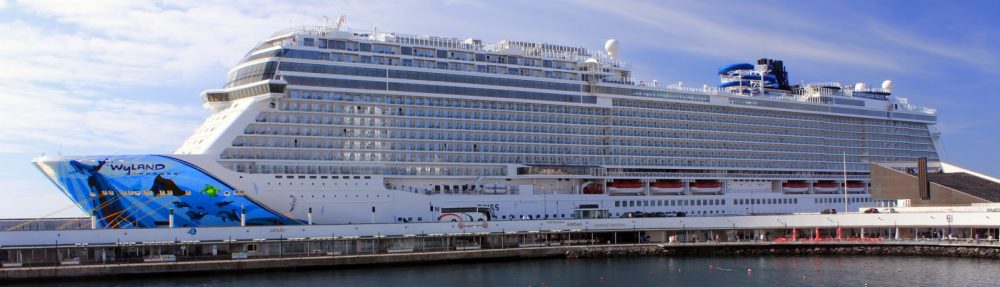
Norwegian Getaway turning in Miami port.

“We do have space. I want that to be very clear, that we have space for growth here at PortMiami,” said Juan Kuryla, port director. “We are growing and need to continue investing.”

Miami is coming off a record year, with 5.3 million cruise passengers, and a similar, slightly better year is expected in 2017-2018. After that, Kuryla is forecasting a continued pattern of record-breaking cruise traffic.

Going from 4.9 million to 5.3 million passengers in a year, the most ever recorded anywhere; Kuryla is juggling multiple projects for a 20 percent bump up in 2019, and even more growth behind that.

“We will likely be at 6.4 million passengers,” he added.

Multiple Projects

The biggest bump up in numbers last year came from Royal Caribbean, with 350,000 more passengers. That figure will grow exponentially when the company opens Terminal A for its Oasis-class ships come 2018.

Talking to Cruise Industry News on a November Monday, there were a staggering seven cruise vessels docked and Kuryla was weeks away from the grand opening of Terminal F, a new facility developed for MSC Cruises and the MSC Seaside.

That terminal is only the beginning, as MSC has bigger plans, including the deployment of the Meraviglia in the Caribbean, sailing from Miami alongside the Seaside in summer 2019.

Discussions are ongoing with Virgin and Norwegian for new terminals.

“Both would be additional to the terminals we have,” Kuryla said. “We are taking some land on the north side from the cargo operations to create a footprint for additional terminals.”

Not to be overlooked, Carnival Cruise Line has been the port’s largest customer dating back to the 1970s and accounted for more than 2 million passenger movements last year. This year the new Carnival Horizon will homeport in Miami after a brief summer in New York.

“We are also in discussions with them on how to work together to accommodate further growth,” explained Kuryla.

‘Total Commitment’

He attributed the growth to a total commitment to the cruise industry not only by the port but by the willingness of elected officials to accept the port’s and cruise line’s recommendations on investments.

New terminal projects must consider not only the space for the terminal, but land infrastructure ranging from parking to utilities, apron needs, traffic patterns and more, Kuryla said.

“The speed at which we need to grow to accommodate new ships is unprecedented,” he continued, “and we are moving quickly.”

Various studies have been conducted on LNG, and the port is moving toward a solution regarding whether bunkering would be a land or water-side operation. Kuryla said he expects Miami to receive its first LNG-powered ship in 2022.