For RCCL’s Fain, China a case of deja vu

Two weeks ago I wrote about Frank Del Rio’s take on China and the obstacles he saw to further growth there, but the Norwegian Cruise Line Holdings CEO is clearly not the only cruise chief thinking a lot about development in Asia.

Royal Caribbean Cruises Ltd. chairman Richard Fain delivered some insights into his thinking on China on a recent conference call with investors. He listed four areas in which China is similar to the industry in North America and Europe, at a comparable stage of maturity.

China has troubled cruise investors, most recently because of price softness in Shanghai.

Drawing on 30 years of decision-making experience, Fain said he’s seen it before. “It is striking how many parallels there are in China’s evolution today compared to other places in other times where we have developed a market for cruising,” Fain said.

Cruising in North America in the 1980s looked much like China does today, according to Fain’s analysis.

“It was poorly known to the population at large,” Fain said. “Distribution was through a small number of specialist agencies. There was little choice of itineraries, and growth was episodic and dictated by the arrival of new ships.”

In addition, favorable word of mouth was the main way people found out about cruising, he said.

Fain characterized travel agencies specializing in cruises in the 1980s as a “niche” business and said China’s embryonic cruise travel agency system will evolve with time, as in the U.S.

He said worries about the paucity of destinations in China parallel the same concerns in the U.S market years ago. When Royal Caribbean was trying to decide on a fourth ship, there was “a great deal of hand wringing” about whether there would be interest “beyond the established group of then popular destinations.

“Today we all look back on that concern and find it laughable, but then it was a real concern. Similarly in China, our attachment area today for customers is small and our itineraries are limited, but a quick look at the map shows just how enormous the potential really is.”
Bask in Luxury at The Haven with Norwegian Cruise Line

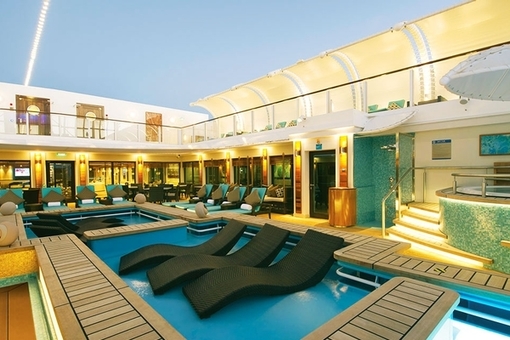
Bask in Luxury at The Haven with Norwegian Cruise Line

Sourced through Scoop.it from: www.travelpulse.com

Cruise lines use initiatives to break free from the pack

Food and film pairings at the Rooftop Terrace on Celebrity’s Millennium-class ships is part of the line’s Celebrity Distinction program.

Cruise lines are increasingly bundling their innovations under a catchy title or phrase that draws attention to what they’re doing in the hope of differentiating themselves from the pack.

The latest to do so is Celebrity Cruises, which announced its “Celebrity Distinction” moniker in July.

Norwegian Cruise Line coined “Norwegian Edge” in January for a package of culinary, shipboard and private island improvements.

And before that, lines created platforms such as Fun Ship 2.0 (Carnival Cruise Line), Royal Advantage (Royal Caribbean International) and Signature of Excellence (Holland America Line).

What unites them, said one marketing expert, is the desire to create a more premium image for their brand.

“These are all elite positionings within the overall category,” said Liz Dolinski, a New York marketing consultant and founder of the social media marketing firm Luminosity.

Dolinski said that cruise lines often struggle to convince travelers that their products are different from the rest “especially when you think about which are the customers who are going to pay a higher price. So they’re trying to create some specialness that rises up above their brand.”

Celebrity Distinction brings together a host of initiatives that Celebrity has launched in the past year. It includes some traditional elements, such as drydock upgrades to three older ships. It also applies to more novel ones, such as the pairing of food and cinema on Celebrity’s outdoor Rooftop Terrace on Millennium-class ships.

And it has some singular features, such as Celebrity’s naming one of its ships for the first American-born female captain.

Dondra Ritzenthaler, senior vice president for sales, trade support and services, said what motivated the new platform was that Celebrity was not gaining enough attention for its unique features when it announced them individually.

“Platforms like these give [us] the ability to be able to tell a wonderful story in a way that encompasses more than one thing at a time,” Ritzenthaler said.

Speaking to a group of travel agents at an event in New York Harbor last week, she said that although Celebrity was communicating its distinctiveness, “people weren’t really grasping it, weren’t appreciating the value we were adding or the money we were spending, because it came in one at a time.”

Labeling programs can be particularly vital to upmarket lines, where service programs and other tweaks can be subtle, Dolinski said.

Mass-market lines such as Carnival have used labels to aggregate the hardware improvements on their ships. Fun Ship 2.0 is devoted to physical improvements such as new restaurants, bars and entertainment venues.

Likewise, Royal Advantage began as a refurbishment program for Royal Caribbean’s older ships.

But Celebrity Distinction includes things not so easily communicated, such as an increased number of overnight stays in key ports or more cruises that are tied to high-profile events.

Dolinski said that making features better known can be a key to higher pricing.

“If all the brands feel the same and you want a high-end customer who will pay slightly more, you have to give them something that you can’t get anywhere else,” she said. “As soon as you add an element to your product that is not present in another place but is truly unique it helps create the extra price differentiation.”

Perhaps the prototype for marketing an upgrade package was Holland America’s Signature of Excellence, launched in 2004. It grouped not only hardware improvements, such as new bars and stores, but soft goods, including special linens, and onboard enrichment programs, such as free classes on Microsoft’s Windows software.

Last year, Holland America announced a $300 million fleetwide improvement program focused initially on suites, but bucking the trend, it did not give the new package a name.