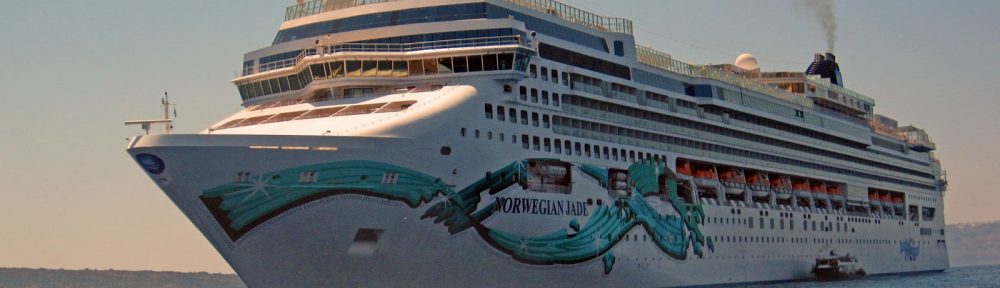
Norwegian Dawn: Mauritius blocks cruise ship over cholera fears

Mauritius has denied a Norwegian cruise ship permission to dock at the capital Port Louis over fears of a potential cholera outbreak on board.

At least 15 people on the Norwegian Dawn have been in isolation over suspected illness.

Mauritian authorities said the decision to block the ship was “taken in order to avoid any health risks”.

Samples were taken for testing on Sunday, with results expected to be known on Tuesday.

The passengers developed mild symptoms of a stomach illness during a trip to South Africa, a representative of Norwegian Cruise Line Holdings said.

Mary Francovilla Dees, 69, a passenger on the Norwegian Dawn told the BBC that despite the delay the atmosphere on the ship has been “fairly calm”.

“The passengers on this ship have appeared to take this in their stride,” she said.

Ms Francovilla says passengers have entertained themselves by sitting by the pool, attending shows and going to the bar.

A Dutch passenger on board told BN DeStem they were told there could be a cholera outbreak on board by the captain.

There have been cholera outbreaks in southern Africa over the last few months, with Zambia being hardest hit.

Since January 2023, at least 188,000 people have been infected with cholera across seven countries in southern Africa, according to the UN. More than 3,000 people have died.

“The health and safety of passengers as well as that of the country as a whole are of the utmost to the authorities,” the Mauritius Ports Authority said.

The ship arrived in Mauritius on Saturday evening after arriving a day early because it did not stop in Réunion Island.

There are 2,184 passengers and 1,026 crew members on the ship. About 2,000 planned to disembark in Port Louis, with another 2,000 expected to board at the same time.

Those who were disembarking or joining the cruise will now do so on 27 February, the Norwegian Cruise Line spokesperson said.

Expedia to raise $3.2bn funding ‘to survive’

Expedia to raise $3.2bn funding ‘to survive’

Expedia has named group vice-chairman Peter Kern as new chief executive and announced moves to raise $3.2 billion in funds.

Kern has been running Expedia with chairman Barry Diller since the removal of former chief executive Mark Okerstrom in December.

The $3.2 billion in new capital will come via a $1.2 billion investment by private equity firms Apollo Global Management and Silver Lake and $2 billion in new debt.

Apollo Global Management and Silver Lake will each receive a seat on the Expedia board.

The group also announced acting chief financial officer Eric Hart will take the role permanently. Hart took over from former chief financial officer Alan Pickerill, who left alongside Okerstrom.

Expedia said it would seek government aid in countries where it could and announced the furlough of employees and reduced hours of others, initially to the end of August

The group said executive salaries would be cut by 25% and board members be paid nothing for the remainder of the year.

In February, Expedia announced the loss of 3,000 jobs, 12% of its workforce, as Diller pronounced: “We are stopping doing dumb things.”

In a statement yesterday Diller said: “We have one mandate to conserve cash, survive and use this time to reconstruct a stronger enterprise.

“We are unable to make any predictions as to when travel will rebound but emphatically believe that it will.”

The $2 billion in debt will be raised through the issue of ‘senior unsecured notes’ (bonds) and is expected to close on May 5.

In a statement, Expedia said: “These efforts are part of a comprehensive strategy to enhance Expedia Group’s financial flexibility and strengthen its liquidity position.

Kern has been a member of Expedia’s board since 2005 and vice chairman since 2018. He was chief executive of Tribune Media until September 2019 and is a managing partner of private equity firm InterMedia Partners.

Hart has been with Expedia for 11 years and chief strategy officer since November 2019. He previously ran Expedia’s CarRentals.com brand for three years of oversaw corporate strategy.

Kern said: “Between the significant steps Expedia Group continues to take to simplify the business and this new funding, we are in a better position to rise to the current challenge and come out even stronger. We understand the financial challenges ahead.”

Carnival Corp boss denies sector was slow to react to coronavirus

Carnival Corp boss denies sector was slow to react to coronavirus

Carnival Corporation boss Arnold Donald has refuted suggestions the cruise industry was “slow” to react to the outbreak of coronavirus.

He argued that cruise is actually one of the best-placed sectors of travel to cope with anticipated stricter health and safety protocols in the future.

The chief executive of the nine-brand cruising giant said: “The cruise industry put a pause on the cruise before anybody else did. Before hotels or restaurants and other places of social gathering.

“Cruise ships are not the cause. Neither are they the reason for the spread.”

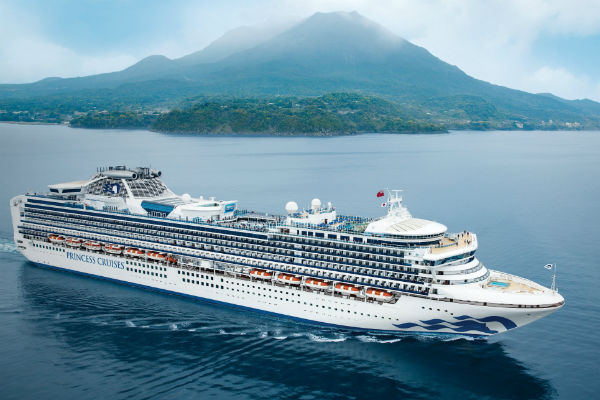
Commenting on the outbreak onboard Diamond Princess which was held in quarantine off Yokohama by Japanese authorities, Donald said: “This was an evolving situation. There was very little knowledge early on, in February and early March.

“But we did exactly what we were told to do. We co-operated fully with the Japanese Ministry of Health. They decided to hold the ship and put a quarantine in place, so we complied with that and at the same time, we tried to make it as comfortable as possible for our passengers and crew.”

And he added: “If you listen to our guests on Diamond or Grand Princess, you’ll hear lots of plaudits for our crew and our corporation. Our guests feel strongly that we did our best.”

Asked if he blamed authorities of the destinations and ports that wouldn’t allow ships with confirmed cased of Covid-19 to disembark passengers, Donald said: “I won’t sit and judge anybody at the moment. We all need to focus on helping.

“There were certain situations where we had ships with people on board that needed medical attention – not even Covid-19 related – that couldn’t get it in a timely manner they would have normally. That was unfortunate. There’s no question that happened and we tried to give assistance where we could. But I will not judge.”

Donald concluded: “So people say we were slow, but we were first [to suspend operations] – before all the other social gathering venues.”

And he added that cruise was well-placed for the future when stricter health and safety protocols are expected to be introduced across the travel industry.

“I don’t think there’s anything unique to this that particularly ascribable to cruise alone. In fact, in many ways, a cruise is better set up to handle this than society in general,” said Donald.

“We already do isolation, deep cleaning, hold medical records, do temperature scanning, use hand sanitizers and promote regular hand-washing. We also document a lot of passenger information. So we’re uniquely suited in some ways.

“Airport terminals? Not so much. Subways? Not so much. Hotels? Restaurants? Not so much,” he said.

But he added: “Covid-19 has its own epidemiology. Whatever the medical experts deem is necessary to deal with it in the future, we will cooperate and implement.”