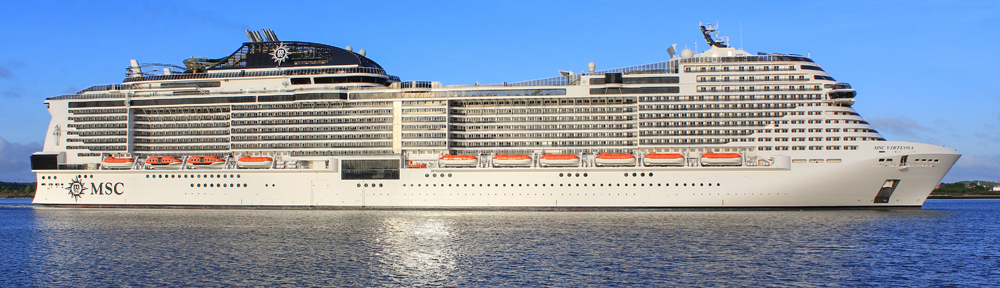

LNG-fuelled Arvia has been handed over by shipyard Meyer Werft to the UK’s P&O Cruises.
P&O Cruises president, Paul Ludlow, explains the sister ship of Iona, built in 2020, has taken the latter vessel’s general arrangement but has additional features.
He says, “Arvia is the latest evolution in the P&O Cruises experience, embodying the newest trends in travel, dining and entertainment, and is the epitome of a sunshine resort sailing year-round to the warmest climates. It takes its sister ship Iona’s design aesthetic and general arrangement but provides new and exciting outside and inside spaces which make the most of Arvia’s deployment to the Caribbean.”
Explaining the energy-efficient features, he points out Arvia is P&O Cruises’ second ship to be powered by LNG. Mr Ludlow adds, “As an Excel-class ship, Arvia has an optimised hull design to minimise drag and is installed with the latest energy-efficient technology on board.”
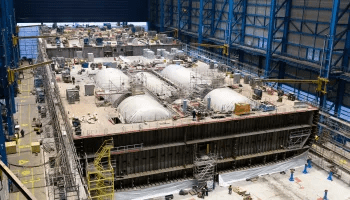
LNG tanks in the bowels of the ship.
The ship concept is based on the platform Meyer Werft has created for several brands of Carnival Corp. “Technically, the ship has been designed with tailor-made, optimised hydrodynamics and is equipped with the latest technology to minimise energy consumption while offering spacious public areas and cabins for passengers,” explains Meyer Werft communications manager Florian Feimann.
He points out that when the shipyard designed the class, there were no regulations by IMO or classifications for LNG use on passenger vessels. “Next to the development of the LNG propulsion system, the clarification and development of regulations were the major milestones. Meyer Werft was also involved in designing the regulations.”
Commenting on the use of LNG, Mr Feimann says, “In addition to reducing CO2 emissions, emissions of nitrogen oxides and particulate matter can be almost completely eliminated, and sulphur oxides completely avoided. All cruise ships in Meyer Werft’s current orderbook feature this low-emissions propulsion system.
According to SOLAS and SRtP regulations, there are two separate engine rooms with two engines each. These engines power generators, which power the electric engines in the Azipods.
While the technical aspects of Arvia are almost the same as Iona, there have been updates and changes carried out to the interiors of the ships.
The design features and venues were developed to create a ship that makes the “destination and sea the star”.
“The clear direction was to design and create spaces and ‘wow’ moments that celebrate the sea and bring the outside in, for example, SkyDome with its retractable roof and the Grand Atrium with widescreen ocean views which will be the focus of entertainment for the ship,” Mr Ludlow says, adding the interior also had to feature cues inspired by P&O Cruises’ “rich and proud nautical heritage”.
There is a broader choice of cuisine with new restaurants created exclusively for Arvia. Green & Co featuring Mizuhana offers guests, fish and plant-based dishes. Guests will be able to dine at the sushi bar and watch expert chefs at work or be seated at tables to enjoy the views out to sea.
6th Street Diner is an all-American diner serving breakfast, brunch, dinner and sweet treats, accompanied by great music and ice-cold cocktails.
Mr Ludlow says there are more experiential retail areas on board including an area showcasing the latest in tech at sea, a ‘design your own’ fine jewellery bar; and the first-at-sea Swarovski ‘Wonder Lab’ concept store featuring the latest crystal collections from Swarovski’s new creative director, Giovanna Engelbert.
New entertainment options include Altitude, Arvia’s outdoor adventure zone which features Altitude Skywalk, P&O Cruises’ first-ever high-rope experience, Altitude Minigolf and the new aqua zone at Splash Valley.
“Mission Control is also exclusive to Arvia and is a uniquely immersive experience combining an escape game with multimedia simulation and a live-action story to create a thrilling underwater challenge,” says Mr Ludlow.
Guests on Arvia will be able to watch the stage musical, Greatest Days – The Official Take That Musical which is an adaptation of the West End musical The Band, which features the songs of Take That and is by Olivier Award-winning writer Tim Firth. Arvia will also feature WaveLength, a new interactive gameshow, virtually starring presenter and game show host Ben Shephard.
And Infinity, P&O Cruises’ first swim-up bar, will give guests the opportunity to enjoy their favourite drinks.

Enter SkyDome
He explains there are more inside and outside spaces to enjoy, for example, the SkyDome will feature a retractable glass roof, creating a relaxed poolside environment with dining and drinking options for guests. “In the evening, the space will seamlessly transition into an entertainment venue, showcasing superb production shows, live music, guest act tributes and aerialist performances. Guests will also be able to enjoy blockbuster movies under the stars on the huge SeaScreen,” Mr Ludlow says.
Marine glazing specialist Brombach + Gess developed and delivered the retractable glass roof which consists of two sliding elements and a fore and an aft non-movable part. With an overall length of 43 m, a width of 34 m and a height above the baseline of 62 m, the roof adorning Arvia is an impressive highlight.
The roof structure is a grid construction with arches from starboard to portside and longitudinal beams made of welded rectangular hollow profiles. The roof structure is made of steel and weighs about 156 tonnes.
To keep the temperatures under the roof at a moderate level, the roof is equipped with durable solar control laminated safety glass. The glasses are glued on the steel structure, with sealing between the glass panes leaving the surface of the roof flat with no upstands that could accumulate residue, making it easy to clean the roof.
The roof is opened and closed using motorised worm gears and chains with a running speed of 1 m/min, allowing the roof to be converted within 10 minutes.
Brombach + Gess says, “Sliding roofs are a great solution to use on areas on a ship efficiently at any time – sudden changes in weather will not be a problem and the endless view is a great experience.”
Iona and Arvia: design differences
London and Prague-based international architecture and interior design practice Jestico + Whiles scooped interior designer contracts for P&O Cruises’ Iona and Arvia.
Jestico + Whiles associate director Jennifer de Vere-Hopkins tells PST’s sister publication Passenger Ship Interior & Refurbishment Review, “We were recommended to P&O Cruises, and they came to us because we are outsiders [to the cruise industry]. They wanted to work with a hospitality designer that could give fresh ideas and a new perspective.”

Within the hospitality sector, the firm’s designs range from the interiors of large hotels to one-off restaurants and bars. Projects include the Mandarin Oriental Palace, Lucerne and W Hotel Edinburgh.
Jestico + Whiles was one of three firms employed to design the interiors of the two ships. The company designed the Grand Atrium and many of the food and beverage areas.
Jestico + Whiles was tasked with making areas in Arvia look different to the first ship. Explaining one of the main differences, Ms de Vere-Hopkins says, “P&O Cruise’s brief was to accommodate the pop-up entertainment right in the centre of the atrium, rather than starboard like Iona. The lighting and sound are focused on the centre space with the redesigned staircase as a backdrop and a chandelier above.
“We want people to dance in the centre and we had an interesting design driver as you can’t dance on stone [which is in the Iona’s Grand Atrium]. We also set out to bring in a more natural feel to Arvia with wood, which is a perfect surface for dancing and one of the new design features is a ripple of wood across the floor.”


 Wetravel2u's Weblog