Preziosa will arrive in early October offering itineraries visiting five European cities, with its 2022/23 winter season due to run through to April 2023.
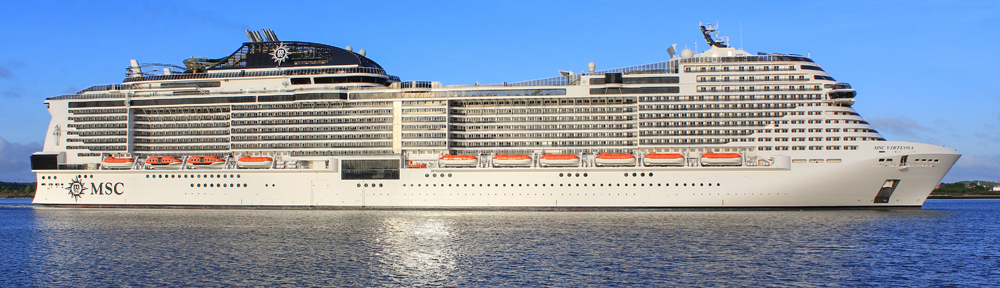
Sales will open in the coming days, said MSC. Preziosa will replace MSC Virtuosa, which will sail in summer 2022 from Southampton.
Virtuosa’s season will get underway with a Guernsey mini-cruise departing 29 April and will wrap up with a final Mediterranean sailing scheduled to depart on 4 November.
MSC managing director the UK and Ireland, Antonio Paradiso, said Preziosa’s deployment from Southampton underlined MSC’s commitment to the UK market and travel trade.
“We are proud that we are providing agents with such a variety of products to sell in the ex-UK space this year,” said Paradiso. “Sailing MSC Virtuosa from Southampton last year allowed us a great opportunity to access the new-to-cruise market, which made up 50% of our sales for summer 2021.”
Preziosa will offer a seven-night winter itinerary featuring five European city destinations, with calls in Hamburg, Zeebrugge (for Bruges and Brussels), Rotterdam (for Amsterdam) and Le Havre (for Paris).
Virtuosa, one of MSC’s newest ships and capable of carrying around 4,000 more guests than Magnifica, will offer a range of 20 itineraries including two-night mini cruises calling in Saint Peter Port in Guernsey to 12 nights exploring the Baltics or 14 nights exploring the Western Mediterranean.
MSC said, “high demand” for its summer 2022 sailings had led to the decision to bring Virtuosa back to UK shores. Passengers already booked on Magnifica will be automatically rebooked to the nearest like-for-like Virtuosa sailing.
Agents with booked guests and direct customers will be contacted with all information pertaining to the change.
MSC’s the UK and Ireland managing director Antonio Paradiso said the line “couldn’t turn down the opportunity” to bring Virtuosa back to Southampton after the success of its 2021 summer season.
“The feedback from passengers has been that they loved MSC Virtuosa and are eager to get back on board and explore more of the world on this fabulous ship,” Paradiso said.
“Despite the challenges of 2021 we had a record-breaking year with passengers sailing from Southampton, and it was great to see so many new-to-cruise guests amongst them.
“We have listened to the feedback from consumers and travel agents and have delivered itineraries with more choice, new destinations and longer cruises to warmer climates – all departing from Southampton.”
MSC added that current booking trends also meant it would base a ship in Southampton year-round in 2022 with the vessel due to be announced later this year.
Paradiso added: “Five years ago we announced our intention to grow our business in the UK market and I am pleased to say that this announcement is further evidence of our commitment to this target.
“We have made a series of investments, from increasing the number of sailings from UK ports visiting new and exciting destinations, to supporting the building of the new Horizon Cruise Terminal in Southampton, that all help us achieve our goal to give UK guests the holidays they want, and travel agents the cruises they want to sell.”
The news comes as MSC confirms its full fleet of 19 ships will be sailing by summer 2022, with its requirement for all guests to be vaccinated remaining in place.
MSC said it would continue to implement “the appropriate measures” to ensure guests can “enjoy one of the safest holidays options out there”.
“Our number one goal is reducing our emissions,” said Bill Burke, a chief maritime officer at Carnival Corporation.
That goal is a 40 per cent reduction in the company’s carbon emissions by 2030 when compared to a 2008 baseline, with carbon levels peaking for Carnival in 2011.
It’s a combination of efficiency and sustainability, Burke said.
That involves not only new efficient ships but finding more efficient equipment for the company’s existing fleet, making sure ships are operated well, meaning the right speeds, with the right engine loads.
“Voyage planning is another area where we are focused,” Burke said. “That sort of thing is ‘free,’ if we can get it right, it’s free savings.”
Burke has his sights set on HVAC system improvements as a key area where the company can save money on fuel and cut carbon emissions.
“The efficiency of the equipment has increased in the last few decades. If we haven’t already, we change out chillers and HVAC equipment,” he said.
One megawatt of savings translates roughly to about $1 million annually in fuel, Burke said.
“It’s then the money we can use for other things … it’s seed money to make ships more efficient.”
New Ships Get Efficient
New ships are generally 20 per cent more efficient per passenger than the last class, and that starts with the hull design, Burke said.
Then it’s a process of looking for the best and most efficient equipment fleetwide, with Carnival Corporate Shipbuilding in the UK focused on the job.
With the new deliveries of the AIDAnova, Costa Smeralda, Carnival Mardi Gras and P&O Iona, Carnival sister brands now have four technically identical new ships on the Carnival XL platform. Expect a lot of note comparing.
“We will compare performance, but a lot of that comes down to the itinerary,” Burke said, noting variables such as the speeds the ships travel at plus climate conditions driving air conditioning use.
Trying to compare performance, the company uses climate zones to normalize energy use when reviewing data.
That data becomes easier to use with ships in port, without a propulsion load, with Carnival now asking its brands to operate on just one generator while in port.
“The brands will make adjustments and we will help them with targeted investments to reduce the hotel load to allow them to first operate on one generator (in port) and then get the load lower. We’ve dropped the electrical load down by several megawatts.”
Ships are compared against each other with adjustments for size and climate conditions, with Carnival using its own port power coefficient to measure power usage by ship while docked.
2030 Goal
By 2030 Burke envisions what he called a green fleet with nearly 20 per cent of Carnival Corporation ships powered by LNG.
“Both LNG and non-LNG ships would get some portion of their fuel from biofuels. Batteries would be on a number of ships for peak shaving and non-LNG ships would operate advanced air quality systems (scrubbers),” Burke said.
Those ships running scrubbers would have wash-water filtration and significantly reduced particulate.
“All ships would have achieved our port power coefficient goals and easily operate in port in all climate conditions on a single diesel generator, indicating efficient port hotel service operations.”
Another project is a single fleet-wide maintenance and procurement system.
“That will allow us to better leverage our scale and remove excess inventory.”
Burke also plans to add more courses to the company’s Arison Maritime Center (CSMART) in the Netherlands.
“In addition to operational team training for our officer core, we do have energy efficiency training and we will expand that.”
Many ships, continued Burke, will have air lubrication systems, adding that around 60 per cent of the fleet will be able to plug into shore power by 2030. Another three-quarter of the fleet will have advanced wastewater purification systems, and all ships will have food waste digesters.
“Our ships will be completely instrumented for measuring the efficiency of our largest power consumptions … you have to be able to measure (consumers) to know how you’re doing.”
Data will result in self-correcting behaviour that will improve operational efficiency, according to Burke, who said the ships will continue to get more sensors and measuring capability.
“We will be well on our way to designing and building our first zero emissions and zero discharge ship … that’s the biggest challenge and we hope our work with LNG will have us well prepared for that next fuel.”


 Wetravel2u's Weblog