Carnival Corp said on Friday it was planning to resume operations in a phased manner and would operate with a smaller fleet on its return, months after suspending trips due to the COVID-19 pandemic.
The company’s shares, that have lost more than two-thirds of their value this year, rose as much as 11% to $16.12 in morning trading.
The world’s largest cruise operator said it has reduced capital expenditures by more than $5 billion over the next 18 months and raised a couple more billions to navigate through the virus outbreak.
The cruise business has been one of the worst-hit after several ships, including some owned by Carnival’s Princess Cruises, became coronavirus hotspots.
To survive through the pandemic, cruise operators have raised billions through various means, even pledging ships and private islands.
Carnival alone, raised over $10 billion through a series of financing transactions since voyages were paused, enough to withstand another full year in a zero-revenue scenario, Chief Executive Officer Arnold Donald said on a conference call.
As it restarts voyages, the company expects future capacity to be moderated, while some ships could be removed and new deliveries would be delayed, Carnival added.
“We are also reorganizing the company to emerge stronger, leaner and more efficient,” Donald said.
“Even when we return to full-scale operations, we don’t expect to return to the same staffing requirements as we are addressing our work streams to work in a more efficient manner.”
The 13 ships expected to leave the fleet represent a nearly 9% reduction in current capacity, and the company expects only five of the nine ships originally scheduled for delivery to be delivered.
On Thursday, Carnival said it would resume voyages run by its German cruise line AIDA next month. (Reporting by Nivedita Balu in Bengaluru; Editing by Anil D’Silva and Shounak Dasgupta)
Carnival Triumph’s transformation into Carnival Sunrise includes a suspended ropes course as part of its sports square (credit: Andy Newman)Carnival Triumph’s transformation into Carnival Sunrise includes a suspended ropes course as part of its sports square (credit: Andy Newman) Carnival Cruise Line vice president revitalisation and hotel refurbishment Lisa McCabe opens up on the transformation of Carnival Sunrise and how this will be incorporated into Carnival Victory’s revitalisation In 2019 Carnival Cruise Line carried out the largest refurbishment in its history – and it is using those learnings as it plans a major retrofit for Carnival Sunrise
Carnival Cruise Line vice president revitalisation and hotel refurbishment Lisa McCabe explains “At US$200M, the transformation of Carnival Triumph into Carnival Sunrise was the largest single-ship refurbishment in our company’s history, involving a 38-day drydock in Cadiz, Spain with 7,000 ship employees and contractors working 24/7 to make Carnival Sunrise a reality.
“Given the complexity of the refit, the process was streamlined and efficient. The end result is simply amazing – new dining and beverage outlets, exciting top-deck attractions including a massive water park and a suspended ropes course, updated staterooms and suites, enhanced guest flow and a more contemporary feel overall.”
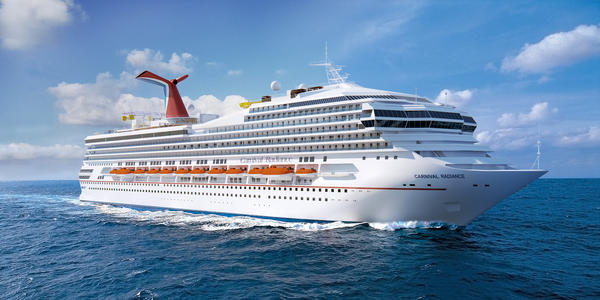
The company is now gearing up for another major transformation – that of Carnival Victory’s transformation into Carnival Radiance.
Carnival Sunrise includes exciting new top-deck attractions, including a massive water park (credit: Andy Newman)
Enter Carnival Radiance
Ms McCabe says “We learned so much from the Carnival Sunrise drydock and have incorporated these learnings as we began the planning for Carnival Victory’s transformation into Carnival Radiance. Not only in the work itself but in all aspects of the refit, from staffing, working with suppliers and vendors and the logistical challenges that come with a project of this magnitude. Our designers have also changed the layout for Carnival Radiance – relocating the Guy Fieri BBQ to enhance visibility and ultimately drive more traffic.”
Carnival Radiance will also feature the first Big Chicken restaurant by its Chief Fun Officer Shaquille O’Neal. “Incorporating a brand new restaurant concept into a renovated ship has its share of challenges – from sourcing materials to equipment and logos – but we worked closely with our internal design teams as well as Shaq’s personnel to create a dining venue we’re sure our guests will enjoy,” says Ms McCabe.
Elaborating on Carnival Cruise Line’s refurbishment strategy, she says “All 27 of our ships undergo a refit every few years and between 2020 and 2021, 13 ships – roughly half our fleet – will undergo a drydock with the work being done varying by ship. Interestingly, because of a lack of drydock space here in North America, we’re refurbishing more ships in Europe which can create even more logistical and staffing challenges given that it’s not as close as our other facilities and we have to sail across the Atlantic just to get there and back. Our marketing and itinerary planning teams are hard at work creating attractive new transatlantic crossings for our guest.”
She expands that every ship in the fleet will undergo at least one major refurbishment during its lifetime and “our focus is making sure we are able to schedule these drydocks and closely manage not only the schedule but also staffing, logistics, design and provisioning to ensure we deliver a quality refit on time and on a budget”.
These refits are part of a US$2Bn ship enhancement project that is introducing new features and standardising offerings across the fleet.
Popular amenities
Ms McCabe says “With many of these refurbishments, we are adding spaces that have proven very popular with our guests – the Caribbean-inspired RedFrog Pub, the cocktail pharmacy-themed Alchemy Bar, expansive water parks and the transformation of the three-deck main theatre into the multi-purpose Liquid Lounge across two decks which allows for a more intimate space with enhanced sightlines while at the same time providing an opportunity to add staterooms in the previous space.”
She points out that the upcoming refurbishment of Carnival Miracle will mark the installation of the 27th Guy’s Burger Joint by longtime partner and Food Network star Guy Fieri so the venues are now available fleetwide.
Asked about the current challenges when it comes to refurbishing the interiors of the cruise ships, Ms McCabe says “Refurbishing ship interiors is an extremely involved and complex process that begins several years before the refit actually takes place. It is imperative that we come up with creative solutions that offer the guest new experiences while also satisfying the needs of our operational teams on board. Real estate is very valuable, and it is important to make spaces multifunctional. In addition to securing quality vendors and subcontractors to refurbish the space the way it was designed, the overall look and feel have to be eye-catching, functional and timeless as it will likely be on the ship for many years.”
Sustainability is also a priority when it comes to interior refits. Ms McCabe says “Being a leader in environmental stewardship is a top priority for Carnival Cruise Line and this, of course, extends to our ship refurbishment programme. We take sustainability into account in everything we do – from the materials, we source to the vendors we use and how they work is carried out each day. We are constantly evaluating our procedures and processes to make sure we are operating in a way that reflects our commitment to being an environmental leader.”
Snapshot CV: Lisa McCabe (Carnival Cruise Line)
Lisa McCabe joined Carnival Corp in 2009 and moved to Carnival Cruise Line to build the refurbishment department in 2012.
She leads a team of project managers responsible for most of the cruise line’s large-scale drydock projects throughout the fleet that includes adding new branded food and beverage venues, stateroom renovations and additions, water parks and upgrades to crew spaces. During her time at Carnival Cruise Line, Ms McCabe has been responsible for over 500 refurbishment projects in shipyards throughout the US, the Bahamas, and Singapore.
Ms McCabe studied interior design at Florida International University and has focused her career on refurbishing ships.
A brand-new Terminal 3 is nearing the final stages of construction for Carnival Cruise Line at Port Canaveral, along with a 1,800-spot parking garage, all in preparation for the new Mardi Gras which will become the first LNG-fueled ship in North America.
Projections call for just under five million cruise guests in the fiscal year 2020, and over 5.6 million by 2024.
For port CEO Captain John Murray, the planning started years ago, wanting to be ready for LNG-fueled ships. The effort has paid off as Port Canaveral will host the Mardi Gras year-round and is expected to be home to Disney’s LNG-fueled ships as well.
“We are growing consistently,” Murray said. “All our cruise lines are very strong and over the next few years they plan to add additional ships.
“We are going to become the Florida port that can expand as the tonnage will be on the market and there won’t be as many berthing options in Florida as there have been in the past.”
Other big news at Port Canaveral includes the summer arrival of Marella Cruises in 2021, a deployment move announced late last year that had been in the works since 2017, said Robert “Bobby G” Giangrisostomi, vice president, cruise business development.
“They were looking for an American product,” he said, adding that the port’s proximity to Orlando was key.
Long term, the big homeport customers have major deals with Port Canaveral, including Carnival, Royal Caribbean and Disney, and Murray said in November he was negotiating a new deal with Norwegian.
With options, Carnival’s latest arrangement could extend to 45 years. For the port, terminal infrastructure is about building smart. “Flexible terminals,” commented Giangrisostomi. “A 1,200-foot ship can have up to 7,000 passengers. You have to be flexible. LNG ships, big ships, medium ships and Port Canaveral can handle them all.”
Deals also include more parking infrastructure, which may not be as long term.
“We have to look at what the concept of parking could be in 10 years,” Murray said, noting autonomous vehicles and an 83 per cent jump in Uber and Lyft usage at the port year-over-year.
Shorter cruises? Plan for more drive-in passengers. Estimates suggest that 40 to 60 per cent of guests embarking at Port Canaveral are drive-in customers.
“We are 200 miles closer to the entire Southeast,” explained Giangrisostomi
Another metric that is up is port-of-call business. With an expected 83 transit calls this year, that number jumps to just over 100 next year with more visits from the Oasis of the Seas sailing from Bayonne.
“Our port-of-call business is substantial,” added David German, director, cruise business development. “It’s good for the local community, with 6,000-plus passengers.”
The out-island arms race has paid dividends to all the Florida ports, Murray added. With cruise lines spending big developing their own destinations in the Bahamas, they have a reason to keep ships in nearby homeports.
New facial recognition has sped up clearing ships with U.S. Customs and Border Protection, which can now happen in as little as two hours for 5,000 disembarking guests.
“They clear the ship very quickly. It helps the cruise lines get to zero counts much sooner,” Murray said.
“Being ready and out front for our cruise customers,” Murray answered when asked about how to run a cruise port successfully. “The guests are the most important part of our operation … easy in, easy off, easy on the ship, easy off the ship. We want to be number one in customer service … It boils down to the end-user.”