Norwegian Upholding Cruise Industry’s Clean Air

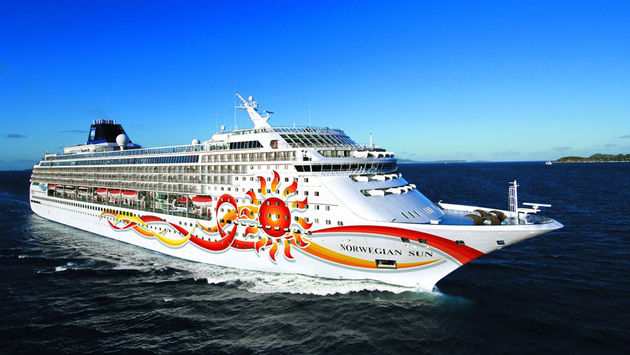
Norwegian Cruise Line, Norwegian SunPHOTO: Norwegian Cruise Line’s Norwegian Sun. (photo courtesy of Norwegian Cruise Line)
The cruise industry is collectively striving for cleaner air standards internationally, and Norwegian Cruise Line is doing its part by having environmentally enhanced its Norwegian Jade and Norwegian Sun.

“We have both a moral responsibility and business imperative to sustain the places we sail and the communities that support our industry,” said Cindy D’Aoust, president and CEO, Cruise Lines International Association (CLIA), in a press release.

“Through innovative and state-of-the-art air emissions programs, we make clean ocean air one of our top priorities.”

Norwegian specifically retrofitted the Jade and Sun with a new Exhaust Gas Cleaning system. Combined with the line’s Sail & Sustain environmental program, the technology will help to dramatically lower air emissions.

The exhaust scrubbers remove sulfur oxide and particulate matter prior to emissions exiting the ships’ smokestacks. Each vessel received five such scrubbers, one per engine. Together, they can reduce sulfur by up to 99 percent and 85 percent of particulates. Combined, the Jade and Sun will lessen the equivalent of around 3,000 tons of Sulfur Oxide, SOx, gas during the coming years.

As a whole, CLIA Cruise Line Members—Norwegian included—are always investing in new ship designs and innovative technologies. One objective is to reduce new marine vessel CO2 emissions by 30 percent come 2025. Other goals include lowering fuel consumption by 5 percent by applying hull paints with special non-toxic coatings and producing emissions-free energy via solar panel installations.

To such ends, the industry has collaborated with the likes of the International Maritime Organization (IMO) in order to regulate environmental standards. It has also gathered NGOs and maritime stakeholders to share air emission reduction concepts.

Port destinations additionally partner with cruise brands to better the environment as the Port of Seattle has. The facility has even awarded lines for their shared commitment towards green initiatives.

“We at the Port of Seattle observe year after year the cruise industry’s commitment to reducing emissions while in port by using shore power and exhaust gas cleaning systems,” said Port of Seattle Commissioner John Creighton, in the release.

“As part of our port community, cruise lines share our goals to reduce maritime-related emissions while maintaining a vibrant harbor. We look forward to our continued relationship with the industry and partnering on our mutual efforts to protect Seattle’s natural environment and air.”

Within the Norwegian fleet, the Jade and Sun represent two of what will soon be eight ships that have installed the scrubber technology. The Norwegian Escape, Norwegian Gem, Norwegian Joy, Norwegian Pearl and Pride of America already utilize the system, and the upcoming new Norwegian Bliss will launch with it in June 2018.

Norwegian is on its own way to achieve its MARPOL Annex VI compliance objective to lower its global sulfur cap from 3.5 percent to 0.5 percent by 2020.

Besides clean air goals, the line’s Safety and Environmental Protection Policy calls for lessening overall operational impact on the environment, disposing of waste according to domestic and global regulations, the recycling and reuse of materials, and targeting other means to improve the environment via management.

All of this is to say the cruise industry—although environmentally imperfect at times—is making concerted efforts to be the best it possibly can be. Provided brands like Norwegian Cruise Line continue to do their part and uphold the standards they themselves pioneer, the earth and travelers will thank them.

For more information on the industry’s environmental efforts, visit https://www.cruising.org/about-the-industry/research.

The Cruise Industry Remains Committed to the Environment

The Cruise Industry Remains Committed to the Environment
PHOTO: Holland America Line’s Westerdam in Alaska. (photo by Jason Leppert)
 

President Donald Trump may have announced that he will be pulling the US out of the Paris climate accord, but the worldwide cruise industry remains committed to environmental protection.

Cruise Lines International Association (CLIA) recently outlined the many ways conservation is promoted within.

“The cruise industry recognizes the importance of taking active measures to preserve our environment and we are constantly striving to develop more eco-friendly practices that enable travelers to stay green’ while traveling,” said Cindy D’Aoust, president and CEO, CLIA, in a press release. “Cruise lines have continued to offer new incentives for earth-friendly travel and know that this attention to our own environmental impact is not only beneficial, it is vital.”

The following are among the many eco-friendly programs and incentives:

Green Policies

Lots of cruise ships partake in recycling and waste treatment at sea as well as on land. Seabourn, for example, specifically utilizes advanced waste water treatment systems and environmentally-friendly cleaning supplies. It also recycles and donates reusable items.

It continues to increase fuel efficiency every year with new ships including low-flow passenger toilets, sinks and showers.

Dedicated Officers

Many CLIA Members employ dedicated officers charged with daily environmental program oversight. Each Disney Cruise Line ship stations Environmental Officers to check water quality and supply. It trains these officers and crew on waste minimization and environmental safety while supervising initiatives such as recycling.

Sustainable Practices

Cruise lines frequently collaborate with eco-friendly vendors and destinations that seek to reduce their carbon footprint. For one, Uniworld Boutique River Cruise Collection works with environmentally-conscious businesses like organic wineries.

Smart Ships

Smart technologies allow modern ships to conserve energy, water and fuel. Examples include Carnival Cruise Line’s partnership with the South Coast Air Quality Management District, the City of Long Beach, California, and Southern California Edison on shore power.

Similarly, Royal Caribbean International’s Quantum-class and Harmony of the Seas smart HVAC have dropped cooling energy consumption by a quarter.

Waste Minimization & Creative Composting

Up front, cruise lines work to reduce supply packaging and then compost food waste. In fact, MSC Cruises uses incinerators, food pulpers, grinders and compactors for garbage processing while Costa Cruises was the first travel company to sign the Milan Protocol.

Solar Sailing

For ships that can, energy waste is reduced by utilizing renewable battery power and solar energy for some systems. AmaWaterways’ Zambezi Queen employs low-emission generators by day and batteries by night, using solar heating for its hot water supply.

Cruise for the Earth

Green voluntourism is available to guests who want to travel and better the world. Azamara Club Cruises has partnered with World Wildlife Fund, and WWF guest speakers are featured on some sailings.

Corporate cousin Celebrity Cruises also encourages Celebrity Xpedition guests to plant trees in Galapagos National Park in support of the Scalescia reforestation effort.

Wildlife Conservation

The environment’s inhabitants are just as important to cruise lines, and Holland America Line has an “Avoiding Whale Strikes” training program in cooperation with National Oceanic and Atmospheric Administration’s (NOAA) and the National Parks Service.

All the company’s deck officers have gone through the course, which is also being shared broadly with the cruise and maritime community.

Proper Disposal

Another crucial element of environmental protection is for crew members and guests to remove garbage responsibly. Crystal Cruises, for instance, promotes its “Crystal Clean” initiatives to communicate environmental education. Of course, it’s important to properly recycle and reuse not only paper and plastic but also glass, aluminum, scrap metal, cooking oil, petroleum oil, toner cartridges, electronics and certain chemicals.

Smarter Sewage

Lastly, technology can also assist in lessening the impact of sewage and water waste, as Avalon Waterways has found with its multi-step procedure and specialized onboard sewage treatment system.

Cruise Industry Celebrates Record-Breaking Year

Cruise Industry Celebrates Record-Breaking Year

Carnival Liberty
PHOTO: Carnival Cruise Line’s Carnival Liberty. (photo via Flickr/Roderick Eime)

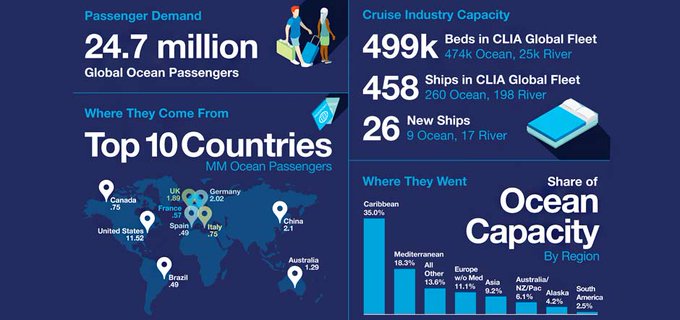
The cruise industry hosted a record 24.7 million ocean passengers around the globe last year, according to new data released by Cruise Lines International Association (CLIA) Tuesday.

The figure topped projections by 500,000 and is up from 23.2 million in 2015.

The Caribbean was the most popular destination for ocean cruisers last year, accounting for a 35 percent share of capacity. Next came the Mediterranean (18.3 percent) and Europe (11.1 percent) while Asia (9.2 percent), Australia/New Zealand/Pacific (6.1 percent) Alaska (4.2 percent) and South America (2.5 percent) rounded out the seven most-visited regions in 2016.

CLIA credits the positive growth to continued development in the Asian market as well as more than two dozen new ships joining its fleet in 2016, including nine new ocean vessels. The 26 new cruise ships introduced last year expanded passenger capacity by 28,000.

According to CLIA, capacity in Asia climbed to 9.2 percent last year, representing a 38 percent increase from 2015. What’s more, Asian travelers are taking shorter cruises and taking them more frequently the trade association has found.

Beyond the booming Asian market and an ever-expanding fleet, CLIA president and CEO Cindy D’Aoust attributes the industry’s growth to its ability to provide travelers with exactly what they’re looking for.

“One of the many reasons that the cruise industry continues to thrive is because of the personalization it is able to offer to its guests from around the world,” D’Aoust said in a statement. “Never before have I been a part of or seen an industry that is so good at listening and reacting to what its customers want, and this is why we are going to see our industry continue to grow.”

As TravelPulse cruise expert Jason Leppert points out, cruise lines are also winning over the all-important millennial market with exciting onboard attractions and kid facilities for younger passengers traveling with children.

Unsurprisingly, CLIA projects another year of encouraging growth on the ocean: The association is forecasting 25.8 million global passengers for 2017.