Norwegian Cruise Line Holdings: Virus depressing bookings globally

The Norwegian Spirit has been moved from Asia to Europe.

The coronavirus Covid-19 outbreak has caused a slowdown in new bookings and increased cancellations worldwide, Norwegian Cruise Line Holdings reported to investors today.

NCLH CEO Frank Del Rio said that the impact of the virus extends beyond Asia, threatening what in early January looked to be the start of a record year for the company.

“The resiliency of our business model will be tested once again by a noncontrollable external factor,” he said. “The effect of the coronavirus outbreak on our business has been swift and severe and the continuous global headline news coverage has been substantial and relentless.”

NCLH said in an earnings release that it has cancelled 40 cruises across its three brands due to the outbreak: 10 on Oceania, six on Regent Seven Seas, and 24 on Norwegian Cruise Line (21 were on the Norwegian Spirit, which was redeployed to the Eastern Mediterranean from Asia earlier this month.

NCLH CFO Mark Kempa called the outright cancellation of cruises on Oceania and Regent Seven Seas “a significant impact for us.”

Image result for regent seven seas asia cruises

“Those are very long lead-booking itineraries with very high per diems,” he said. “Those voyages were completely sold out.”

Despite the Spirit’s extremely condensed booking window, Del Rio said the relocation of the ship provides the best opportunity to maximize its earnings and revenue potential and “demonstrates our nimbleness and ability to redeploy our assets as necessary.”

Looking ahead, Del Rio said that “given the unknown duration and severity of the outbreak, there may additional impacts that are not yet quantifiable. It is affecting the broader consumer demand environment that extends to our global deployment outside of Asia, which cannot be quantified at this time.

“The cruise industry was at the forefront of headline news for reasons that we know and that has caused near panic in the travelling public,” he added. “So, we’ve seen a meaningful decrease in new bookings. A meaningful increase in cancellations. Not just for our Asia sailings but throughout the deployment.”

Del Rio said he’s heard from travel partners and business partners that they are seeing similar trends across their portfolios.

“Business is soft, people are scared to travel,” he said. “Until we see the levelling off of new cases and the cruise industry not being the poster child for the virus, this may continue for some time.”

But he also said that “nothing is permanent.”

“Consumers do have a relatively short memory, thank god. We have seen other major events affecting the cruise industry that were quickly overcome,” Del Rio said.

Silver linings 

Del Rio also pointed to “silver linings,” including what he called the “underlying resilience of our business and potential for a reasonably timed recovery.”

The strong booked position prior to the outbreak, he said, “demonstrates the strong demand fundamentals of our business.”

He also said that in the past five days, NCLH has seen an improvement in week-over-week booking volumes and a decrease in cancellations compared with the prior three weeks.

“I don’t want to call it a turnaround trend just yet, but it is at least one data point of a possible positive change,” he said.

“We are no longer seeing a week-over-week acceleration in the declines in bookings and increases in cancellations. We’re seeing a moderation.”

Del Rio said the bookings decrease is similar to what the company experienced during similar geopolitical events and the financial crisis a decade ago. The difference with this crisis, he said, is the increase in cancellations.

“As an industry and company, we have faced and overcome challenges similar to Covid-19,” Del Rio said.  “I am confident this challenge will not be different. It usually takes eight-plus weeks from the time the news cycle peaks to when we can expect a return to normal booking patterns. It’s not a question of if, but when.”

Coronavirus: Royal Caribbean Cruises to deliver one million surgical masks to China

Image result for spectrum of the seas

Royal Caribbean Cruises will deliver a million protective surgical masks into China as the country battles to contain the coronavirus outbreak.

Richard Fain, the chairman and chief executive of Royal Caribbean Cruises, said the cruise company would work with suppliers to deliver the N-95 protective masks to China for the country’s government.

Face masks are reportedly selling out in cities across Asia as concerns over the virus grow.

More than 1,300 people are known to have died from the virus, including six health workers in China.

Local authorities in the country have reportedly struggled to provide protective equipment such as respiratory masks and goggles in hospitals, according to the BBC.

Fain said: “We admire the all-out efforts of the Chinese government and people to address this crisis and we want to bring our resources to bear to help their efforts.”

Royal Caribbean International president and chief executive Michael Bayley said the line would move a ship to China to carry out a series of complimentary sailings to thank medical personnel once the virus outbreak had ended.

Royal has also revealed that Spectrum of the Seas will offer complimentary cruises sailing from Sydney for Australia’s first responder community and Celebrity Millennium will provide ex-US sailings for firefighters in California following the wildfires.

Coronavirus: Americans from quarantined cruise ship flown from Japan

Image result for diamond princess ship
Diamond Princess

Two planes carrying hundreds of US citizens from a coronavirus-hit cruise ship have left Japan, officials say.

One plane has landed at a US Air Force airbase in California, and its passengers will be isolated at military facilities for 14 days.

There were some 400 Americans onboard the Diamond Princess. The ship with some 3,700 passengers and crew have been in quarantine since 3 February.

Meanwhile, China reported a total of 2,048 new cases on Monday.

Of those new cases, 1,933 were from Hubei province, the epicentre of the outbreak.

More than 70,500 people across China have been infected by the virus. In Hubei alone, the official number of cases stands at 58,182, with 1,692 deaths. Most new cases and deaths have been reported in Wuhan, Hubei’s largest city.

In other developments:

  • In Japan, a public gathering to celebrate the birthday of new Emperor Naruhito later this week has been cancelled, due to concerns over the spread of the virus while organisers of the Tokyo marathon due to take place on 1 March are considering whether to cancel the amateur part of the race, reports say
  • In China, the National People’s Congress standing committee said it would meet next week to discuss a delay of this year’s Congress – the Communist Party’s most important annual gathering – because of the outbreak
  • At the weekend, an American woman tested positive for the virus in Malaysia after leaving a cruise liner docked off the coast of Cambodia
  • A Russian court has ordered a woman who escaped from a quarantine facility to go back and stay there until she is confirmed to be disease-free Fontanka news agency reports. Alla Ilyina has until Wednesday to return
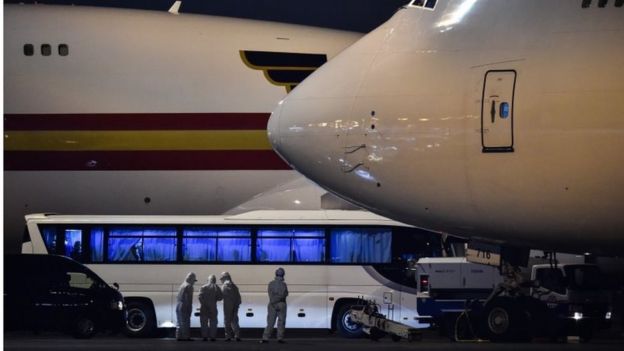
Aircraft wait to take Americans home from Japan after they were taken off the quarantined cruise ship, Diamond Princess, 17 February 2020
Those bound for the US left from Tokyo’s Haneda Airport

What’s happening on the Diamond Princess?

The cruise ship was put in quarantine in Japan’s port of Yokohama after a man who disembarked in Hong Kong was found to have the virus.

On Monday, Japanese officials said there were 99 new cases of infections on board the ship, bringing the total to 454 confirmed cases. It is the largest cluster of cases outside China.

A Russian woman who was onboard and tested positive is thought to be the first Russian national to contract the virus after the two previous cases found in Russia were Chinese nationals, Reuters news agency reports.

She will be taken to a hospital for treatment, the Russian embassy in Japan said.

At least 40 US citizens who were on board are infected and will be treated in Japan, Dr Anthony Fauci, Director of the National Institute of Allergy and Infectious Diseases told US broadcaster CBS.

The two aircraft chartered by the US government left Tokyo’s Haneda Airport in the early hours of Monday. The second flight was due to land at another base in Texas.

More than 300 passengers are being repatriated voluntarily, the US state department said. Fourteen of them were reported during transit to have tested positive for the virus and were being kept separate from the other passengers, it said.

Those entering the US will undergo a 14-day quarantine, on top of the time they have already spent confined on the ship.

“And the reason for that,” Dr Fauci added, “is that the degree of transmissibility, on that cruise ship, is essentially akin to being in a hotspot.”

Some of the Americans have declined to be evacuated, preferring to wait until the ship quarantine comes to an end on 19 February.

Passenger Matt Smith, a lawyer, said he would not want to travel on a bus to the plane with possibly infected people.

Presentational white space

To assist with relief efforts, Japan’s government has given away 2,000 iPhones to passengers on the ship – one for each cabin.

The smartphones were distributed so people could use an app, created by Japan’s health ministry, which links users with doctors, pharmacists and mental health counsellors. Phones registered outside of Japan are unable to access the app.

Other evacuation flights have been arranged to repatriate residents of Israel, Hong Kong and Canada. On Monday, Australia announced that it would evacuate 200 of its citizens too.