Cruise Lines 2019 Q4 Breakdown: By the Numbers

Seabourn, Royal Caribbean and AIDA Ships in Antigua

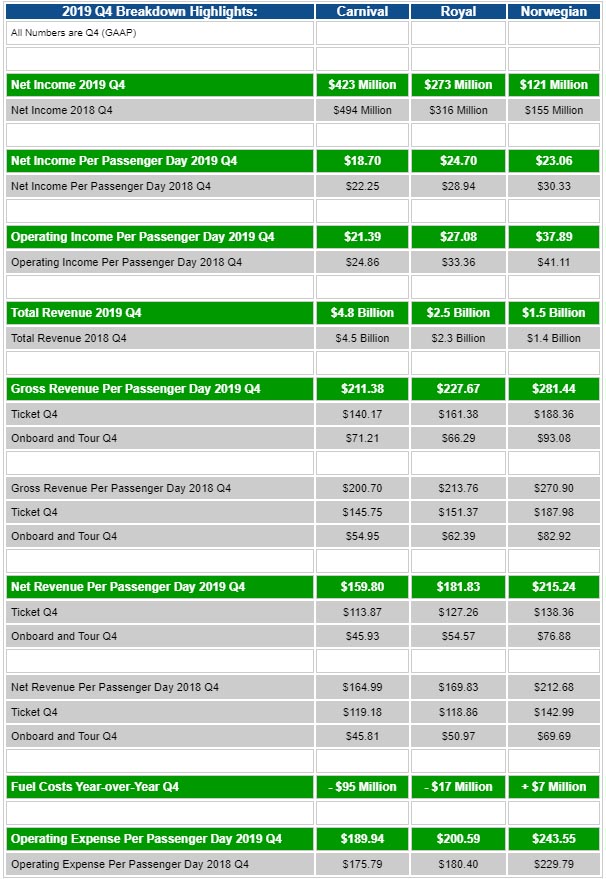
Cruise Industry News takes a look at the financial performance of the “big three” following the final quarter of 2019.

Takeaways:

While gross revenue was up for Q4 2019 for the three publicly-traded cruise companies, increased operating expenses led to reduced operating income, net income and net income per passenger day, compared to Q4 for the previous year.

Net revenue per passenger day was also down year-over-year for Carnival Corporation, up noticeably for Royal Caribbean and up slightly for Norwegian.

Gross revenue per passenger day was significantly up for all three companies, including onboard spending, with gross ticket revenue per day also up for Royal Caribbean and Norwegian, but down for Carnival.

Carnival saw the biggest difference between gross and net onboard revenue: more than $25, making it flat with last year, while Royal had nearly a $12 drop and Norwegian a little more than $10, and up from last year.

Both Carnival and Royal Caribbean saw a decrease in fuel costs year-over-year while Norwegian saw its fuel spend to go up.

Carnival cited the regulatory change preventing travel to Cuba, geopolitical events in Arabian Gulf, Hurricane Dorian, an unscheduled drydock, and multiple shipyard delays. Royal cited the Oasis drydock mishap, Cuba and Hurricane Dorian, and Norwegian also cited Cuba and Dorian.

Because of the fleet mix, Norwegian continued to generate the highest gross and net ticket and onboard spend revenue.
2019 financeCruise Industry Financial Tracking

The Cruise Industry Financial Tracking Report provides an in-depth look into the financial metrics of the leading cruise companies. Learn more.

Included: Carnival, Royal Caribbean, Norwegian, MSC, Star/Genting, Royal Olympic, P&O Princess, Regent, American Classical Voyages and Commodore.

Key metrics include revenue, operating expenses, operating income and net income, as well as those metrics on a per passenger day basis. We also look at EPS, fleets, berths and passenger cruise days.

Coronavirus: Slump in-demand set to cost airlines almost $30bn

Image result for airlines

A slump in demand due to the coronavirus outbreak is set to cost the global airline industry $29.3 billion in lost revenue this year.

The bulk of the revenue loss – $27.8 billion – will hit carriers in the Asia-Pacific region, as Iata warned that 2020 would be a “very tough” year for the sector.

An estimated $12.8 billion will be lost in the Chinese domestic market alone with those outside the region expected to lose $1.5 billion in revenue, the airline trade body calculated.

The total forecast drop in demand of 4.7% would wipe out expected growth this year, resulting in a 0.6% contraction in passenger demand for the year.

This would represent the first overall fall in demand in more than a decade.

The estimated impact of coronavirus assumes that the centre of the public health emergency remains in China.

If it spreads more widely to Asia-Pacific markets then impacts on airlines from other regions would be larger, according to Iata.

The estimates are based on a scenario where coronavirus has a similar impact on demand as was experienced during the SARS outbreak in 2003.

“That was characterised by a six-month period with a sharp decline followed by an equally quick recovery,” Iata said.

“It is premature to estimate what this revenue loss will mean for global profitability. We don’t yet know exactly how the outbreak will develop and whether it will follow the same profile as SARS or not.

“Governments will use fiscal and monetary policy to try to offset the adverse economic impacts. Some relief may be seen in lower fuel prices for some airlines, depending on how fuel costs have been hedged.”

Iata director general and chief executive Alexandre de Juniac said: “These are challenging times for the global air transport industry. Stopping the spread of the virus is the top priority.

“Airlines are following the guidance of the World Health Organisation (WHO) and other public health authorities to keep passengers safe, the world connected, and the virus contained.

“The sharp downturn in demand as a result of COVID-19 (coronavirus) will have a financial impact on airlines – severe for those particularly exposed to the China market.

“We estimate that global traffic will be reduced by 4.7% by the virus, which could more than offset the growth we previously forecast and cause the first overall decline in demand since the global financial crisis of 2008-09. And that scenario would translate into lost passenger revenues of $29.3 billion.

“Airlines are making difficult decisions to cut capacity and in some cases routes. Lower fuel costs will help offset some of the lost revenue. This will be a very tough year for airlines.”

De Juniac called on governments to provide support. He said: “We have learned a lot from previous outbreaks, and that is reflected in the International Health Regulations (IHR). Governments need to follow these consistently.”

He added: “Airlines and governments are in this together. We have a public health emergency and we must try everything to keep it from becoming an economic crisis.”

Iata medical advisor Dr David Powell advised: “If you are sick, don’t travel.

“If you have flu-like symptoms, wear a mask and see a doctor. And when you travel wash your hands frequently and don’t touch your face.

“Observing these simple measures should keep flying safely for all.”

Coronavirus Could Pose Threat to Cruise Ship Credit Ratings

The cruise ship Diamond Princess is docked at the port of Yokohama, south of Tokyo, in this photo taken by Kyodo February 7, 2020. Mandatory credit Kyodo/via REUTERS

The impact on cruise companies’ earnings from cancelled trips, steep discounts and ships quarantined over coronavirus concerns could pose credit risks, said rating agencies Moody’s Investors Service and S&P Global Ratings.

Carnival Corp and Royal Caribbean Cruises said last week that scrapped itineraries in Asia due to the outbreak would affect their earnings per share more than expected. Norwegian Cruise Line Holdings on Thursday forecast an impact of 75 cents per share on full-year adjusted earnings, citing virus-linked fallout.

“It reduces the flexibility that these companies have in their rating categories,” said Moody’s analyst Peter Trombetta. “It removes some of their cushions.”The earnings impact on both Carnival and Royal Caribbean were deemed “credit negative” by Moody’s although neither company’s credit ratings were immediately affected.

In a note published on Wednesday, S&P Global analysts wrote that the impact on Carnival’s cash flow from the coronavirus outbreak is expected to drive leverage above the 2.5 debt to EBITDA ratio is 2020, the threshold that would normally warrant a downgrade if breached. However, if the analysts believe the impact on Carnival to be temporary and that leverage could be lowered within a year or two, they do not expect to downgrade the rating.

Financially, “Carnival would be impacted the most. They also have the most capacity in China. So they would probably see the biggest hit to earnings,” said Trombetta.

In response to a request for comment, a Carnival spokesman said, “The primary impact on the cruise industry is focused mostly on China, which is an emerging market for the cruise industry, so the impact is relatively small.” Neither Royal Caribbean nor Norwegian responded to a request for comment.

While the outbreak casts a shadow on the cruise industry in the short-term, credit analysts said they did not expect the effect to be lasting.

“We have very short memories,” said Trombetta, citing disasters like the wreck of the Costa Concordia ship in 2012, which killed 32 people. “People want to go on cruises. Once some time passes, that demand – so far – seems to keep coming back.”

Fitch Ratings, the third of the three largest credit rating agencies do not publicly rate the cruise companies, but analyst Colin Mansfield, who covers the gaming, lodging and leisure sectors, said he expected the consequences of the epidemic to be temporary.

And yet, Norwegian Cruise Line Chief Executive Frank Del Rio noted on a call with investors on Thursday that the coronavirus in particular “has caused near panic in the travelling public.”

“The decrease in bookings is similar to what we see – we have seen in past similar events, whether they be geopolitical during the financial crisis, et cetera. What’s a little bit different about this one is the increase in cancellations.”

That bias could create longer-term problems for the industry. There is some potential for “a softer demand picture in general if cruise gets some bad PR from this that sticks in peoples’ minds for any period of time,” said Paul Golding, analyst at Macquarie Capital. (Reporting by Kate Duguid; Editing by Megan Davies, Steve Orlofsky and Daniel Wallis)(c) Copyright Thomson Reuters 2019.