Demands grow for ‘green industrial revolution’

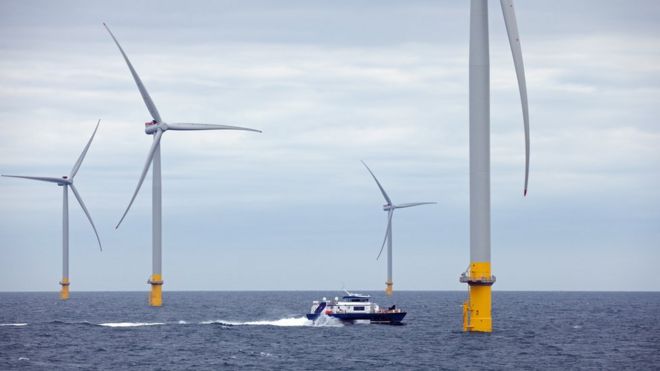
Offshore wind farm
The document plans for a massive expansion in offshore wind
Greenpeace has joined a growing list of organisations demanding that the UK government puts protecting the environment at the heart of any post-COVID-19 economic stimulus package.

The campaign group has produced a detailed “manifesto” with measures to boost clean transport and smart power.

The document follows a comparable call from some of Britain’s most powerful business leaders earlier this week.

Last week, the prime minister also expressed a similar ambition.

Boris Johnson said he wanted to see a “fairer, greener and more resilient global economy” after Covid-19 and that “we owe it to future generations to build back better”.

The manifesto also contains measures to support the protection of nature, green buildings and the creation of an economy in which virtually everything is reused.

Greenpeace says the crisis has given Britain a “once in a lifetime” opportunity to transform life, travel and work.

It added that the plan would create hundreds of thousands of secure jobs.

Green business

On Monday, more than 200 chief executives of some of the UK’s top firms – including HSBC, National Grid, and Heathrow airport – signed a letter to the prime minister asking him to use the Covid-19 lockdown as a springboard to “deliver a clean, just recovery”.

Many people may be surprised how similar the recommendations of these two very different interest groups are.

  • Both Greenpeace and the chief executives are asking the government to prioritise investments in low carbon technologies and calling for the decarbonisation of the British economy to be speeded up
  • Both say they want to see a focus on sectors that best support the environment
  • Both are demanding that financial support for ailing businesses must come with a requirement for them to commit to taking action to reduce their impact on the environment.

Greenpeace’s manifesto is, however, considerably more detailed.

It is a 62-page document with a specific policy, spending and tax measures covering most of the British economy.

It calls on the government to deliver its 2050 net-zero emissions goal before 2045.

Controversial policies

BikeImage copyrightGETTY IMAGES
Image captionThe manifesto contains measures to encourage clean transport

Many voters say they support tackling climate change when polled.

However, lots of the policies Greenpeace proposes would prove very controversial.

For example, motorists say they are ready to change their behaviour to improve air quality, according to a recent AA survey.

But many drivers may balk at Greenpeace’s proposals to radically redesign the road network to favour walking and cycling, at the suggestion that petrol and diesel cars are banned by 2030 or that fuel duty is steadily increased.

Many homeowners might be reluctant to spend money to upgrade their properties to meet tough energy efficiency standards.

At the same time, many local communities are likely to resist the plan for a big increase in onshore wind and solar power to complement a proposed massive expansion of offshore wind farms – few things unite local communities like a proposal to put in an array of wind turbines.
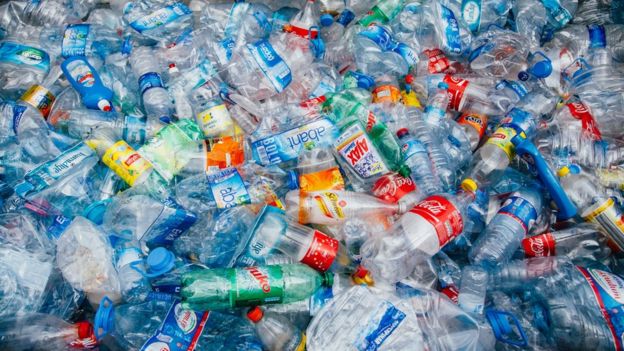
Plastic bottles at recycling plantImage copyrightGETTY IMAGES
Image captionThe manifesto proposes the creation of an economy in which virtually everything is reused

But, says Greenpeace, tough policies like these are essential if the government is going to take meaningful action to tackle climate change.

“The choices our government makes now will define… whether or not we succeed in the fight against the climate emergency”, says John Sauven, executive director of Greenpeace.

“If we fail to get this right, we may never get another chance. Now is the time for a green recovery, and for that, we need action, not words.”

It says there would be huge dividends in terms of job creation, should its programme be adopted.

Greenpeace calculates that its plans would create hundreds of thousands of new high-skilled jobs as well as helping to level up inequalities between communities in the UK.

Unique opportunity

The UK government has already indicated that protecting the environment will feature heavily in any stimulus package.

Back in April, Boris Johnson said a post-COVID-19 recovery plan should include efforts to “turn the tide on climate change”.

Meanwhile, the European Union has unveiled what it called the biggest “green” stimulus in history.

Last week, it said it planned to commit a whopping €750bn (£667bn; $841bn) to its recovery package.

Add in spending from future budgets and the total financial firepower the European Commission says it will be wielding is almost €2tn (£1.8tn; $2.2tn).

Fighting climate change is at the heart of the bloc’s recovery from the pandemic.

There will be tens of billions of euros to make homes more energy-efficient, to de-carbonise electricity and phase out petrol and diesel vehicles.

The idea is to turbo-charge the European effort to reduce carbon emissions to net-zero by 2050.

“If we do not do it, we will be taking much more risk,” Teresa Ribera, deputy prime minister of Spain, told the BBC.

“The recovery should be green or it will not be a recovery, it will just be a shortcut into the kind of problems we are facing right now.”

MSC Meraviglia: ‘8 Golden Pearls’ from Bureau Veritas

Sergio Castellano, Environmental Director, MSC Cruises  --  Philippe Donche-Gay, President Marine & Offshore, Bureau Veritas  --  Mattia Manzi, Master of MSC Meraviglia

Bureau Veritas has recognized MSC Cruises with the “8 Golden Pearls” award for sustainability and environmental stewardship onboard the MSC Meraviglia, the company announced. MSC becomes the first cruise line to take home the honours.

Philippe Donche-Gay, President Marine & Offshore, Bureau Veritas commented: “MSC Cruises has demonstrated its commitment to reducing the environmental impact of their operations and we commend the company for its wide-ranging, ongoing efforts in this space. The various sustainable and environmental technologies installed on the MSC Meraviglia put the ship at the forefront of cleaner cruise operations. The Bureau Veritas 8 Golden Pearls award reflects MSC Cruises’ commitment to excellence and continual improvement in environmental performance.”

Bud Darr, Executive Vice President Maritime Policy and Government Affairs, MSC Group said: “We are honoured to receive this award, and we thank Bureau Veritas for their recognition and ongoing support. They are an invaluable partner on this journey and we look forward to continuing making further progress in the area of environmental stewardship.”

Image result for msc meraviglia

Among the highlights onboard are an exhaust gas cleaning system and advanced wastewater treatment.

In addition to the wastewater treatment, the ship has a holding capacity and Non-Discharge Operation for two days allowing for more autonomy and more flexible navigation, the company said.

In addition, the ship meets the high ISO 22000 standard for food safety. This certification covers food safety management systems across the entire food supply and preparation chain from “farm to fork.”

The Cruise Industry Remains Committed to the Environment

The Cruise Industry Remains Committed to the Environment
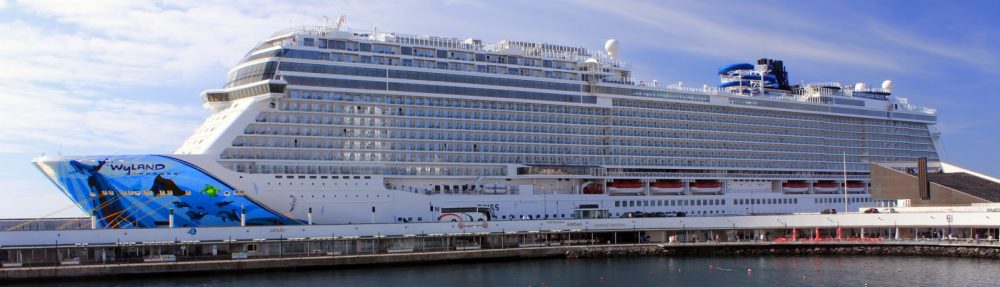
PHOTO: Holland America Line’s Westerdam in Alaska. (photo by Jason Leppert)
 

President Donald Trump may have announced that he will be pulling the US out of the Paris climate accord, but the worldwide cruise industry remains committed to environmental protection.

Cruise Lines International Association (CLIA) recently outlined the many ways conservation is promoted within.

“The cruise industry recognizes the importance of taking active measures to preserve our environment and we are constantly striving to develop more eco-friendly practices that enable travelers to stay green’ while traveling,” said Cindy D’Aoust, president and CEO, CLIA, in a press release. “Cruise lines have continued to offer new incentives for earth-friendly travel and know that this attention to our own environmental impact is not only beneficial, it is vital.”

The following are among the many eco-friendly programs and incentives:

Green Policies

Lots of cruise ships partake in recycling and waste treatment at sea as well as on land. Seabourn, for example, specifically utilizes advanced waste water treatment systems and environmentally-friendly cleaning supplies. It also recycles and donates reusable items.

It continues to increase fuel efficiency every year with new ships including low-flow passenger toilets, sinks and showers.

Dedicated Officers

Many CLIA Members employ dedicated officers charged with daily environmental program oversight. Each Disney Cruise Line ship stations Environmental Officers to check water quality and supply. It trains these officers and crew on waste minimization and environmental safety while supervising initiatives such as recycling.

Sustainable Practices

Cruise lines frequently collaborate with eco-friendly vendors and destinations that seek to reduce their carbon footprint. For one, Uniworld Boutique River Cruise Collection works with environmentally-conscious businesses like organic wineries.

Smart Ships

Smart technologies allow modern ships to conserve energy, water and fuel. Examples include Carnival Cruise Line’s partnership with the South Coast Air Quality Management District, the City of Long Beach, California, and Southern California Edison on shore power.

Similarly, Royal Caribbean International’s Quantum-class and Harmony of the Seas smart HVAC have dropped cooling energy consumption by a quarter.

Waste Minimization & Creative Composting

Up front, cruise lines work to reduce supply packaging and then compost food waste. In fact, MSC Cruises uses incinerators, food pulpers, grinders and compactors for garbage processing while Costa Cruises was the first travel company to sign the Milan Protocol.

Solar Sailing

For ships that can, energy waste is reduced by utilizing renewable battery power and solar energy for some systems. AmaWaterways’ Zambezi Queen employs low-emission generators by day and batteries by night, using solar heating for its hot water supply.

Cruise for the Earth

Green voluntourism is available to guests who want to travel and better the world. Azamara Club Cruises has partnered with World Wildlife Fund, and WWF guest speakers are featured on some sailings.

Corporate cousin Celebrity Cruises also encourages Celebrity Xpedition guests to plant trees in Galapagos National Park in support of the Scalescia reforestation effort.

Wildlife Conservation

The environment’s inhabitants are just as important to cruise lines, and Holland America Line has an “Avoiding Whale Strikes” training program in cooperation with National Oceanic and Atmospheric Administration’s (NOAA) and the National Parks Service.

All the company’s deck officers have gone through the course, which is also being shared broadly with the cruise and maritime community.

Proper Disposal

Another crucial element of environmental protection is for crew members and guests to remove garbage responsibly. Crystal Cruises, for instance, promotes its “Crystal Clean” initiatives to communicate environmental education. Of course, it’s important to properly recycle and reuse not only paper and plastic but also glass, aluminum, scrap metal, cooking oil, petroleum oil, toner cartridges, electronics and certain chemicals.

Smarter Sewage

Lastly, technology can also assist in lessening the impact of sewage and water waste, as Avalon Waterways has found with its multi-step procedure and specialized onboard sewage treatment system.