Wind Turbine Behemoth Plans for Hydrogen Future

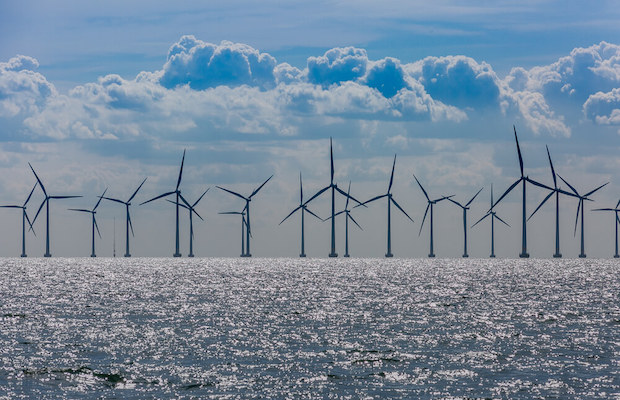
offshore wind turbine

By William Mathis and Laura Millan Lombrana (Bloomberg) — Siemens Gamesa Renewable Energy SA has one eye on the future where its wind turbines could play a key role in creating hydrogen.

The company, which earlier this year launched the world’s biggest wind turbine, plans to start a pilot project in Denmark to test how its machines could power production of the fuel seen as key to eliminating carbon emissions from transportation and heavy industries. The European Union has big plans for the clean-burning gas and the bloc placed it at the centre of its Green Deal earlier this year.

The pilot project is under construction near Siemens Gamesa’s Danish headquarters in Brande, western Denmark, Chief Executive Officer Andreas Nauen said in an interview on Thursday. It will include a 3-megawatt wind turbine that will power a 400-kilowatt electrolyzer, a machine that separates the hydrogen atoms in water from oxygen atoms, “We will be for the first time combining the two technologies,” said Nauen, who took over as CEO in June after leading the company’s offshore division. “It is not to produce hydrogen in big quantities, but to test the combination of both.”

It could be a compelling model. Danish utility Orsted A/S is already exploring a number of hydrogen projects for its wind farms and Royal Dutch Shell Plc plans to produce the gas from a park it’s going to build off the Dutch coast. Making and selling hydrogen could provide a new source of revenue for wind projects that would offset the risk in the sometimes volatile electricity market.

BNEF projections of the cost of producing green hydrogen, when compared with hydrogen derived from natural gas.
No one before has used wind power alone, without a grid connection, to produce hydrogen, Nauen said. It’s a project that will provide insight that could be crucial to scaling up the technology too much larger turbines and wind farms both on land and at sea.

Earlier this year, Siemens Gamesa announced plans to build a 14-megawatt offshore turbine with a rotor diameter of 222 meters (728 feet), a few meters larger than the previous record.

The company expects to conduct testing at the hydrogen pilot from October to December and then start hydrogen production in January. A Danish hydrogen fuel company called Everfuel will distribute the gas for vehicles including taxis and buses to use in Copenhagen.

European governments aim to spend billions of dollars to help nurture domestic industries to produce hydrogen. The funding could help scale production and bring down costs.

Offshore Experience

Siemens Gamesa is currently at a similar stage with hydrogen as it was a few years ago with offshore wind, Nauen said.

The executive has worked in offshore wind for more than a decade and has seen how the industry went from being a niche market using turbines designed for land use into a multi-billion-dollar industry with tailor-made machines the size of skyscrapers. Hydrogen could follow a similar trajectory if companies figure out an economical way to produce it. If it takes off, hydrogen will change the whole energy landscape, he said.

“I could imagine maybe it goes a little faster now, but it’s way too early,” Nauen said. “All the money that you currently see coming into this business is about making sure the technology works.”

The company has a team working on hydrogen that’s spread across all of Siemens Gamesa’s divisions. In the future, the company could sell wind farm developers hydrogen equipment along with its turbines, Nauen said. But he doesn’t expect any large-scale wind-hydrogen project until around 2025.

© 2020 Bloomberg L.P.

Vestas wins new orders for wind turbines in the US, Canada, France, The Netherlands, Italy, Japan and Vietnam

V117-4.2 MW®

Vestas has received an order for 278 MW of V150-4.2 MW turbines for a 302 MW project in the US including previously purchased 4 MW components. The order includes supply and commissioning of the turbines as well as a 10-year Active Output Management 5000 (AOM 5000) service agreement, designed to ensure optimised performance for the lifetime of the project. Turbine delivery will begin the second quarter of 2021 with commissioning scheduled for the fourth quarter of 2021. The project and customer are undisclosed.

In Canada, Vestas has received a 151 MW order of V136-3.45 MW turbines delivered in 3.6 MW Power Optimised Mode from Capital Power for the 97 MW Whitla Wind 2 and 54 MW Whitla Wind 3 projects in Alberta, Canada. The order includes supply and commissioning of the turbines as well as a 10-year service agreement, designed to ensure optimised performance for the lifetime of the project. Turbine delivery and commissioning are scheduled for 2021.

Whitla Wind 2 and 3 expand on the 202 MW Whitla Wind 1 Project, installed in 2019 and featuring the same turbine type.  Whitla Wind 1 was selected as one of four projects by the Alberta Electric System Operator (AESO) in Alberta’s first renewable energy auction, a competition that attracted global participation.

Alberta plans to add up to 5,000 MW of renewable energy to the grid by 2030. The province is the third-largest wind market in Canada, which ranks 9th in the world for installed capacity. The wind has been the number one source of new electricity generation in Canada for more than a decade.

In France, international renewable energy developer Valeco has placed a 42 MW order for three wind projects, consisting of the supply and installation of eight V100-2.0 MW wind turbines delivered in 2.2 MW Power Optimised Mode and eight V117-3.45 MW wind turbines in 3.0 MW operating mode, as well as Active Output Management 5000 (AOM 5000) service agreements, designed to maximise energy production for the sites.

The name and location of the projects are undisclosed. Turbine delivery and commissioning are scheduled for the first half of 2021.

Vestas has over 5.1 GW capacity installed and over 2,300 wind turbines in France. These numbers place the company as the main contributor to the expansion of wind energy in France, where last year the company had a 40 per cent market share.

Also in France, Elicio has placed a 32 MW order for the Le Haut Plateau wind project, consisting of the supply and installation of nine V136-3.45 MW wind turbines delivered in 3.6 Power Optimised Mode, as well as an Active Output Management 5000 (AOM 5000) service agreement for at least the next 20 years.

Turbine delivery will begin in the third quarter of 2021, with commissioning scheduled for the fourth quarter of the same year.

Vestas to deliver 46MW Dutch delight - reNews - Renewable Energy News

In The Netherlands, Vestas has won a 36 MW repowering order with Vattenfall for the Jaap Rodenburg II project. The wind project will be installed in the Province Flevoland, near Almere and will feature ten V117-3.45 MW turbines with 91.5-metre towers delivered in 3.6 MW Power Optimised Mode to maximise energy production in the site’s medium to high wind conditions, while meeting the local tip height requirements. This repowering project will replace the 10 V66 turbines and will more than double the installed capacity at the location.

The project will feature a VestasOnline Business SCADA solution, lowering turbine downtime and thus optimising the energy output. The contract further includes supply, installation and commissioning of the wind turbines, as well as a 10-years Active Output Management 5000 (AOM 5000) service agreement.

Deliveries are expected to begin in the first quarter of 2021, while commissioning is planned for the second quarter of 2021.

In Italy, the company has received a 49 MW order for two projects located in the Campania region, consisting of six V110-2.0 MW wind turbines delivered in 2.2 MW Power Optimised Mode and ten V117-3.45 MW wind turbines in 3.6 MW operating mode.

The supply and installation contract also includes a 5-year Active Output Management 5000 (AOM 5000) service agreement.

Turbine delivery and commissioning are planned for the first half of 2021. The names of the wind parks are undisclosed as per customer request.

With a 70 per cent market share in 2019 and with over 4.3 GW total capacity installed, Vestas leads the market as the main contributor to the expansion of wind energy in Italy.

In Japan, Vestas is working with Tokyu Land Corporation and Japan Wind Development, having secured a 76 MW order for Chitose Wind Farm and Noheji Mutsuwan Wind Farm in the Aomori prefecture.

Due to the typhoon and earthquake-prone environment of the region, an extended collaboration between all project partners was required when designing a turbine solution to maximise wind capture in the sites’ challenging wind and weather conditions.

The order includes the supply and supervision of four V117-3.45 MW and six V105-3.45 MW turbines that are all delivered in 3.6 MW Power Optimised Mode at Chitose Wind Farm, as well as eleven V105-3.45 MW turbines in 3.6 MW Power Optimised Mode at Noheji Mutsuwan Wind Farm.

With a robust design for tough wind sites, the turbine variants are well-suited for the sites’ challenging climatic conditions and all turbines will feature customised 94m towers to accommodate seismic loads, high turbulence and extreme wind speeds.

Vestas will also provide multi-year Active Output Management 5000 (AOM 5000) service agreements for both wind farms. With an energy-based availability guarantee, the agreement will ensure optimised performance and long-term business certainty.

Delivery of Vestas’ turbines will begin in the first quarter of 2021 with commissioning scheduled for the fourth quarter of 2021.

MHI Vestas Secures Order in Japan for 139 MW Offshore Wind Projects

Vestas installed its first turbines in Japan in 1995 and has since then installed a total of 650 MW, making Vestas the leading wind energy provider in the Japanese market.

In Vietnam, Vestas has won an 84 MW order to supply, transport, install and commission a total of 20 V150-4.2 MW wind turbines, in which it worked closely with the customer to customise a solution featuring V150-4.2 MW turbines at a hub height of 145 metres to help optimise the wind energy production for the project.

The order takes Vestas’ firm order intake for the V150-4.2 MW in Vietnam to over 600 MW since its first order win in March of last year, underlining the turbine variant’s excellent fit to deliver high and efficient energy production in Vietnam’s low to medium wind speeds.

The project and customer are undisclosed, but the construction of the project is expected to be completed in the third quarter of 2021, ahead of the current wind feed-in tariff deadline in Vietnam.

Norway Opens Expansive Offshore Areas to Wind Development

offshore wind farm

The Norwegian government has announced the opening of more than 860,000 acres of the Norwegian Continental Shelf to offshore wind development.

The areas, known as “Utsira Nord” and “Sørlige Nordsjø II”, are located in Norwegian waters in the northern North Sea. Combined, the two areas allow for the development of 4,500 MW of wind power.

“Offshore wind power offers great opportunities for Norwegian businesses,” said Tina Bru, Minister for Petroleum and Energy. “In the immediate future the market will be in other countries, but if the costs for offshore wind power continues to fall it could also become competitive in Norway. It is now time to prepare for future development by allocating space for offshore renewables.”
.
A proposal to open areas and a draft regulation were open for public comment in 2019.

The Utsira Nord is located to the west of Haugesund and is ideally suited for floating wind power. The area is also large, encompassing 1,010 square kilometres close to shore.

The Sørlige Nordsjø II borders the Danish sector in the North Sea and could be best suited for “direct export” of electricity. The area spans 2,591 square kilometres in mostly shallow water that would allow traditional wind turbines.

The Norwegian government has set an opening date of 1 January 2021.