MSC Cruises: Building New Technologies and Features

To introduce new technologies to ships, the cruise industry needs to simplify access for guests as much as possible, said Francesco Pugliese, vice president of mobile and onboard digital technology at MSC Cruises.

While new developments pile up ashore, cruise lines need to be careful in the way they are implemented onboard, he said.

“We call it ‘keep it simple,’ which means simplifying access as much as possible for our guests. You need to consider all the scenarios and make sure they have a smooth experience,” Pugliese said, mentioning MSC Cruises’ MSC for Me mobile app.

While some guests will embark with the app installed on their phones, others will download it onboard, which can lead to different experiences.

“So, you need to ensure there’s always a smooth path but, of course, not forgetting the cybersecurity issues and challenges that we have,” Pugliese added.

The digital ecosystem onboard also needs to focus on the features that the guests are looking for, he said.

In addition to training crew to help passengers deal with the new technologies, cruise lines also need to ensure that they are communicating with guests in the right way, Pugliese said.

“It’s very important. That’s why we work in close collaboration with our marketing colleagues to explain to the guests, for instance, that the app is for free, which is something that they don’t always realize.”

Pugliese also said that, with new features on ships, the vessels are becoming one of the reasons why guests choose to embark on a specific sailing.

“They are not selecting their cruise based on itinerary anymore, they want to focus on the attractions and experiences that a ship can offer,” he explained.

“That’s why we developed a series of concepts that we implemented on our new ships, which are basically immersive,” Pugliese continued.

One of the new attractions is Starship Club, which is a bar that features a robot bartender who can make cocktails and entertain guests.

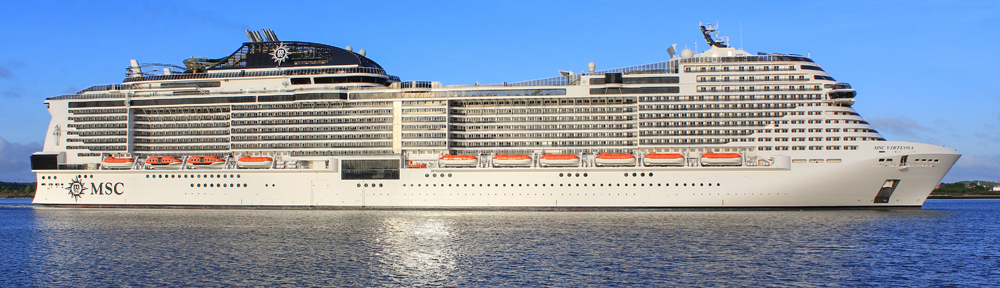
The venue was introduced onboard the MSC Virtuosa in 2021 and was later rolled out to other new buildings.

“You order your drink on a list of pre-defined cocktails and, while you wait for it to be prepared by the robotic bartender, you get immersed in a kind of experience that brings you to outer space,” Pugliese explained.

Pugliese highlighted the uniqueness of the cruise industry, which allows cruise lines to collect more data than other companies.

“We start collecting data from the very beginning when passengers purchase their cruise and want to personalize it. Once they get onboard, they usually stay seven days with us, so this means you can collect a huge amount of data,” he explained.

Artificial Intelligence (AI) can help in the process of understanding and analyzing this information, Pugliese added.

STX France reveals newly-christened MSC Meraviglia’s ‘advanced’ propulsion

Exclusive: STX France reveals newly-christened <i>MSC Meraviglia</i>’s ‘advanced’ propulsion
MSC Cruises’ MSC Meraviglia, built by STX France, has been christened

MSC Cruises’ 171,598gt MSC Meraviglia has been christened at Le Havre, France. As well as being the largest ship belonging to a European shipowner, it has an advanced, “very ambitious” propulsion plant and is the first of MSC Cruises’ fleet to debut digital innovation programme ‘MSC For Me’.

STX France vice president of projects Stéphane Cordier told PST: “From a building efficiency standpoint, the construction of this prototype was extremely smooth; the overall design and architecture of ship developed very efficiently and according to schedule.”

One of the main standout features is MSC For Me, which will be rolled out across the fleet and debuts on MSC Meraviglia.

MSC Meraviglia will be powered by an all-electrical plant consisting of four 12-cylinder diesel engines. Mr Cordier said this arrangement was “very ambitious”. Usually ships of this size have five or six engines.

Singling out the benefits of MSC Meraviglia’s engine arrangement, he said: “The limited number of machines allows them to run at higher power, contributes to the general efficiency and is a more compact arrangement.”

“We have an ambitious vision for the future and MSC Meraviglia marks the start of the second phase of growth for our company,” said Pierfrancesco Vago, MSC Cruises’ executive chairman in a statement. “For this reason, this evening is an extremely proud moment for all of us at MSC Cruises as we see the first of our next-generation ships being named.”

“The new ships that we are building — between 2017 and 2020 alone, we will receive six new ships — are purpose-built, featuring innovation in both product and design, as well as the very latest-cutting edge marine and consumer-facing technology to create unforgettable holiday experiences at sea for guests of all ages. MSC Meraviglia is the first to make this vision come to life, as it sets a new standard for cruise ships as a destination in itself.”

Comparing Carnival’s Ocean Medallion Versus MSC for Me

Comparing Carnival’s Ocean Medallion Versus MSC for Me

 MSC for Me wearable bracelet. (Photo courtesy of MSC Cruises)
 

Princess Cruises recently announced a fourth ship in its fleet would receive Carnival Corporation’s latest Ocean Medallion technology. Rival MSC Cruises has newly introduced its own MSC for Me guest tech as well.

While the two are very similar, there are also differences to discuss.

Quick Background

The whole high-tech trend towards wearable and app-based devices really started when Royal Caribbean International implemented its SMART Check-In and WOWbands on its newest ships.

The idea is simply to help expedite initial embarkation with as much data pre-entered before arriving pier-side and to have a rubber bracelet that can more conveniently replace a key card. This then provides RFID access to opening cabins and making purchases in conjunction with the Royal iQ app.

Carnival’s Ocean Medallion

Announced at CES 2017, Carnival’s Ocean Medallion takes the concept much further. Curiously, it won’t first be rolled out on its Carnival Cruise Line brand but rather its Princess Cruises one. Regal Princess will introduce it in November 2017, followed by Royal Princess in January 2018, Caribbean Princess in March 2018 and now Island Princess in May 2018.

Ocean Medallion is based on a coin-sized device that can be pocketed or worn on the wrist or as a pendant. It then branches out as part of the larger O·C·E·A·N (One Cruise Experience Access Network) for passenger personalization. Besides the physical device, the Ocean Compass links everything as a digital concierge on ship displays, cabin televisions and guests’ mobile devices.

READ MORE: Will Princess Cruises’ Future Medallion Tech Change the Face of Travel?

Specific features include expedited embarkation and stateroom access, not unlike Royal Caribbean. Additional capabilities encompass real-time ship navigation, friends and family locating, messaging, dining and spa reservations and even drink and food ordering with crew delivering to wherever a guest is located currently or as scheduled.

Behind the scenes, Near Field Communication (NFC) and Bluetooth Low Energy (BLE) systems support the platform.

MSC for Me

While less hyped initially, MSC Cruises will actually beat Carnival to the punch when it launches its own MSC for Me experience first on the MSC Meraviglia in June 2017, followed by MSC Seaside in December.

Again, MSC’s thinking is similar, but the line already plans to implement it fleet-wide across its upcoming eleven ships and existing twelve. Its goals extend to facilitating the crew with better means of servicing 170 different nationalities and their languages onboard.

MSC promises over 130 smart features backed—on the Meraviglia for example—by 144 interactive screens, 244 information screens, 31 virtual staterooms screens, 81 video wall monitors, 2,244 NFC-equipped cabins, 3,050 Bluetooth beacons, 700 access points and 1,200 CCTV cameras.

READ MORE: MSC Cruises’ Newest Ships Will Offer Awesome Digital Assistant for Guests

Guests will also have wearable bands and can access everything via a mobile app as well. Specific abilities will comparably include stateroom access, live navigation (accurate to 16 feet), concierge booking services and check-in.

Beyond that, MSC for Me will allow guests to book trips, utilize virtual reality to preview shore excursions, view and share cruise gallery images, receive preference-based geo-located recommendations and even be facially-recognized by cameras for more customized service.

Outlook

First, how will the technology be received by Princess and MSC guests? Second, will Carnival Cruise Line join the fold as a standard mainstream competitor? Will Norwegian Cruise Line as well?

Currently, Norwegian relies more on way-finding and reservation kiosks rather than wearables, and even Royal Caribbean has room to grow to match Carnival and MSC.

Of course, the implementation of such ship-wide systems is by no means quick and easy, and any investments towards such platforms need to be made wisely and as future-proofed as possible. One thing is for certain: old-school cruising is gone and the new high-tech equivalent is here to stay.