MSC Cruises and Chantiers de l’Atlantique celebrate milestones

MSC Cruises and Chantiers de l’Atlantique celebrate milestones

MSC Cruises and Chantiers de l’Atlantique have celebrated two milestones for the construction of the cruise line’s next generation of vessels. 

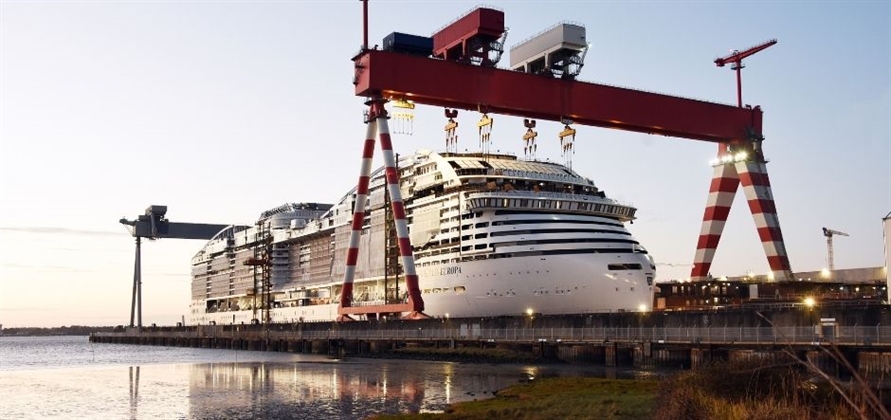
MSC World Europa was floated out for the first time at the shipyard in Saint-Nazaire, France. Meanwhile, a traditional coin ceremony took place as the keel was laid for MSC Euribia, with Anne Claire Juventin, who is responsible for quality control at Chantiers de l’Atlantique, and Valentina Mancini, brand manager from MSC Cruises, performing the role of godmothers. 

MSC World Europa and MSC Euribia will become the first LNG-powered vessels to join the MSC Cruises fleet next year, with the construction on MSC World Europa II due to commence in early 2023. The three newbuilds represent an investment of €3 billion ($3.39 billion) by the cruise line. 

“Today is another important milestone in our journey towards net zero emissions by 2050 for our marine operations,” said Pierfrancesco Vago, executive chairman of MSC Cruises. “We have a lot more to do but I am pleased that despite all that we have faced from the pandemic over the last two years, we have still been able to achieve with our partners at Chantiers de L’Atlantique the launch of these new LNG vessels – the first ever made in France.” 

Chantiers de l’Atlantique and MSC Cruises also confirmed that a fuel cell pilot plant known as Blue Horizon will also be installed onboard MSC World Europa. The plant will produce electricity from the ship’s LNG fuel through electrochemical reactions at its electrodes, unlike currently installed engine generators which produce electricity through fuel combustion.  

The fuel cell technology selected by Chantiers de l’Atlantique and MSC Cruises is the solid oxide fuel cell (SOFC) developed by Bloom Energy. The SOFC uses ceramic materials, allowing operation at temperatures of up to 800C at the core of the fuel cell. This allows for electrical efficiency of around 60 per cent and provides the opportunity to recover significant heat from the exhausts, which will bring the overall efficiency of the system close to 90 per cent. The Blue Horizon pilot plant installed onboard MSC World Europa will consist of two 75-kilowatt modules. 

The technology will be able to reduce greenhouse gas emissions by 30 per cent compared to conventional dual-fuel engines, without producing nitrogen oxide, sulphur oxide or particulate matter emissions. SOFC is also compatible with a range of fuels, including bio or synthetic LNG, methanol, ammonia and hydrogen. The operational data and technical feedback from the ship will be provided to Chantiers de l’Atlantique and Bloom Energy to enable improvements of the technology in the future. 

“With MSC World Europa, we have designed and built a cruise ship with an outstanding level of performance and efficiency,” said Laurent Castaing, general manager of Chantiers de l’Atlantique. “The integration of this fuel cell demonstrator allows us to take a major step forward and imagine what the cruise ship of the future will be like.” 

MSC World Europa has now been moved to a wet dock for work to continue ahead of her scheduled delivery in November 2022. The ship will spend her inaugural season in the Gulf region offering seven-night cruises from Dubai, United Arab Emirates. Construction will continue on MSC Euribia, with a global design contest for artists to create artwork for the ship’s hull inspired by the sea and the marine ecosystem.

MSC and Chantiers Mark Double Newbuild Milestones

MSC Cruises and Chantiers de l’Atlantique today celebrated two significant new-build milestones for the construction of the line’s next generation of environmentally advanced vessels.

The new MSC World Europa was floated out, while the coin ceremony was held for the MSC Euribia. Of note, MSC also confirmed the World Europa will have a fuel cell on board.

The MSC World Europa and MSC Euribia will become the first LNG-powered vessels to join the MSC fleet next year representing an investment of €3 billion in Liquified Natural Gas (LNG) ships with the construction on MSC World Europa II due to commence in early 2023, according to a statement. 

Pierfrancesco Vago, Executive Chairman, MSC Cruises, said: “Today is another important milestone in our journey towards net zero emissions by 2050 for our marine operations. Following billions of euros of investment, we are announcing significant construction developments in not just one but two of our next-generation LNG-powered vessels bringing us ever closer to our vision of the emissions-free cruise industry.

“We have a lot more to do but I am pleased that despite all that we have faced from the pandemic over the last two years, we have still been able to achieve with our partners at Chantiers de L’Atlantique the launch of these new LNG vessels – the first ever made in France that will also introduce potential new fuel cell technologies to make them even more efficient. We now need to take even bigger steps and we will need the continued support of our suppliers, partners and Governments to achieve this. We all need to work together to achieve our green future.”

Laurent Castaing, General Manager, Chantiers de l’Atlantique, added: “It is indeed a very special moment we are living today. This is not only because these ships are respectively the 15th and the 16th we are building for MSC Cruises- which shows the outstanding quality of the relationship we established between our two companies since the ’90s. This is not only because they will rank among the largest and the finest of the world’s cruise market. But it is also and especially because they represent a giant step towards what the cruise ships of the future will look like. At their delivery, they will have the best carbon footprint of the market, in terms of emissions per passenger and per day”

MSC Cruises and Chantiers de l’Atlantique also confirmed today the installation of a fuel cell pilot plant onboard the MSC World Europa known as Blue Horizon. The technology will use LNG to convert fuel into electricity at one of the highest efficiencies of any power solution available today, producing electricity and heat on the ship, the company said. 

The fuel cell technology selected by Chantiers de l’Atlantique (CdA) and MSC Cruises is the SOFC (Solid Oxide Fuel Cell) developed by Bloom Energy.

The SOFC will reduce emissions of greenhouse gases (GHG) by about a further 30 per cent compared with a conventional LNG engine without producing emissions of nitrogen oxides, sulphur oxides or fine particles.

Anne Claire Juventin responsible for Quality Control from Chantiers de l’Atlantique, and Valentina Mancini, Brand Manager from MSC Cruises performed the traditional maritime ritual as godmothers representing the shipowner and the shipbuilder when they placed two coins under the keel as the historical sign of blessing and good fortune for the project, and the ship’s operational life at sea.

The float out of MSC World Europa, which will be the first LNG-powered vessel to join the MSC Cruises fleet took place at the shipyard in Saint-Nazaire where she will now be moved to a wet dock for work to continue on the ship until her delivery in November 2022.

The Pandemic didn’t stop us – Nobody is growing like Us (MSC)

With the new flagship MSC Seashore recently named at its private island Ocean Cay, MSC Cruises is eyeing US expansion, sustainable innovations and “hidden” destinations in the Middle East. Tom Parry speaks to chief executive Gianni Onorato.

A Welsh journalist and an Italian cruise boss discussing Darwin on board a ship in Miami might sound to some like the set-up for a Christmas cracker joke – December is upon us after all.

But the reference to the famous naturalist by MSC Cruises chief executive Gianni Onorato neatly conveys the journey his line has taken in recent years, and the course it has plotted out of the pandemic and into the future.

“I love Darwin and his theory of survival,” says Onorato, relaxing in his chair in MSC Seashore’s Top Sail Lounge. “Covid has led us to do things we would never have thought about – we’ve adapted and evolved.”

Evolution is an appropriate label for Seashore. MSC’s new flagship is its first Seaside Evo-class vessel, larger than sisters MSC Seaside and MSC Seaview. In fact, it’s the largest ever built by Italian shipyard Fincantieri.

We’re speaking in mid-November, the day before Seashore is christened 65 miles east at Ocean Cay in the Bahamas, MSC’s private island and marine reserve.

A former aragonite sand mine and “industrial wasteland”, the island has undergone an environmental evolution of its own since it was acquired by MSC in 2015, one the line hopes will entice guests.

Bringing Seashore to Miami marks “the next phase” in the Italian-owned line’s stateside aspirations.

EXPANSION PLANS

Onorato says the brand is hoping to reach one million US guests across its fleet within the next two years, an ambition fuelled by plans to open a new PortMiami terminal in 2023 – the world’s largest – capable of housing three ships and welcoming 36,000 passengers a day.

British cruisers will be a vital source market, with Onorato of the belief that MSC is the “only truly international cruise company” able to adapt its offering to suit multiple nationalities on board.

Seashore is MSC’s seventh ship to launch in four years, with the line’s fleet due to growing to 23 ships by 2025. “Even the pandemic did not stop us – nobody is growing the way we are growing,” says Onorato.

Ocean Cay will be central to attracting new customers. A three-year restoration project has seen 7,500 tonnes of industrial waste and scrap metal removed from the island and 75,000 plants and shrubs planted, while 64 square miles of Ocean Cay’s waters are now protected. A marine research centre is also being built to support coral conservation.

It’s been a labour of love for MSC executive chair Pierfrancesco Vago. Speaking at Seashore’s christening ceremony, Vago said it was “a dream come true” to see Ocean Cay’s transformation come to fruition, six years after he conceived the plan.

Onorato says the Bahamian island “fits perfectly with UK expectations” of a Caribbean cruise; but with the destination marketed more on its environmental credentials than visitor attractions, MSC is taking a different approach to industry rivals.

“Everyone has conceived their islands differently – it depends on the DNA of the company,” he says. “In some cases, lines want to fill an island with waterslides [but] that wouldn’t be MSC and our love for the sea. In our case, we wanted to create a natural lagoon.”

At a press conference the following day, Vago adds: “We didn’t want to offer a theme park – the ship is already the theme park. We wanted natural authenticity [and] I think the island speaks for itself.”

Given its shipping heritage, the company having been founded by captain Gianluigi Aponte in 1970, sustainability – or more specifically love and desire to protect the sea – is an issue high on the agenda for MSC.

Several of the line’s upcoming ships will be fuelled by the more environmentally-friendly liquefied natural gas, while its future Miami home and the Horizon terminal opened in Southampton this summer offer plug-in shore power.

Other methods for cleaner cruising are also being developed, says Onorato, including better ways to store energy onboard and use it for hotel operations. MSC is already exploring hydrogen fuel, with testing taking place on its cargo ships.

So could a hydrogen-powered ship be a reality in the next decade? “It’s a long process,” he says. “We can’t do it alone, but we’ve got great partners to help us.”

Other efforts such as itineraries enabling ships to sail more slowly, using more environmentally-friendly silicone paint and developing air conditioning systems that adapt to the number of people in the room, will also play their part. “Each one of these measures is little, but they all add up,” says Onorato.

EYES ON THE EMIRATES

An important milestone, and further evolution, will come with the launch of its next-generation vessel – MSC World Europa – in December 2022.

Hailed by the line as its “most innovative and environmentally advanced ship”, World Europa will make its debut in the Middle East and sail its inaugural season in the Gulf, including a call to Dammam in Saudi Arabia to visit the Unesco World Heritage site of Al Ahsa.

The kingdom is a destination in which MSC has invested heavily and earmarked for future expansion, with MSC Bellissima due to spending the forthcoming winter season operating out of Jeddah, after a five-year agreement with Cruise Saudi for preferential berthing rights at the port.

But with this expansion into the region, both by MSC and other major cruise brands comes a level of scrutiny. Onorato, who insists Saudi Arabia possesses “hidden treasures” for cruise guests to explore, is candid about the reputation of the country and its leaders but believes Saudi opening up to tourism is “a sign they want help” and presents travel companies with the chance to help modernise things.

“They are open to being confronted by our world. They are offering us their hand and we need to take it,” says Onorato. “They’re trying to improve and we have a duty to help. We have a duty to support them. Tourism can change the culture.”

Closer to home, and after being the first line to restart the UK cruising in May, MSC delivered another brand first last month – ex-Southampton winter cruises to northern Europe on MSC Magnifica, which will run through to April.

Onorato returns to Darwin and the adaptability needed to first restart successfully, and then evolve its outlook.

“We’d never thought about domestic cruises in the UK; I think the success we had shown there is undoubtedly a market [for winter cruises from Southampton] and that there is a market for northern Europe.”

So much so, Onorato teases a ship “larger than Magnifica” will sail in Southampton next year. The line’s investment in Southampton’s Horizon terminal “means larger ships and more ships” too, Onorato smiles.

“We need to invest in travel agents’ and consumers’ minds,” he says. “We’ve seen a huge improvement in brand awareness from the trade – they have seen we’re seriously committed to the UK.”

It seems yet more evolution from MSC will soon be on its way.