Royal Caribbean Group’s new Galveston terminal, which is opening on Nov. 9, will be the first cruise terminal to generate 100% of its needed energy through on-site solar panels. According to a press statement, this makes the terminal, which will be used by the company’s Royal Caribbean International brand, the first LEED Zero Energy facility in the world.
We are focused on innovating across all aspects of our company, especially in our work to advance sustainability in the communities we visit,” said Jason Liberty, president and CEO, of Royal Caribbean Group. “We deeply value both the oceans we sail and the communities we visit and operate in, and the modern design and development features at our terminal in Galveston will work in service of both.”
The new cruise terminal at the Port of Galveston will be the first in Texas to achieve LEED Gold certification, an industry-leading certification expected to be received within the first two quarters of 2023.
The Galveston terminal marks the cruise company’s fourth LEED-certified facility and its first Gold certified. The previous projects include Terminal A at PortMiami; the Springfield, Oregon campus; and the Innovation Lab at Royal Caribbean Group’s corporate headquarters in Miami.
The $125 million, 161,334-square-foot Galveston Cruise Terminal significantly expands the company’s presence in the port, increasing the cruise line’s ability to accommodate up to 630,000 guests annually. The opening of the terminal will mark the first time Galveston welcomes Royal Caribbean International’s signature Oasis Class, the world’s largest cruise ship, with the arrival of Allure of the Seas and the first time the company is bringing its frictionless arrival and departure process to Texas.
MSC Cruises and Chantiers de l’Atlantique have celebrated two milestones for the construction of the cruise line’s next generation of vessels.
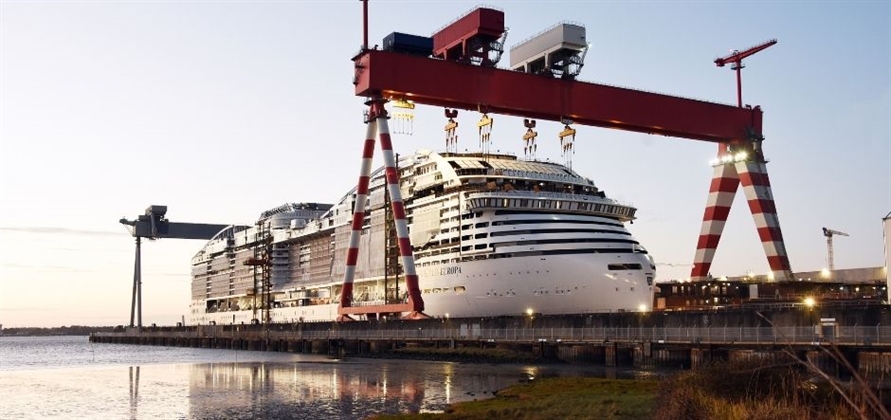
MSC World Europa was floated out for the first time at the shipyard in Saint-Nazaire, France. Meanwhile, a traditional coin ceremony took place as the keel was laid for MSC Euribia, with Anne Claire Juventin, who is responsible for quality control at Chantiers de l’Atlantique, and Valentina Mancini, brand manager from MSC Cruises, performing the role of godmothers.
MSC World Europa and MSC Euribia will become the first LNG-powered vessels to join the MSC Cruises fleet next year, with the construction on MSC World Europa II due to commence in early 2023. The three newbuilds represent an investment of €3 billion ($3.39 billion) by the cruise line.
“Today is another important milestone in our journey towards net zero emissions by 2050 for our marine operations,” said Pierfrancesco Vago, executive chairman of MSC Cruises. “We have a lot more to do but I am pleased that despite all that we have faced from the pandemic over the last two years, we have still been able to achieve with our partners at Chantiers de L’Atlantique the launch of these new LNG vessels – the first ever made in France.”
Chantiers de l’Atlantique and MSC Cruises also confirmed that a fuel cell pilot plant known as Blue Horizon will also be installed onboard MSC World Europa. The plant will produce electricity from the ship’s LNG fuel through electrochemical reactions at its electrodes, unlike currently installed engine generators which produce electricity through fuel combustion.
The fuel cell technology selected by Chantiers de l’Atlantique and MSC Cruises is the solid oxide fuel cell (SOFC) developed by Bloom Energy. The SOFC uses ceramic materials, allowing operation at temperatures of up to 800C at the core of the fuel cell. This allows for electrical efficiency of around 60 per cent and provides the opportunity to recover significant heat from the exhausts, which will bring the overall efficiency of the system close to 90 per cent. The Blue Horizon pilot plant installed onboard MSC World Europa will consist of two 75-kilowatt modules.
The technology will be able to reduce greenhouse gas emissions by 30 per cent compared to conventional dual-fuel engines, without producing nitrogen oxide, sulphur oxide or particulate matter emissions. SOFC is also compatible with a range of fuels, including bio or synthetic LNG, methanol, ammonia and hydrogen. The operational data and technical feedback from the ship will be provided to Chantiers de l’Atlantique and Bloom Energy to enable improvements of the technology in the future.
“With MSC World Europa, we have designed and built a cruise ship with an outstanding level of performance and efficiency,” said Laurent Castaing, general manager of Chantiers de l’Atlantique. “The integration of this fuel cell demonstrator allows us to take a major step forward and imagine what the cruise ship of the future will be like.”
MSC World Europa has now been moved to a wet dock for work to continue ahead of her scheduled delivery in November 2022. The ship will spend her inaugural season in the Gulf region offering seven-night cruises from Dubai, United Arab Emirates. Construction will continue on MSC Euribia, with a global design contest for artists to create artwork for the ship’s hull inspired by the sea and the marine ecosystem.
MSC Cruises and Chantiers de l’Atlantique today celebrated two significant new-build milestones for the construction of the line’s next generation of environmentally advanced vessels.
The new MSC World Europa was floated out, while the coin ceremony was held for the MSC Euribia. Of note, MSC also confirmed the World Europa will have a fuel cell on board.
The MSC World Europa and MSC Euribia will become the first LNG-powered vessels to join the MSC fleet next year representing an investment of €3 billion in Liquified Natural Gas (LNG) ships with the construction on MSC World Europa II due to commence in early 2023, according to a statement.
Pierfrancesco Vago, Executive Chairman, MSC Cruises, said: “Today is another important milestone in our journey towards net zero emissions by 2050 for our marine operations. Following billions of euros of investment, we are announcing significant construction developments in not just one but two of our next-generation LNG-powered vessels bringing us ever closer to our vision of the emissions-free cruise industry.
“We have a lot more to do but I am pleased that despite all that we have faced from the pandemic over the last two years, we have still been able to achieve with our partners at Chantiers de L’Atlantique the launch of these new LNG vessels – the first ever made in France that will also introduce potential new fuel cell technologies to make them even more efficient. We now need to take even bigger steps and we will need the continued support of our suppliers, partners and Governments to achieve this. We all need to work together to achieve our green future.”
Laurent Castaing, General Manager, Chantiers de l’Atlantique, added: “It is indeed a very special moment we are living today. This is not only because these ships are respectively the 15th and the 16th we are building for MSC Cruises- which shows the outstanding quality of the relationship we established between our two companies since the ’90s. This is not only because they will rank among the largest and the finest of the world’s cruise market. But it is also and especially because they represent a giant step towards what the cruise ships of the future will look like. At their delivery, they will have the best carbon footprint of the market, in terms of emissions per passenger and per day”
MSC Cruises and Chantiers de l’Atlantique also confirmed today the installation of a fuel cell pilot plant onboard the MSC World Europa known as Blue Horizon. The technology will use LNG to convert fuel into electricity at one of the highest efficiencies of any power solution available today, producing electricity and heat on the ship, the company said.
The fuel cell technology selected by Chantiers de l’Atlantique (CdA) and MSC Cruises is the SOFC (Solid Oxide Fuel Cell) developed by Bloom Energy.
The SOFC will reduce emissions of greenhouse gases (GHG) by about a further 30 per cent compared with a conventional LNG engine without producing emissions of nitrogen oxides, sulphur oxides or fine particles.
Anne Claire Juventin responsible for Quality Control from Chantiers de l’Atlantique, and Valentina Mancini, Brand Manager from MSC Cruises performed the traditional maritime ritual as godmothers representing the shipowner and the shipbuilder when they placed two coins under the keel as the historical sign of blessing and good fortune for the project, and the ship’s operational life at sea.
The float out of MSC World Europa, which will be the first LNG-powered vessel to join the MSC Cruises fleet took place at the shipyard in Saint-Nazaire where she will now be moved to a wet dock for work to continue on the ship until her delivery in November 2022.




 Wetravel2u's Weblog