Pierfrancesco Vago, executive chairman, the Cruise Division of MSC Group, highlighted the strengths of MSC Cruises during a speech in New York at the MSC Seascape’s christening on Wednesday.
“Our industry was put in the spotlight just like New York was, but like you in the face of adversity, we came together and steered ourselves on the right course,” Vago said.
He said that cruise lines had developed stringent health protocols that set the standard. While other sectors remained closed, MSC quickly resumed operations, becoming one of the first major cruise lines to sail again when it resumed operations in the summer of 2022.
“Just like New York, we are back stronger than ever. Today, as macroeconomic conditions change, there are valuable lessons to draw from this experience. High inflation, speculation and economic uncertainty are on the rise, but consumers won’t compromise on their right to have a break,” Vago continued.
“Our capability to adapt is unmatched. We offer the best value for money. Despite the uncertainty, we continue growing.”
Despite the growth in new ships, Vago said the industry needs to remind the world that cruising is essential due to its economic impact.
MSC Cruises and Chantiers de l’Atlantique announced today that the first of MSC’s next-generation ships, the World Europa, will have two 75 kW solid oxide fuel cells onboard running on natural gas. The gas will come from the LNG that will fuel the ship’s main engines.
Pierfrancesco Vago, executive chairman of MSC Cruises, said in conjunction with the announcement that LNG will not only reduce the emissions of the new ship, but once green LNG becomes available on the scale, the ship will be able to operate at zero emissions.
For this reason, he said, he is encouraging producers, regulators and other stakeholders to accelerate its development and that of its supply chain.
In addition, he said that MSC is also studying other fuel technologies, such as hydrogen that could potentially be compatible with LNG engines.
Fuel cells offer another pathway and the two 75 kW units installed on the World Europa will serve as a test project in a real operational environment.
Today also served as the coin ceremony for another MSC ship, the Euribia, and to recognize the contributions of Valentina Mancini, corporate brand manager for MSC Cruises in Geneva, and from Chantiers, Anna Claire Juventin, who heads up the yard’s quality control, as godmother.
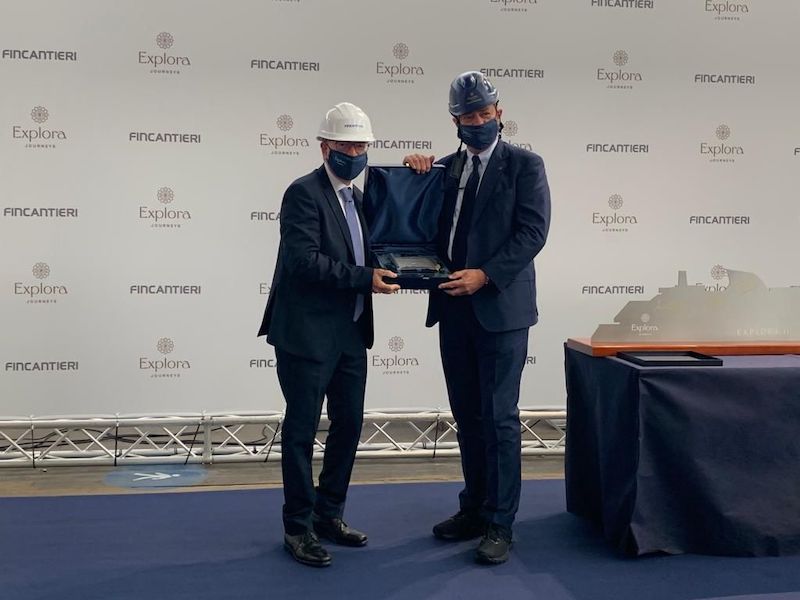
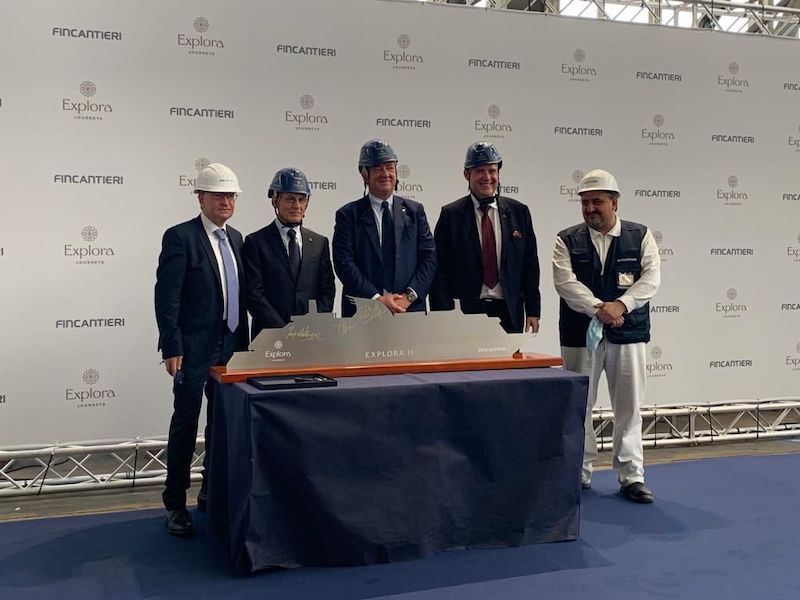
The first steel of the Explora II, the second of four new-concept luxury cruise ships that Fincantieri is building for Explora Journeys, the new luxury cruise brand by MSC Group, was cut today at the Castellammare di Stabia (Naples) shipyard.
The order for this class of ships, announced in 2018, is worth a total of over 2 billion euros.
The Explora I is currently under construction in Monfalcone, while the Explora II will be built at the Sestri Ponente (Genoa) yard, with deliveries respectively in 2023 and 2024.
A traditional maritime ceremony took place today at its Castellammare di Stabia yard near Naples for the first steel to be cut for the second vessel. Attending the event, among others, were MSC Executive Chairman, Pierfrancesco Vago, Explora Journeys CEO, Michael Ungerer, and Fincantieri General Manager Merchant Ships Division, Luigi Matarazzo.
“The start of Explora Journeys’ second ship signals our firm commitment to our tourism partners for the coming-to-market of our new luxury brand with a significant financial investment in a fleet of innovative, elegant ships, that will bring together our vision and purpose to create an ocean state of mind like no other. Given our belief in this brand to create a new category in luxury, lifestyle travel, we will continue to invest in its expansion to attract the growing number and aspirations of the next generation of discerning luxury travellers,” said Vago.
Michael Ungerer, CEO of Explora Journeys, added: “We are greatly encouraged by the tremendous enthusiasm and support we have received so far from the travel advisor community who have placed their trust in Explora Journeys since our launch in June and for their overwhelming response to our exclusive `By Appointment’ service and innovative commercial terms … Explora Journeys has also been awarded ‘preferred’ status with a number of leading travel agency groups, an honour not normally bestowed on a brand prior to its coming into service, that demonstrates an unprecedented recognition from the luxury travel industry and which reinforces our commitment to, and confidence, in our robust B2B2C strategy.”
According to a press release, all four vessels will have a gross tonnage of approximately 64,000 tons and will feature the latest maritime and environmental technologies and solutions available. Each is equipped with 461 guest suites.
Including these four vessels, the partnership between Fincantieri and the cruises division of MSC Group counts eight ships to date: the MSC Seaside and MSC Seaview, delivered in 2017 and 2018, and the two enriched Seaside Evo ships – the MSC Seashore, delivered in July, and her sister ship, the MSC Seascape, which will enter into service next year.


 Wetravel2u's Weblog