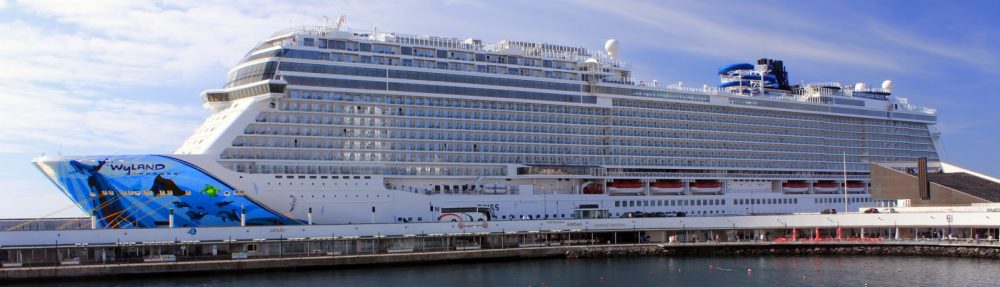
Costa Toscana floated out at Meyer Turku shipyard.

Costa Toscana has been designed to be a travelling 'smart city' (Image: Costa Cruises)
Costa Toscana has been designed to be a travelling ‘smart city’ (Image: Costa Cruises)

Costa Toscana is the third of five LNG-powered newbuilds ordered by Costa Group for its subsidiary lines. Two other vessels, Costa Smeralda and AIDAnova have already entered service. They are part of an expansion plan that includes seven new ships to be delivered to Costa Group by 2023, for a total investment of more than €6Bn (US$7.27Bn).

Costa saidthe vessel has been designed to be a travelling ’smart city.’ The use of LNG is expected to eliminate sulphur dioxide emissions and reduce particulate matter into the atmosphere by over 90% while also lowering nitrogen oxide up to 85% and CO2 emissions by up to 20%.

Desalinisation plants on board will process seawater directly to meet the vessel’s daily water supply requirements, and energy consumption will be reduced to a minimum via an intelligent energy efficiency system. In addition, 100% separate collection and recycling of materials such as plastic, paper, glass and aluminium will be carried out onboard, as part of an integrated approach aimed at supporting circular economy projects.

The vessel’s design was curated by hospitality designer Adam D Tihany who worked with Milanese architects Dordoni Architetti, New York-based Jeffrey Beers International and cruise ship specialist Partner Ship Design in designing different areas of the ship. Costa Toscana features Italian-made furnishings, lighting, fabrics and accessories.

At the heart of the new flagship is the Colosseo – a three-deck-high, midship-located show lounge featuring large LED screens mounted on its walls and dome. The vessel features 2,600 cabins for its occupants and the Sea Terrace cabins offer a verandah with a view of the ocean.

Costa Cruises chief commercial officer and president of Costa Group Asia, Mario Zanetti said “Despite the current challenging scenario, Costa Group is confirming its investment in fleet expansion. We are confident in the recovery of our industry, and we are excited about the arrival of new ships like Costa Toscana, which embodies the elements we want to focus on for the future.”

Meyer Turku chief executive Tim Meyer said “The float-out is always a very special occasion for us shipbuilders, as the ship is finally set to its natural environment. As this is also the start of the final stage of shipbuilding, all the exciting colours, venues and features will start taking their final form. In the coming months it will be finalised at the pier and then tested and commissioned in Q3 for delivery. “

Once interior fittings have been completed, Costa Toscana will make its maiden voyage in Brazil in the 2021-22 cruise season departing Santos on 26 December 2021, with a week-long itinerary visiting Salvador and Ilhéus, before returning to Santos on 2 January 2022.

Fincantieri Reveals Plans for Major New Shipyard in Yucatan, Mexico

Italian shipbuilding group Fincantieri has revealed plans to manage a major new shipyard in Mexico’s Yucatan state capable of servicing some of the world’s largest cruise vessels, cargo ships and oil and gas vessels.

Fincantieri this week signed a letter of intent related to the project with the Yucatán Government offering Fincantieri a 40-year concession for the exclusive management of a new ship repair, conversion and maintenance yard at the Port of Progreso, the state’s main port located about 35km from the capital city of Merida. Fincantieri will also take part in the design and construction of the site.

The company said plans are to have two masonry dry docks, said to be “the largest in the Americas,” which will be able to hold ships up to 400 meters in length, “particularly cruise ships, large cargos and Oil & Gas vessels, which need complex operations,” Fincantieri said in a press release. The yard will also have a lifting platform for units up to 150 meters in length, about 1,000 meters docks, cranes, workshops, special equipment, offices, and warehouses, it said.

Construction is scheduled to begin in the first half of 2021 with completion by 2027 “after various steps,” the company said.

The government is expected to directly manage the initial work through a special purpose company that will handle the dredging and construction of infrastructure. “Fincantieri is to provide advice from the very beginning, to carry out the later stage, also involving other partners, building the advanced facilities, notably workshops and lifting equipment, and installing the equipment and finally starting activities,” the company said.

“Mexico exports close to 400 billion dollars of goods every year, importing around 350 billion dollars. A considerable volume of this import/export is made through shipments by sea. Not to mention, the significant cruise traffic along the coasts of the United States, in the Caribbean and in the Gulf of Mexico, where there are the renowned settlements of the Maya civilization.

“The new Progreso shipyard will be strategically placed to serve the merchant operators of this area, benefiting from the near Yucatán navigation channel, a natural outlet to the Atlantic Ocean. The Gulf is also a region with a strong concentration of Oil & Gas related operations, with offshore exploration, production and storage of oil and natural gas,” Fincantieri said.

Meyer Turku Announces 450 Permanent Layoffs

A cruise ship under construction at the Meyer Turku shipyard in Turku, Finland. Photo: Meyer Turku

HELSINKI, April 28 (Reuters) – German shipyard Meyer Werft’s Finnish subsidiary on Tuesday started statutory talks to lay off up to 450 of its roughly 2,000 employees because of a hit to business from the coronavirus pandemic.

The shipyard, in Turku on Finland’s west coast, had initially started talks over temporary layoffs but said the market situation had now forced it to look for permanent cuts.

“These negotiations will include the permanent layoff of 450 people and another 900 are affected by other measures. These include temporary layoffs of different length, work time adjustments and other arrangements,” the company said in a statement.

Instead of ramping-up from one to two large ships delivered per year until 2023, the assumption is now that the Turku yard will build just one large cruise ship per year, it added.

“The corona pandemic has changed the situation unexpectedly and totally. We are facing the fact that the corona-caused pause in cruising requires to stretch the order book,” said Meyer Turku Chief Executive Jan Meyer. (Reporting by Anne Kauranen; Editing by Mark Potter)