Carnival and Fincantieri Celebrate 30 Years of Partnership

Carnival and Fincantieri Celebrate 30 Years of Partnership

Carnival and Fincantieri recently celebrated three decades of collaboration between the two companies.

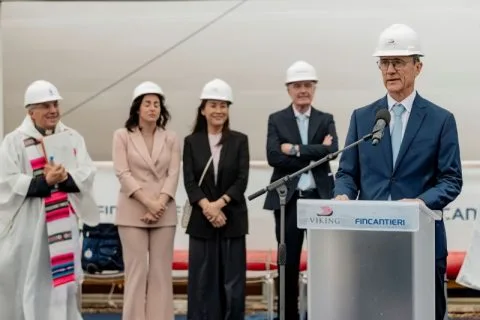
The partnership was highlighted during the steel-cutting ceremony for the new Carnival Destiny, which will be built at Fincantieri’s Monfalcone yard.

Carnival’s relationship with the shipbuilder started with the original Carnival Destiny, which was delivered in 1996.

“Carnival contacted us about a new ship design they had in mind, which they were calling ‘the ship of the future’,” said Maurizio Cergol, designer of the vessel.

“The Carnival Destiny certainly set a precedent at the time with its configuration, having its public spaces amidships, near the lifeboats.”

Cergol said that the design allowed for a larger number of balcony staterooms, creating a new standard for the industry.

“The market responded extremely positively to the possibility of taking cruises in a cabin where you could not only see the sea but also smell it, feel it and feel the breeze,” he continued.

Cergol said that the ship had an adequate, powerful name, as it tied together the fate of Fincantieri and Carnival.

For Fincantieri’s President Biaggio Mazzotta, the event marked both a beginning and an anniversary, highlighting the steel cutting of the new Carnival Destiny.

Introducing a new design to Carnival’s fleet, the new ship will be built at the Monfalcone shipyard, with delivery scheduled for mid-2029.

“With the cutting of the first metal sheet for this new vessel, this next-generation ship starts to take shape,” he said.

Mazzotta noted that the ship will be the largest in Carnival’s fleet, adding that the ceremony marked the “first spark” of a project that will accompany the shipyard for years to come.

“This is not a point of arrival but a point of departure,” he continued, noting that the project has a special meaning, taking place exactly 30 years after the delivery of the original Carnival Destiny.

“Thirty years is not just a milestone but a measure of trust that has been renewed order after order, ship after ship, in a business where decisions are made by looking at decades in the future,” Mazzotta added.

He also highlighted the human element of the collaboration between the companies, noting that “behind every hull and technological breakthrough there is the work of men and women, including designers, engineers, technicians and workers.”

“All the companies in our supply chain have made this partnership a shared heritage,” Mazzotta said, thanking all the involved parties.

“This collaboration tells the story of what Italy does best: combine tradition, innovation, craftsmanship and technology.”

Giorgio Gomiero, senior vice president of operations for Fincantieri, noted that shipbuilding is a complex business and that the partnership with Carnival allowed the yard to grow.

“Carnival was a challenge that allowed Fincantieri to reach where it is today. There were certainly a number of difficult moments,” he explained.

“Critical moments arise during the construction period,” Gomiero added, noting that the original Carnival Destiny was the largest cruise ship in the world when it debuted in 1996.

“It was the first passenger ship in the world to exceed 100,000 tons of gross tonnage. Now, in 2026, we are starting the construction of a vessel with a gross tonnage of 230,000 tons,” he continued.

“Each time there’s an evolution, not only for the shipowner, Carnival, but these projects also create the conditions to do better and raise the bar, allowing us to set new goals together.”

Having started his relationship with Carnival as Project Manager for the Carnival Breeze construction, SVP Shipyard Director Marco Lunardi said that collaboration between the cruise line and Fincantieri has allowed the yard to push boundaries.

“Carnival has been a driving force. I still remember the phrase ‘make it happen,’ which we were told time and time again when we faced challenges from the client,” he said.

“Yet this served as the incentive to push beyond those limits, and through ingenuity, flexibility and even imagination, we found solutions that allowed us to make the product we created a model of excellence,” Lunardi added.

Luigi Matarazzo, general manager of the shipyard’s merchant ships division, said that the relationship between the two companies is based on mutual trust.

He highlighted that Fincantieri built 65 ships for Carnival in the past 30 years, with a further eight currently in the pipeline.

“We’ll reach 73 but my hope is to reach 100 ships, which will further strengthen the strong bond we have,” Matarazzo added.

Explora and Fincantieri Celebrate Explora III’s Delivery

Explora and Fincantieri Celebrate Explora III’s Delivery

The delivery ceremony of the Explora III, the third vessel built by Fincantieri for Explora Journeys, took place today in Genoa at the Fincantieri shipyard in Sestri Ponente.

Pierfrancesco Vago, executive chairman of MSC Group’s Cruise Division, said: “The delivery of the Explora III marks another important milestone in realizing our vision for Explora Journeys.”

“In just three years, we have defined a new and distinctive perspective in ocean travel. With each new ship, we expand our ability to offer guests new perspectives on the world through increasingly immersive experiences in the destinations we visit,” added Vago.

“The Explora III reflects our commitment to innovation, craftsmanship excellence and responsible growth, while contributing to the broader economic benefits that cruise tourism brings to coastal destinations and communities.”

Pierroberto Folgiero, CEO and general manager of Fincantieri, said: “The Explora III testifies to Fincantieri’s ability to lead the transformation of the shipbuilding industry through innovation, sustainability and the evolution towards new technologies and alternative fuels.”

“The entry into the fleet of the first ship powered by liquefied natural gas (LNG) marks a significant milestone in this journey, an expression of the development of increasingly sustainable and technologically advanced solutions,” added Folgiero.

Fincantieri said in a press release that the newbuild was celebrated with numerous authorities and institutions in attendance, including:

  • President of the Liguria Region, Marco Bucci
  • Mayor of Genoa, Silvia Salis
  • Admiral Inspector Antonio Ranieri, and
  • President of the Port System Authority of the Western Ligurian Sea, Matteo Paroli.

The Explora III is the third out of six ships; the remaining three are all under construction and will take to the sea within two years: the Explora IV and Explora V in 2027, and Explora VI in 2028.

Guests were welcomed by:

  • Biagio Mazzotta, president of Fincantieri
  • Pierroberto Folgiero, chief executive officer and general manager of Fincantieri;
  • Luigi Matarazzo, general manager of Fincantieri’s Merchant Ships Division
  • Massimo Canesin, director of the Fincantieri Shipyard in Sestri
  • Diego Aponte, chairman of the MSC Group
  • Pierfrancesco Vago, executive chairman of the Cruise Division of the MSC Group
  • Anna Nash, president of Explora Journeys
  • Maya Aponte, godmother of the ship, and
  • other managers of Fincantieri and MSC.

The Explora III will use liquefied natural gas (LNG), reducing emissions of sulfur oxides by 99 percent, nitrogen oxides by 85 percent, particulate matter by 98 percent and greenhouse gases by up to 20 percent.

It is designed to run on renewable and latest-generation fuels such as bio-LNG, synthetic LNG and biofuels. The Explora V and Explora VI will also adopt fuel cells.

Designed and built under RINA class surveillance, the Explora III has been acknowledged for its environmentally sustainable and passenger-comfort design, and was certified to sail in the polar regions.

Wartsila and Carnival Extend Collaboration with Lifecycle Agreement

Wartsila and Carnival Extend Collaboration with Lifecycle Agreement

Wartsila and Carnival Corporation have entered into an eight-year Lifecycle Agreement covering four cruise ships in the Princess Cruises and Carnival Cruise Line fleets, including two newbuild vessels currently under construction.

The agreement marks the first service contract between the companies covering Carnival LNG-fueled cruise ships.

“The agreement reinforces Carnival Corporation’s ongoing commitment to operational excellence, sustainability and delivering a world-class guest experience,” said Vera Lannek, VP of strategic sourcing and asset management at Carnival.

“By working with Wartsila through a long-term lifecycle agreement, we can further strengthen the performance of the covered vessels while supporting the high standards our guests and operations depend on,” added Lannek.

“This agreement is the latest milestone in the long-standing relationship between Carnival Corporation and Wartsila,” said Andrea Morgante, VP of performance services at Wartsila Marine.

“It reflects our shared focus on ensuring high-performing cruise operations through proactive lifecycle support, data-driven insight and close technical collaboration throughout the vessel lifecycle.”

Wartsila said in a press release that under the agreement, it will provide a lifecycle maintenance solution for the vessels’ Wartsila dual-fuel engines and related equipment.

Wartsila booked the order in Q2 2026, and the Lifecycle Agreement provides long-term lifecycle support focused on optimizing asset performance throughout the vessel lifecycle.

The scope of the agreement includes:

  • Planned and unplanned maintenance support
  • Spare parts supply and logistics
  • Major engine overhauls
  • Remote monitoring and condition-based maintenance
  • Technical audits and performance reviews
  • Advisory services
  • Crew training, and
  • Performance management through agreed KPIs and a performance-based framework.

According to the press release, the agreement also provides Carnival with a lifecycle partnership focused on maintaining fleet reliability, increasing asset availability and optimizing total cost of ownership across the covered vessels.

Its performance-based structure also aligns the companies around measurable operational outcomes, including lower unscheduled maintenance costs and fewer unplanned stops.