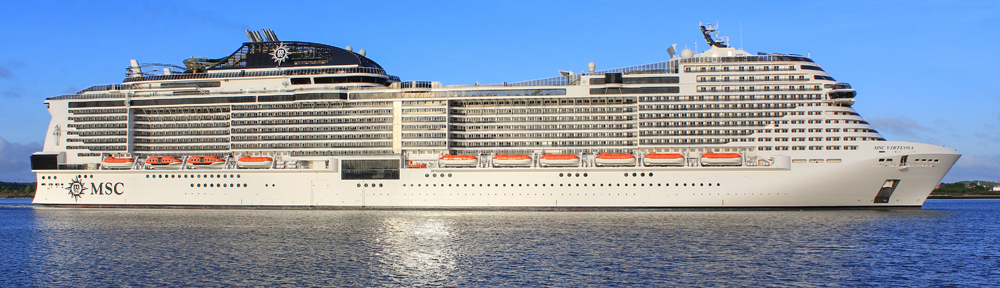
Málaga Welcomes Mein Schiff 2, First Cruise Ship Since Pandemic

Málaga has become the first port in Spain’s mainland to host a cruise ship upon the restart of operations after a 15-month pause.

According to a press release, TUI Cruises’ Mein Schiff 2 arrived from the Canary Islands on June 16 at 6:15 a.m.

Carrying 1,275 passengers, she stayed in the port until 7 p.m. of the same day, when she departed for Palma de Mallorca to start domestic itineraries in Spain.

The Mein Schiff 2 will be visiting Málaga again on June 22 and July 6, according to the MedCruise Association.

To mark the special first sailing, representatives from the port and the destination have met with Tom Roth, the captain from Mein Schiff 2, and handed a commemorating plaque.

“Today is a very important day for Málaga, (which) proves how governmental bodies have worked together, and will keep working together, for Málaga, a cruiser-friendly destination,” said the President of the Port Authority of Malaga Carlos Rubio.

The Mayor of Malaga Francisco De la Torre said that cruise tourism will help reactivate tourism in Málaga, which is an “essential cruise destination for cruise lines.”

Roth highlighted that “this is the beginning of a beautiful friendship.”

According to the press release, TUI Cruises developed a “bubble” cruise experience, allowing only organized excursions, which guarantees that the anti-COVID-19 safety measures are respected, thus benefiting both the passenger and the crew, as well as the population of the destinations visited.

In Málaga, cruise passengers visited the city and other towns nearby in small groups, having chosen emblematic places of the historical city centre of Málaga, as well as Ronda, Mijas or Marbella, among others, supporting the recovery of the economy.

The Mein Schiff 4 was also in the Málaga port on June 16, arriving at 3 p.m. for a technical stop with no passengers.

Palfinger Completes First Cruise Drydock Since Pandemic

Palfinger Marine has completed its first major refurbishment jobs since the start of the pandemic, according to a press release.

The job involved servicing 18 lifeboats and 20 winches for the Allure of the Seas from Royal Caribbean International.

To complete the job, 11 technicians from Palfenger’s U.S. service office travelled to Naventia’s shipyard in Cádiz, Spain, where they joined five LSA- and seven refinishing technicians from Palfinger Spain. 

Palfinger’s Florida-based Operations Manager Josh Lozano has celebrated the resumption of major cruise operations at Palfinger.

“Slowly but surely, we were able to resume our work after the lockdown, starting with the first successful service job for the Allure of the Seas,” he said.

Together, the technicians working on the Allure refinished the canopies on 18 lifeboats – which can carry up to 370 people each – and inspected the boats and release gear. 

This work included “cleaning and maintaining the release hooks as well as inspecting the boats according to MSC.402 and other regulations required by class and flag,” the company stated. The jobs took 30 days to complete.

Lozano said that they have also been performing two cruise drydocking in Italy and Singapore, utilizing the company’s corresponding local offices. Additional planned inspections were performed by the company’s UK office.

From Warships to Wind Turbines: Spain Shipyard Eyes EU Aid in Pivot to Wind Power

FILE PHOTO: DJ Mattaar / Shutterstock

Spanish shipbuilder Navantia is stepping up its bet on offshore wind energy, a venture that stands to benefit from the European Union’s fiscal response to the pandemic.

The landmark 750 billion-euro ($890 billion) pandemic-recovery aid will encourage Spain to invest more in clean energy. That could galvanize the company’s recent pivot into sea-based power projects, said Managing Director Javier Herrador del Rio. With demand flagging for its military vessels, Navantia has branched into building the massive foundations for wind turbines that can stretch out of the water as high as a 50-story office building.

The comment underscores how companies across the EU are gearing up to take part in the bloc’s biggest-ever stimulus package. Europe’s leaders have said they want countries to spend a significant portion of the funds on making the regional economy more carbon-neutral. Navantia’s green projects might become a test case for the program.

‘Highly Cyclical’

Spain and Italy are poised to be among the largest recipients of the funds and both countries are hashing out details of how to spend the money. The fiscal jolt is an opportunity for the Spanish administration to start investing in offshore wind farms in the northern Galicia and Basque regions and in southern Andalusia, Herrador del Rio said.

Naval shipbuilding “is highly cyclical and even more so during such volatile times like we’re living through now – when we exit one crisis and then fall into another,” the managing director of Navantia’s Bay of Cadiz Shipyard said in an interview. Rocky economic times limited Spain’s ability to invest in new ships and forced state-owned Navantia into more manufacturing areas. The offshore wind became a strategic priority in 2018, he said.

The firm’s fortunes have ebbed since the 1980s when demand was high for made-in-Europe warships and oil tankers and the company employed about 40,000. While staff has since dropped to about one-tenth of that, it was still able to take on Saudi Arabia’s 2018 order of five corvettes for its navy, one of Navantia’s few major shipbuilding contracts in recent years.

Incipient Industry

While Spain was a global pioneer in solar and wind projects, the offshore wind-park industry is still quite young. Contracts Navantia has signed in the sector don’t generate nearly as much revenue as building submarines and aircraft carriers.

Overall, companies globally are operating about 30 gigawatts of offshore wind energy, said Imogen Brown, an analyst at BloombergNEF, an energy research firm. That’s a fraction of the 611 gigawatts of land-based wind projects, based on data through 2019, she said.

Most of the turbines are in the North Sea, off the coasts of the U.K., the Netherlands, Denmark and Germany. The strong winds and comparatively shallow seabed have allowed major players such as Denmark’s Bladt Industries and the Netherlands’ Sif Group to anchor what is known as “bottom-fixed” turbines to the ocean floor.

Navantia has received commissions for 10 projects since 2014, including orders to manufacture several dozen bottom-fixed turbines for Iberdrola’s 500-megawatt offshore wind farm in Brittany.

The Mediterranean Sea that borders much of Spain has relatively deep waters. That has pushed Navantia and other manufacturers, including Italian shipbuilder Saipem SpA, to shift their focus to floating wind turbines. But the technology is still incipient and there’s not a standardized design, Brown said.

“It’s only demonstration projects that have been commissioned so far,” she said. “We think bottom-fixed wind turbines will still be the driver in the market pre-2030.”

Europe’s increased funding for clean-energy projects will help to bolster investments in technologies to improve floating projects, Herrador del Rio said at the company’s Puerto Real shipyard near the Strait of Gibraltar, the strategic entrance to the Mediterranean from the Atlantic Ocean. That funding will eventually lead to building more wind farms off the Spanish coasts and in the Mediterranean Sea.

“Sooner or later it will become a reality,” he said. “I’m convinced.”