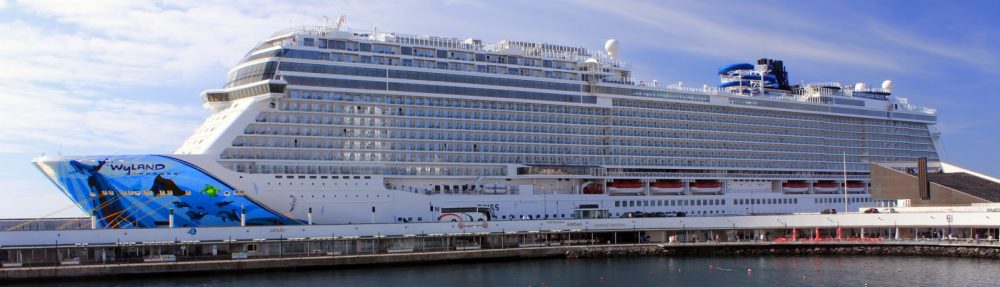

- ABB Ability™ Marine Braking Assistance helps ships minimize stopping time and distance, without compromising steering capability
- Initially developed at the request of Royal Caribbean Group, the new digital solution improves safety for ships, seafarers and passengers
- Automated braking saves wear and tear on critical ship control systems
As the world’s largest cruise ship Wonder of the Seas, departed on her maiden voyage in the beginning of March 2022, she was the first in the world to feature the new ABB Ability™ Marine Braking Assistance. Designed for safe and smooth emergency stops, the automatic braking system is the result of collaboration between supplier and owner, initiated at Royal Caribbean Group’s request.
Following full sea trials by shipbuilder Chantiers d’Atlantique and acceptance by the owner, the DNV-approved Marine Braking Assistance provides the latest example of how technology can be leveraged to improve safety for ships, seafarers and passengers.
Marine Braking Assistance, through the push of a button, triggers an automated braking sequence, optimizing the angles and power of all the Azipod® propulsion units based on vessel position, heading and speed to allow maximum braking efficiency. Critically, operators have time to attend to other urgent matters while retaining control over steering.
“We at ABB take great pride in introducing new technologies to the industry to improve safety and add value for our customers. Marine Braking Assistance is a good example of a co-creation project where we, in close collaboration with Royal Caribbean Group, developed a solution that makes a real operational difference,” said Kalevi Tervo, Global Program Manager of ABB Marine & Ports. “The adoption of an automated process that improves safety holds special significance at a time when regulators are moving forward on rulemaking for autonomous ships.”
The Marine Braking Assistance can be compared to an automated braking system (ABS) whose safety benefits car drivers today expect as standard. Automation of the braking sequence also minimizes the wear and tear systems experience due to vibration cavitation and the heating up of braking transformers under manual control.
Hard stopping a ship in an emergency situation can be highly stressful. Unlike slamming on the brakes of a car, for vessels with shaftline propulsion the turn to full astern results in losing steering ability. For a vessel equipped with podded propellers, the pod way emergency stopping procedure allows much faster stopping, with limited steering ability, but it demands step-by-step manual actions by the helmsperson, at a moment when other issues require immediate attention.
Anders Aasen, Vice President, Global Technical Operations, at Royal Caribbean Group states: “We have a long history of innovating to improve maritime safety. I am pleased to debut Marine Braking Assistance technology onboard our ships through close cooperation with ABB.”
ABB’s Process Automation business is a leader in automation, electrification and digitalization for the process and hybrid industries. We serve our customers with a broad portfolio of products, systems, and end-to-end solutions, including our # 1 distributed control system, software, and lifecycle services, industry-specific products as well as measurement and analytics, and marine offerings. As the global #2 in the market, we build on our deep domain expertise, diverse team and global footprint, and are dedicated to helping our customers increase competitiveness, improve their return on investment and run safe, smart, and sustainable operations. go.abb/processautomation
ABB (ABBN: SIX Swiss Ex) is a leading global technology company that energizes the transformation of society and industry to achieve a more productive, sustainable future. By connecting software to its electrification, robotics, automation and motion portfolio, ABB pushes the boundaries of technology to drive performance to new levels. With a history of excellence stretching back more than 130 years, ABB’s success is driven by about 105,000 talented employees in over 100 countries. www.abb.com


